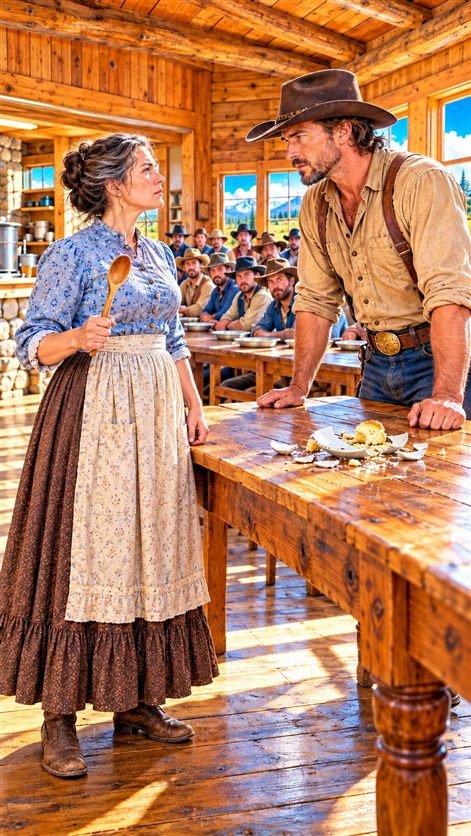
The dry-land wind outside the Dunore general store didn’t just howl; it stripped the paint off the sign and left the wood weeping sap, but inside, the air smelled of dead mice, rancid suet, and the kind of quiet desperation that could rot a man’s boots from the inside out. The twenty-year-old sourdough starter packed inside Nell Whitaker’s cracked ceramic crock was still alive, but barely—surviving on a diet of stale flour water and stubbornness, much like the twenty-man crew at Red Willow Ranch who were currently sharpening their skinning knives with murder in their eyes. There was no time for pleasantries, no gentle introduction to the alkali flats of Wyoming, and no mercy from the sixty-eight-dollar bank note waiting like a hangman’s knot with Caleb Mercer’s name on it.
“This is what you call food?”
The plate hit the rough-hewn pine of the bunkhouse table with a dull, sickening thwack, shattering the dry biscuit into gray shards that scattered across the grease-stained boards. Twenty ranch hands froze, forks halfway to their mouths, the rhythmic chewing instantly dying out across the long room like a grassfire hitting a salt flat. Eleanor Whitaker stood in the kitchen doorway with fine, gray dust smeared across her faded calico apron and a heavy boxwood spoon gripped tight in her right hand. She didn’t blink against the dust or the sudden, suffocating tension that dropped like a wet blanket over the room. Her eyes, the color of muddy river water after a spring thaw, tracked the ruined biscuit, drifted up to Caleb Mercer’s broad, sweat-streaked shoulders, and held his furious gaze without a flicker of fear. Then, without a word of apology or defense, she turned her back on him, her skirts swishing against the doorframe, and walked back into the suffocating heat of the galley.
What nobody at Red Willow Ranch understood yet—not the cursing hands, not the twitchy bookkeeper in town, and certainly not Caleb Mercer, whose jaw was currently working a piece of tobacco like he wanted to grind it to powder—was that Nell Whitaker had been on the property for less than twelve hours. In that brief span, she had already diagnosed why the beef was turning gray in the bins, why the supply wagons were coming up light from town, and why three of the oldest hands had their saddlebags packed out in the lean-to. She had arrived on the noon coach with a single, battered wicker traveling case, four dollars and thirty cents in a knotted wool sock, and a greasy slip of paper torn from the public board outside the mercantile: *Cook needed. Twenty men. Three meals daily. No overtime.* Everyone in Harlow Creek had passed over the notice with a shake of their heads, knowing the ranch was a sinking ship. Nell had taken it because sinking ships usually had crawl spaces where a woman with a past could disappear.
She discovered the depth of the rot within seven minutes of stepping across the threshold. The kitchen wasn’t just dirty from a careless day or two; it was failing in slow motion, an institutional decay born of neglect and deliberate theft. The heavy iron stove burner sat warped on its seating, listing like a foundering schooner and wasting half its heat up the chimney. Bags of winter wheat had been stacked directly against a damp, stone foundation wall, drawing the cellar rot right up through the burlap. A side of salt pork hung too close to the stovepipe, sweating grease in the draft, and one of the primary cornmeal barrels was thick with gray weevils that crawled over the staves in living waves. The baking powder tin was empty save for a crusty yellow residue, and three cast-iron skillets had been stacked so carelessly that their rims were chipped and jagged.
Caleb found her squatting in the gloom by the flour bins, her fingers tracing the damp seams of the sacks with a cold, professional precision.
“Who let you in?” His voice was gravel dragged over river stones, sharp enough to draw blood.
“The door,” she said, not looking up as she jotted a figure into a small, leather-bound memorandum book with a stub of pencil.
His jaw tightened until the skin went white over the bone. “I don’t remember hiring a ghost to rifle through my stores.”
“You didn’t. You hired a cook.” She finally raised her chin, her gaze locking onto his with an unnerving lack of deference. “And you’re currently out of baking powder, your winter wheat is half-spoiled with cellar damp, and that pork hanging by the stove will turn green by Thursday if it stays on that hook another hour.”
“I didn’t ask for your opinion on my pork,” he snapped, taking a step into the cramped space, his bulk making the low ceiling feel even more oppressive.
“No,” Nell said, standing up with a smooth, unhurried grace that defied the exhaustion in her bones. “You asked for a cook. My name is Eleanor Whitaker. Nell. I’m taking the position.”
“I haven’t offered it to you.”
“You will.”
The sheer audacity of the woman should have sent him flying into a rage, should have had her thrown off the property before the dust of her boots could settle on his porch. Instead, Caleb Mercer stopped, his dark eyes narrowing as he took in the ink-stained fingers, the straight back, and the utter lack of apology in her posture.
“Seven dollars and fifty cents a month,” Nell said, reciting her terms as if reading from a legal bill of lading. “Full authority over kitchen stores, pantry locks, and weekly supply orders.”
“Six dollars,” Caleb countered automatically, though the heat had gone out of his voice.
“Seven-fifty.”
“Six-fifty.”
“Seven-fifty, and the warped burner plate gets replaced by a smith from town before Sunday.”
Caleb stared at her for three long seconds, the silence in the kitchen punctuated only by the distant, hollow clank of a windmill turning in the dry wind. “Supper is at six.”
“That means yes?”
“That means don’t be late.” He turned on his heel and stalked out, his spurs jingle-jangling a harsh rhythm down the hall.
Nell spent the next two hours hauling the warped burner out with a pair of blacksmith’s tongs, hammering the cast iron back toward true on the anvil behind the barn, and scrubbing the bins with boiling lye water until the wood screamed for mercy. While she worked, the low murmur of trouble drifted through the open windows from the ranch yard. Two hands were squared off near the horse trough, their fists bunched at their sides, while a third sat on a mounting block holding an ice-packed rag to a split jaw. A thickset man called Pete was jabbing a finger toward the bunkhouse roof, shouting about packing his gear and heading for the railhead.
“Three days of burnt beans,” Pete roared, his voice carrying over the wind. “And something was crawling in the mush last night. A man can’t work a string of wild stock on worm-meat and ditch water!”
That single complaint told Nell more about the state of Red Willow Ranch than any ledger could have. The operation wasn’t just short on cash; it was coming apart at the seams from a systemic rot of morale, and the men were ready to riot over something as fundamental as a decent meal. She didn’t flinch; she simply went back inside, scrubbed her hands in a bucket of cold well water, and set to work on the evening rations.
At precisely six o’clock, she laid out a meal of dry-beans simmered long and slow with salt pork and wild onions, heavy yellow cornbread baked in a smoking-hot skillet, and a batch of thick, heavy biscuits raised with the dregs of her ancient sourdough starter. There was no meat to spare beyond the fatback, no fancy sauces or sugar-cured hams, but the food was hot, clean, and prepared by someone who understood the chemistry of heat and flour.
Pete tasted the beans first, lifting a heavy iron spoon with suspicious reluctance. Nell stood by the pass-through, her hands wiped clean on her apron, bracing herself for the inevitable curses.
Instead, the big hand chewed slowly, his eyes widening slightly as the smoky flavor of the pork hit his tongue. He swallowed, looked down at his tin plate, and then looked across the table.
“There more of this?” he asked.
The low-grade rumble of discontent in the bunkhouse died down instantly. Chairs scraped against the pine floor as men reached for the cornbread pan, passing the iron skillet down the line with an efficiency born of hunger. Rory, the young, gangly hand who had met her at the gate with a skeptical eye, reached for a biscuit and actually had the manners to mutter a low *thank you* to the empty air near the kitchen door.
Caleb Mercer did not eat with his men. He never did. He took his plate at a small, scarred writing desk set in the dark corner of the main ranch house parlor, isolated from the noise and the friction of the crew. Nell carried his tray through the dim corridor herself, setting it down with a deliberate thud that made the china rattle.
Caleb took one bite of the sourdough biscuit. Then he stopped, his fork hovering halfway to his mouth.
“Miss Whitaker.”
She paused in the doorway, her hand on the latch.
“These are different.”
“Buttermilk,” she said flatly.
“We don’t keep buttermilk on the ranch. Too hard to haul from town without it turning on the grade.”
“You didn’t keep it. But you had half a stone jug of sour cream and whey sitting behind the potato sacks in the root cellar. I churned it down.”
His eyes narrowed, the dark pupils contracting in the lamplight. “You were told to stay out of the root cellar root-racks.”
“I was told to feed twenty men. I’ll need a weekly dairy order from the creamery in Harlow Creek starting Monday.”
“I’ll consider it.” Caleb looked down at his plate, then back up at her, his expression unreadable. “The men were packing their gear this afternoon. Three of them.”

Caleb Sterling is an American frontier fiction writer and Old West history researcher based near Sheridan, Wyoming. Dedicated to authentic 19th-century pioneer lore, trail diaries, and homestead sagas, he has penned over 240 serialized tales celebrating the resilience, romance, and untamed spirit of the American frontier.