The sharp, metallic shriek of iron wheels grinding against the damp rails tore through the afternoon air as the stationmaster raised his hand to signal the final boarding call. A terrifying silence hung over the platform, broken only by the shivering breaths of nine children who had just been discarded by the world.
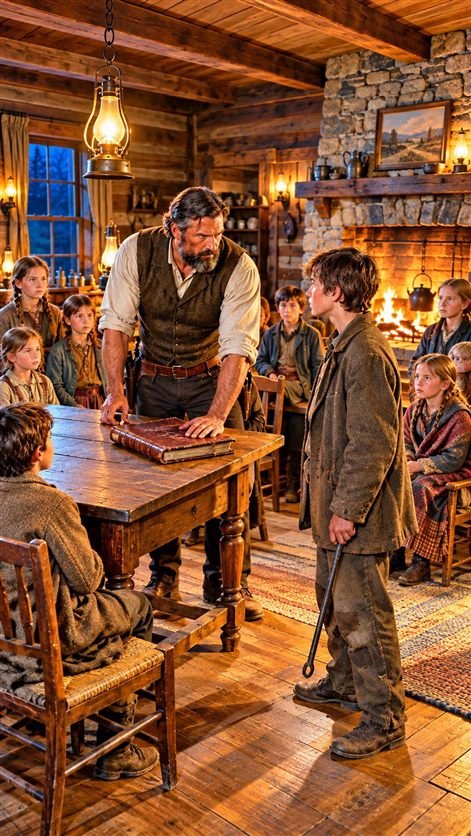
The final whistle echoed across the dusty railway station as happy families departed in their wagons, each carrying a child they had chosen from the orphan train. But nine children remained. Nine frightened faces. Nine broken hearts. Nine little souls who had watched strangers examine them, whisper about them, and walk away. Forty-one-year-old Emmett Barlow hadn’t come looking for children. He had ridden into town for fencing wire and coffee, intending to return to the lonely ranch where he had lived alone for six miserable years. Then he heard that terrible word. Load them back onto the train. Denver will take the leftovers. Miss Harriet Wexler, the fifty-three-year-old supervisor, closed her worn ledger and addressed the stationmaster. That’s everyone. Put the remaining children aboard. The home in Denver will take the leftovers. Emmett froze. He looked toward the children standing beneath the fading afternoon sunlight. Thirteen-year-old Tobias leaned painfully on an injured leg, positioning himself protectively in front of the others. Beside him, twelve-year-old Josephine held eleven-year-old Millie’s trembling hand. Eight-year-old twins Effie and Etta stood pressed together. One hummed softly, desperately trying to keep her fear from showing. Nine-year-old Samuel stared at his battered shoes. Ten-year-old Peter wore a cheerful smile that couldn’t disguise the heartbreak in his eyes. Six-year-old Caleb nervously smoothed a stubborn cowlick. And four-year-old Adah slept against Tobias’s good leg, unaware that another rejection awaited her. Emmett swallowed hard. Six years earlier, he had buried his beloved wife, Alena, after a long fever stole her life one spring morning. They had dreamed of filling their ranch house with children. But those dreams had died with her. Since then, Emmett had eaten alone, worked alone, and returned every evening to rooms filled with unbearable silence. Sometimes he left a lantern burning beside the front window, pretending someone might still be waiting for him. Now, staring at nine unwanted children, he felt something awaken inside his chest. The stationmaster called for final boarding. One whistle. Miss Wexler reached for Adah. Come along, sweetheart. A second whistle. Tobias struggled to straighten his injured leg. Josephine pulled Millie closer. Then Emmett moved. Six enormous strides carried him across the platform.
His fist struck the ticket counter so violently that the inkwell jumped. NO! Every conversation stopped. Even the humming twin fell silent. Miss Wexler stared at him. Sir? Those children aren’t getting back on that train. And what exactly do you propose? Emmett removed his hat. I’ll take them. Miss Wexler blinked. Which child? All nine. A shocked murmur swept across the platform. Mr. Barlow, she whispered, surely you cannot mean— I mean every single one. His voice was steady. I’ve got land. I’ve got a house with more empty bedrooms than I can stand. I’ve got food, work, and enough years left to give these children a proper home. He stepped closer. And if you send them to Denver, I’ll follow that train until I bring them back. For the first time in years, Emmett wasn’t thinking about everything he had lost. He was thinking about everything he could still give. Write it down, he demanded. Emmett Barlow, Cedar Bluff. Miss Wexler slowly opened her ledger. Little Adah stirred, lifted her tiny hand, and wrapped her fingers around Emmett’s rough thumb. Are you going to be our papa? she whispered. Emmett’s eyes filled with tears. He opened his mouth to answer. But before a single word escaped, a furious voice exploded from behind the crowd. STOP! DON’T LET HIM SIGN THAT LEDGER! Everyone turned. A man was pushing toward the crowd, his face pale with alarm. You don’t understand! he shouted, pointing directly at the nine children. There’s something about those children you haven’t been told! Miss Wexler’s face suddenly drained of color. And Emmett realized she was hiding something…
The man was Silas Grote, the town’s elderly magistrate, his breath coming in ragged gasps as he shoved past the ticket agent. Sweat plastered his thinning gray hair to his forehead, and his hand trembled as he gripped the edge of the wooden counter. Miss Wexler slammed the ledger shut so fast the pages fluttered like trapped moths. Grote, you have no business here, the supervisor snapped, her voice losing its professional smoothness and turning sharp with panic. She glanced nervously toward the tracks where the locomotive hissed white plumes of steam into the chilly autumn air. I have every business, the magistrate wheezed, pointing a shaking finger at thirteen-year-old Tobias. Look at them, Barlow. Look at all nine of them. They aren’t orphans from the New York charity wards like the others. They came on a special private car three hours before the regular passenger cars arrived. Emmett felt a cold prickle of dread crawl up his spine. He looked down at Tobias, who had instinctively stepped further in front of his younger siblings, his jaw clenched so tight the muscles twitched. What are you talking about, Silas? Emmett demanded, stepping between the magistrate and the children. Miss Wexler told me they were from the destitute shelters back East. She lied, Grote shouted, slamming his palm against the counter. Those children aren’t destitute. They’re the sole survivors of the Blackwood Estate massacre up near Omaha. A collective gasp rose from the remaining townspeople on the platform. Even the stationmaster took an involuntary step backward. Emmett stared down at the children, his heart hammering against his ribs. The Blackwood murders? That wealthy shipping tycoon and his entire household were butchered in their beds three weeks ago. Everyone in Nebraska read about it in the newspapers. The killer was never found, and the authorities claimed the children vanished into the night before the fire consumed the mansion. Miss Wexler threw her hands up, her face flushed with anger and desperation. It was supposed to be a confidential relocation! If the underworld thugs who wiped out the Blackwood family find out where these children are hidden, they’ll bring that violence right here to Cedar Bluff! We had to change their names, split up their records, and scatter them through the orphan train system just to keep them breathing! Tobias looked up at Emmett, his dark eyes filled with a heavy, unnatural sorrow that no thirteen-year-old boy should ever carry. We saw them, Mr. Barlow, Tobias said quietly, his voice cracking slightly. We were hiding in the pantry when the men came for our parents. We didn’t see their faces, but we heard them talking about a ledger. A ledger that proves our father didn’t embezzle the shipping funds—he was framed by the very syndicate that murdered him. And those men are still hunting for us because we know the truth. They aren’t looking for orphans; they’re hunting witnesses. Silence descended upon the platform, heavy and suffocating. The wind swept across the plains, rattling the dry tumbleweeds against the rails. Miss Wexler wrung her hands, staring at Emmett with pleading eyes. Now you know, Mr. Barlow. Put them back on that train. Let the authorities in Denver deal with the target on their backs. If you take them to your ranch, you’re inviting a executioner right to your front door. You’ll die trying to protect kids that aren’t even yours. Emmett looked at the children. He looked at little Adah sleeping against Tobias’s leg, at Josephine trembling as she clutched Millie’s hand, at Samuel staring at his worn-out shoes. He thought of the lonely ranch house, the dark, empty rooms, and the lantern he left burning every night for a family that would never return. Alena would never have walked away. She would have stood right where he was standing, facing whatever darkness lay ahead. Emmett slowly unbuttoned his wool coat, reached down, and lifted little Adah into his arms. She stirred, burying her face into his shoulder, her tiny fingers curling into the fabric of his shirt. He looked straight at Miss Wexler, then at Magistrate Grote. Let them come, Emmett said, his voice ringing with a cold, absolute resolve. I’ve spent six years living in a grave. If these children need a home, they get a home. And if anyone wants to take them from my ranch, they’ll have to go through me first.