A weary bride steps onto a lonely platform wearing the unmistakable stains of violence, instantly upending the quiet expectations of a frontier town. Can a union forged through a newspaper advertisement survive the deadly secrets both strangers carry into the mountains?
The noon train screamed into Mercy Hollow beneath a boiling cloud of Colorado dust. Steam rolled across the platform as passengers descended, but the moment Mara appeared on the iron steps, conversations died one by one. She carried a worn carpetbag in one hand and a cracked leather satchel in the other. Mud stained the hem of her plain brown traveling dress. And across one sleeve was a dark streak of dried blood. Mara ignored every stare. Her eyes searched the platform until they found Abel Stone. He was impossible to miss. Nearly seven feet tall, with massive shoulders, a dark beard, and hands that looked capable of breaking timber, Abel stood beside the freight office like Wolfjaw Mountain itself had grown legs. Mara walked straight toward him. Then she stopped.
Are you afraid of women?
Silence swallowed the station. Men lowered their hats. Mothers pulled their children closer. Even old Mr. Pike stopped shouting about freight schedules. For weeks, Mercy Hollow had been gossiping about the woman who answered Abel Stone’s advertisement for a wife. Everyone expected someone timid and desperate, a woman grateful enough for shelter that she wouldn’t ask questions. They were wrong. Mara was twenty-eight and had spent years hearing what the world thought of women like her. Too loud. Too stubborn. Too heavy. Too much. Somewhere beyond Kansas City, she had finally decided that anyone offended by her existence could learn to live with the inconvenience. She stopped directly in front of Abel.
You Abel Stone?
His gaze moved toward the blood on her sleeve.
Yes, ma’am.
Good. Mara dropped her luggage. I’m your wife, unless you plan on fainting.
A nervous laugh rippled through the crowd. Abel didn’t laugh.
Are you hurt?
No.
Whose blood is that?
Mara glanced at her sleeve as casually as if he’d asked about the weather. A gentleman on the train decided a woman traveling alone shouldn’t keep her own seat. Then he decided to put his hands on me.
She shrugged.
His nose strongly disagreed with both ideas.
The platform went silent again. Something changed behind Abel’s eyes.
Where is he?
His voice had become dangerously quiet.
Still on the train, Mara replied. Probably reconsidering his theology.
The corner of Abel’s beard lifted. Mara folded her arms.
One more thing. Your advertisement said you wanted a quiet wife. If that’s true, I’ll save us both the trouble and catch the next train east.
Abel blinked.
I wrote steady.
The newspaper printed quiet.
Mara’s eyebrow rose.
Well, that’s fortunate.
She smiled.
Because silence has never been one of my talents.
Someone near the ticket window whispered, Lord help him.
Mara immediately turned. With the sweetest church smile imaginable, she replied, Ma’am, the Lord has had twenty-eight years to improve me, and apparently chose not to.
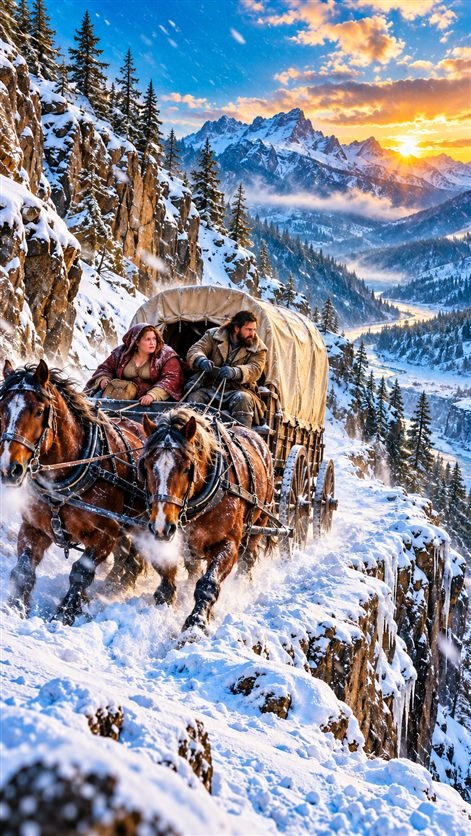
Abel laughed. Not politely. Not because everyone else was watching. It was the startled laugh of a lonely man who had almost forgotten what genuine amusement felt like. And Mara noticed. They left Mercy Hollow before sunset, climbing toward Wolfjaw Mountain. The road quickly became treacherous. Their wagon crawled along a narrow ledge overlooking a steep ravine while black pines crowded the mountainside. Thunder rolled across the peaks. Rain began tapping against the wagon as the sky darkened. Abel kept both hands firmly on the reins. Mara watched everything.
Rock on the left.
I see it.
Washout ahead.
I see that too.
A low branch suddenly swept toward them. Abel ducked just in time. He glanced sideways at Mara, caught somewhere between irritation and amusement.
Do you intend to drive this wagon from the passenger seat for the entire journey?
Mara didn’t answer immediately. She studied the narrowing mountain trail. The ravine beside them. The storm gathering overhead. Then she looked at the enormous stranger beside her, the man the entire town seemed frightened of, yet who had spoken softly to her from the moment she arrived. For the first time since stepping off that train, something in Mara’s expression changed. Her teasing smile faded. She slowly reached toward Abel. His eyes dropped toward her hand. Thunder cracked above Wolfjaw Mountain. And Mara quietly touched the heavy iron ring on his left hand.
You wear it on the wrong finger for a widower, she murmured over the wind.
Abel didn’t flinch. The horses stepped carefully through the mud, their hooves slipping slightly against the shale. The silence between them stretched, heavier than the rain clouds pressing down upon the pines.
It was my brother’s ring, Abel said finally, his voice deep and steady against the rising gale. He didn’t survive the winter we came up from Texas. I took it when we buried him in the clearing behind the cabin. We looked identical from a distance. Folks in Mercy Hollow still get us confused sometimes.
Mara pulled her hand back, resting it on her lap. Her gaze didn’t leave his profile, searching for the truth in the harsh angles of his face. She knew about brothers who didn’t survive winters. She knew about men who wore dead men’s jewelry to hide from ledgers that never balanced. The blood on her sleeve had dried hours ago, but the memory of the man on the train, the one who had tried to force her from her seat, was already fading into the background of a much larger danger.
Your advertisement mentioned a cabin, Mara said, changing the subject with deliberate intent. It didn’t mention the distance from the nearest sheriff.
There isn’t a sheriff within forty miles who cares what happens above the timberline, Abel replied. That’s why I needed someone who wouldn’t panic at the first sound of thunder. Or the first threat.
Is that why you placed the notice in the St. Louis paper instead of the local gazette? Because the local girls knew too much about the Stone family?
Abel’s jaw tightened. The horses sensed his tension and broke into a nervous trot. The wagon swayed, its wooden frame groaning under the weight of their meager possessions and the looming shadows of the forest. The road narrowed further, squeezed between a sheer rock wall on the right and a terrifying drop into the abyss on the left.
The St. Louis paper reaches women who are running away from things, Abel said, his eyes fixed on the darkness ahead. Women who know how to keep their mouths shut when the past catches up.
And what are you running from, Abel Stone?
Nothing. I live here.
No one lives on Wolfjaw Mountain unless they’re hiding from a badge or a bullet. Mara leaned closer, her voice cutting through the hiss of rain. I didn’t come out here to play nursemaid to a hermit with a guilty conscience. I came because I needed a place where my own name stopped following me down every street.