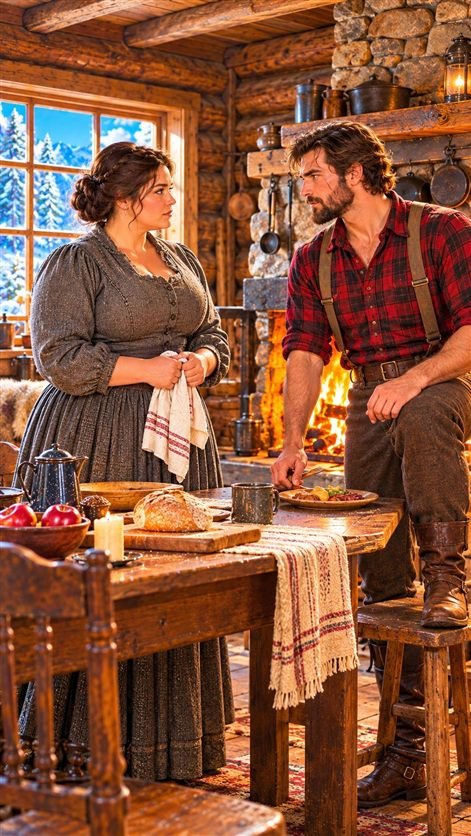
The rusted iron blade of the butcher knife severed the frozen marrow with a dry, sickening crack that echoed off the grease-stained log walls of the cabin.
Martha Maddie Higgins did not flinch, though the cold in the Bitterroot foothills was already biting through her coarse woolens, threatening to lock the joints of her thick fingers before the stew could be brought to a boil. She was two hundred and sixty pounds of stubborn pride trapped in a desolate Montana territory in October of 1884, and the man standing in the doorway was watching her with eyes as dead and grey as river silt. Jebidiah Miller had made his terms brutally clear on the very first day she stepped off the rattling stagecoach into the alkaline dust of Stevensville, her knuckles white around the handle of her battered leather valise.
“I paid for a worker, not a liability,” Jeb had spat, his voice a low, dangerous rumble like distant thunder as he surveyed her heavy frame.
Relegating her to the stove, he had made it abundantly clear that she was there to cook and nothing more. No words of endearment, no shared hearth, and certainly no partnership. He had advertised for a wife through a matrimonial agency in St. Louis, pouring out rough, poetic lines about needing a woman to share his homestead, and Maddie had answered with all the aching hope of a lonely soul. She had written of her heart, her resilience, and her capacity for labor, but she had omitted one crucial, unforgiving detail: she had sent no photograph.
Stepping down from the coach that first afternoon, the wooden suspension groaning under her massive weight, she had met his icy blue gaze and watched the rugged hope in his face shatter into cold, furious disbelief. He had not tipped his hat. He had stalked forward, his heavy boots echoing on the pine planks, and looked her up and down with open contempt.
“You lied to me,” he had said flatly, his hand resting instinctively near the bone-handled knife at his belt.
“I never lied,” Maddie had countered then, her cheeks burning beneath the relentless sun, her chin lifted high despite the trembling in her bones. “I wrote you the truth of my heart, of my willingness to work.”
Now, three weeks into a bone-chilling autumn that promised an early and brutal winter, the reality of their arrangement pressed down on the cabin with the weight of an avalanche. Jebidiah Miller was not merely a stern bachelor; he was a desperate man drowning in a failing ranch. The cattle were thin, the grass was turning to brittle straw beneath premature frosts, and the flour barrels in the root cellar were sinking lower by the day. Yet every time Maddie tried to step outside to mend a fence line or haul water from the icy creek, Jeb intercepted her with a sharp word and a shove back toward the cast-iron stove.
“Stick to the kettles, Maddie,” he muttered now, stepping into the cabin and shaking a flurry of grey sleet from his wide-brimmed hat. The ragged scar cutting through his heavy beard twitched as he worked his jaw. “The south pasture fence is down again. Elk got through. We don’t have meat to spare for wandering beasts.”
“Then let me help you drive them off,” Maddie said, wiping her flour-dusted hands on her apron. “I’m strong enough to swing a heavy branch, Jebidiah. I carried fifty-pound sacks of flour up three flights of stairs in St. Louis tenements before the cholera took my sister.”
Jeb let out a bitter, humorless laugh, hanging his heavy coat on a peg with unnecessary violence. “This ain’t a boarding house, and I ain’t looking for a charity case to haul my weight. You cook, you clean the hearth, and you stay out of my way. That’s the bargain.”
He turned his back on her, grabbing a whetstone and a strip of leather, beginning the rhythmic, scraping slide of steel against grit that had become the soundtrack of her isolated days. Maddie bit down on the inside of her cheek until she tasted copper. In the bustling boarding houses of her past, her size had made her the target of cruel jests, but it had also given her an undeniable presence and a back strong enough to break horses if given the chance. She had risked everything on a stack of letters and a one-way ticket west, crossing half a continent for a man who now treated her like a piece of broken furniture taking up space in his kitchen.
Night after night, the wind howled down the mountain pass, rattling the ill-fitted window frames. Maddie lay awake on her narrow cot in the lean-to pantry off the kitchen, listening to Jeb pace the floorboards of the main room. She heard the low, agonizing groans he muffled in his pillow—sounds of a man breaking under the sheer, crushing weight of isolation and impending ruin. He was starving himself to stretch the rations, giving her the lion’s share of the salted pork and cornmeal while he chewed on hardtack and bitter chicory.
The realization hit her like a physical blow during the second week of November. Jeb wasn’t just cold; he was terrified.
The winter of 1884 was shaping up to be a killer, and the Miller ranch had zero margin for error. If the livestock died, Jeb died with them. If the flour ran out before the spring thaw, there would be no rescue party coming up the Bitterroot trail. He was pushing her away not just out of bitter disappointment, but because he believed she was a dead weight who would freeze or starve the moment things turned truly desperate.
Maddie decided to wage her own war against the mountain.
While Jeb spent long, exhausting days riding the perimeter of the property on his exhausted bay gelding, trying to patch miles of split-rail fencing with frozen fingers, Maddie began her quiet subversion. She started with the pantry. Taking the meager scraps of tallow, wood ash, and rendered fat, she spent the dark hours boiling, straining, and pressing. Using an old copper preserving kettle, she manufactured batches of lye soap, working the heavy mixture with a wooden paddle until her thick arms ached and her palms blistered.
When Jeb came home smelling of horse sweat and frozen mud, too tired to look her in the eye, he found stacks of neatly wrapped, hard-cured soap sitting on the dry sink.
“What’s this?” he grunted, holding up a greyish bar.
“Trade,” Maddie said steadily, not looking up from her mending. “The stage driver stops at the depot come Friday. I traded the extra tallow for dried beans and a bag of salt. We needed the salt, Jebidiah. Unless you prefer your meat rotting in the barrels come December.”
Jeb stared at the soap, then down at her calloused, reddened hands. For a fleeting second, something flicker-thin and vulnerable crossed his ice-blue eyes before he slammed his mug onto the wooden table with a crack that rattled the tin plates. “I didn’t ask you to trade. I told you to cook.”
“And I told you I am a partner, not a slave,” she snapped back, her voice rising to match the howling gale outside. “You can starve to death on your pride if you want, Jebidiah Miller, but I survived the slums of St. Louis and I didn’t come out here to watch a stubborn fool freeze in the dark because he’s too proud to accept help from a fat woman!”
Silence dropped over the cabin, heavy and suffocating. Jeb slowly raised his head, his jaw set so tight the muscle leaped beneath his beard. He didn’t yell. He didn’t storm out. He simply looked at her with a terrifying, unreadable intensity, turned on his heel, and walked out into the freezing sleet, slamming the heavy oak door behind him.
He didn’t return until midnight, half-frozen and smelling of stale whiskey from the trading post down in the valley. Maddie was waiting by the hearth, a bowl of hot broth keeping warm over the dying embers. She didn’t scold him. She didn’t ask where he had been. She simply handed him the steaming wooden bowl, watched him drain it in silence, and went to her pallet without a word.
The turning point came on a Tuesday in early December, when the sky turned the color of bruised lead and the temperature plummeted forty degrees in a single hour. A full-scale blizzard screamed down from the Canadian border, burying the ranch house in a white shroud by noon.