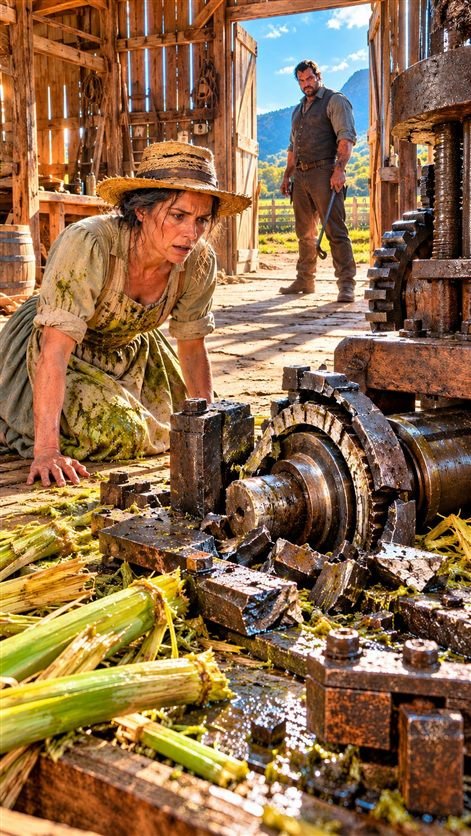
The sharp crack of the shattering bearing echoed across the dying valley like a gunshot, scattering a flock of crows into the smoke-choked sky. Martha froze with a handful of raw sorghum pulp, her lungs burning not just from the stifling autumn heat, but from the terrifying certainty that Gideon Rusk was already watching from the ridge.
Red Hollow had always been a cruel place to farm, a sun-scorched basin where men broke their backs over failing corn and prayed for rain that never came. When Martha Quinn handed over a crumpled five-dollar bill for twelve acres of thorny, unwanted weeds beyond Miller Creek, the entire town gathered at the general store to laugh at the grieving widow. They called her touched in the head, a woman weeping over dead dirt who didn’t even know the difference between a cash crop and stubborn brush. But four days later, as the first ancient iron rollers crushed those despised stalks into a thick, pale green stream of juice, Jacob Mercer stopped his mule and stared at her as if she had just performed alchemy.
“You paid five dollars for that entire field?” Jacob asked, his voice flat with disbelief.
“Yes,” Martha replied, her hands steady despite the tremor in her chest.
“For weeds?”
“They aren’t weeds.”
Jacob glanced toward the overloaded wagon of towering, heavy-headed cane. “They’re not corn.”
“No.”
“Not wheat.”
“No.”
“Cattle barely touch them.”
“Also true.”
Jacob wiped the sweat from his sun-blackened forehead with a dirt-stained sleeve. “Then what exactly did you buy?”
Instead of answering, Martha slid a small tin cup beneath the wooden channel where the golden-green liquid pooled. “Turn the press.”
The old mule strained against the harness. Wooden gears groaned in protest, smelling of hot axle grease and damp pine. Another thick stalk vanished between the iron cylinders with a wet, brutal snap. Martha filled the tin and handed it to Jacob, her eyes fixed on his.
“Drink.”
He raised it to his nose, hesitating. Sweet. Intensely sweet, with a sharp, grassy undertone that smelled of raw earth and impending life. He took a cautious sip, and his expression instantly dissolved from mockery into pure shock.
“What is this?” he demanded, his eyes wide.
Martha offered a quiet, fleeting smile. “The crop everyone laughed at.”
The memory of those first desperate days still haunted her. Four days before that historic pressing, the county auctioneer had practically begged someone to take the Miller Creek tract off the hands of the bank. Red Hollow farmers swore by wheat, corn, hay, and cattle; anything else was an insult to the soil. But Martha remembered her grandmother back in southern Illinois, a woman who boiled down giant grasses every autumn until the kitchen filled with a steam so rich it made the wallpaper curl. She remembered the rhythm of the rollers, the bubbling copper kettles, the foam skimmed away with a wooden paddle, and the transformation of bitter green water into dark, life-saving amber.
More than that, she remembered the droughts. Red Hollow had suffered two brutal summers that left the creek beds cracked like broken china and the corn stalks twisted into gray parchment. Sorghum, she knew, possessed a stubborn resilience that defied the dry winds of the plains. While sugar was an expensive luxury shipped from distant ports in heavy wooden crates, and molasses cost more than a working family earned in a week, this plant asked for nothing and survived everything. Martha hadn’t bought worthless weeds; she had bought an invisible kingdom.
Yet vision alone could not turn grass into syrup. She needed machinery, and Jacob’s abandoned horse-powered press was her only hope.
“It hasn’t worked since I was a boy,” Jacob had warned her when she first knocked on his unpainted door.
“Then we fix it,” she said.
And fix it they did. Jacob labored for three days in the stifling barn, replacing a rotted wooden gear with seasoned white oak. Martha spent hours scrubbing decades of rust from the heavy iron rollers with lye and sand. When a crucial bearing cracked during a test run, the local blacksmith, William Dodd, hammered out a replacement so solid it could have withstood a cannonball.
The first batch was a disaster. Martha misjudged the heat beneath the massive copper vat, and the syrup burned black, thick, and bitter as charcoal. Jacob tasted a single spoonful, winced until his eyes watered, and stared silently at the floor.
“Say nothing,” Martha warned, her heart sinking.
“I wasn’t going to.”
“You were.”
“I was merely wondering whether fence posts enjoy breakfast.”
The second batch was watery, tasting more of boiled grass than sweetness. But by the third attempt, something miraculous happened in the copper kettle. The liquid darkened into a deep, translucent amber, thick as honey, carrying a rich, caramel warmth that drifted across the fields and drew neighbors out of their porches just to sniff the air.
Selling it, however, proved harder than making it. Merchant Harvey Bell took six jars on consignment, shoved them into the dark corner of his mercantile, and sold exactly one—to Jacob, out of sheer pity. Realizing that men like Harvey bought security and ignored innovation, Martha changed her strategy entirely. She bypassed the store shelves, baked a massive batch of buttermilk biscuits every Saturday morning, and set up a small wooden trestle table right in the middle of the crowded market square.