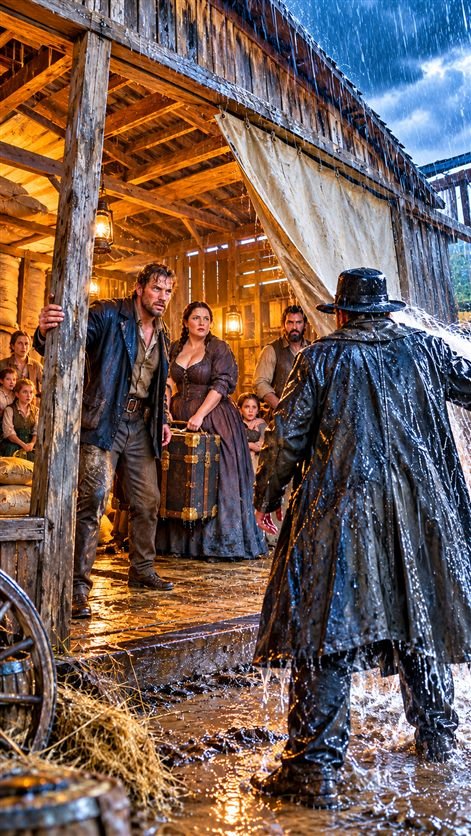
Before you decide whether we are worth the trouble of sheltering, she whispered, her voice trembling for the first time, you need to read what they say we did in Philadelphia.
Caleb took the damp, yellowed news sheet. By the flickering, dying light of a tallow candle, he smoothed the creases and began to read the dense columns of print, his eyes widening as the narrative of arson, defiance, and a desperate midnight escape unfolded before him, revealing a truth far darker and more dangerous than any mail-order bride catalog could ever have promised.
The newsprint was coarse and smelled of stale ink and damp cellar air. The headline above the four smudged portraits shouted across the page about a midnight fire at the Saint Jude Asylum for Destitute Women in downtown Philadelphia, an institution funded by the municipal board and run with a pious, iron-fisted cruelty that rarely made the public records. According to the reporter, the fire had not been an accident of faulty gas lines or winter hearths, but a deliberate act of sabotage executed from within the locked wards by four inmates classified as incorrigible and dangerous.
Caleb traced the lines with a scarred thumb. The text detailed how Adeline Fenwick, registered as patient number four hundred and twelve, had organized a systematic rebellion among the laundry workers, using smuggled lye and phosphorus matches taken from the dispensary to fire the laundry chutes before dawn. The goal had never been murder—the report carefully noted that night guards had been locked in the supply closets rather than harmed—but destruction. They had burned down the entire administrative wing to ash, specifically targeting the basement archives where the board of directors kept the legal indentures, medical histories, and forged property deeds of hundreds of women who had been committed under false pretenses to strip them of their family inheritances.
And inside that trunk, Caleb murmured, looking down from the paper to the battered brass-bound box resting between Adeline’s knees, are the original deeds.
Not just deeds, Adeline said, her voice dropping to a harsh whisper that barely cut through the sound of the rain. The records of every woman they locked away to steal land in Pennsylvania and Ohio. The names of the judges, the doctors who signed the false lunacy certificates, the bankers who cashed out accounts of women declared legally dead while still breathing. When we set that fire, we didn’t just break our own locks. We took the ledgers out of the safe before the roof fell in.
Nathan stepped closer, staring down at the newspaper portraits with a look of stunned awe. They called you lunatics.
They called anyone who fought back a lunatic, Clara snapped bitterly, her fingers gripping the edge of her skirt. Our father built the Fenwick textile mills before he died. When our mother followed him a year later, our uncle had us committed within the month so he could sell the mills and clear our titles. They tried to break us with cold water, darkness, and medicine that made your tongue swell until you couldn’t speak. Adeline taught us how to swallow our pills and spit them out in the slop buckets. She taught us how to pick the brass locks with wire pulled from the mattress frames.
Harlan had moved over from the brazier, his massive frame casting a long, distorted shadow across the corrugated iron wall. He looked down at the trunk, then at Adeline, his face unreadable in the dim light. And the marriage agency? How did you find men in Nebraska willing to send railroad tickets to four fugitive arsonists from Philadelphia?
We didn’t use our real names, Adeline said, her chin lifting with a flicker of her old defiance. We answered an advertisement placed by a broker named Miller who was looking for destitute females willing to settle out west sight-unseen, no questions asked, provided they paid half their own fare. We sold our last spare petticoats to the cook for train tickets as far as Chicago, then used forged transit passes to get across the Mississippi. We thought… we foolishly thought that once we reached the frontier, nobody would care about Philadelphia warrants or state property boards. We thought we could just lose ourselves in the cornfields and start over.
And then you found us, Caleb said softly. Four brothers living in a half-built shack on a floodplain with no money, no finished house, and a pile of debts.
Adeline looked around the crowded, miserable grain shed, listening to the groaning of the timber frame as the floodwaters pressed against the lower walls. She looked at Nathan’s young, earnest face, at Peter’s bruised flowers, at Harlan’s watchful stance, and finally back to Caleb.
We didn’t mean to drag you into our fight, she said, her voice dropping its defensive edge, leaving behind something raw and painfully vulnerable. When the ferryman told us about the warrants, when that agent walked through the door just now, I expected you to hand us over to save your own skins. It would have been the sensible thing to do. You don’t know us. We are strangers who lied to you before we even shook your hands.
Caleb folded the newspaper carefully and handed it back to her. He did not immediately answer. He walked over to the open double doors of the shed, peering out into the pitch-black void of the storm. The rain had settled into a steady, heavy deluge, but the frantic roaring of the river seemed to have leveled off slightly, the crest perhaps finally passing the ridge.
His mind raced through the implications. If the state agent had tracked them this far, he would be back at first light with the county sheriff and a posse. The local authorities in Nebraska didn’t care about Philadelphia philanthropists or corrupt lunatic asylums, but they cared about harboring fugitives and destroying state property. If the Penrose brothers were found harboring four escaped asylum inmates who had burned down a public building, their own meager homestead claims would be instantly forfeited, their land seized by the county for vagrancy and conspiracy, and they would find themselves driven out of the valley before the autumn harvest.
And yet, looking back over his shoulder, Caleb saw his youngest brother Nathan sitting down on the straw beside Martha, quietly showing her how to braid a fresh stem of timothy grass to replace her crushed ribbons. He saw Peter dividing his last piece of salted beef and offering half to Clara without a word of demand or expectation. He saw Harlan standing guard near the front like a stone pillar, his hand resting casually on his skinning knife, ready to defend a group of women he had known for barely six hours.
They were all fools, the four Penrose brothers. They had spent their entire lives wanting something better than the hard, dirt-scratching poverty of their father’s failed farm, mistaking the desperate hunger for a home with the actual capacity to build one. They had bought into a mail-order illusion because the alternative—remaining lonely, hardened bachelors working themselves to death in the Nebraska dust—was too bleak to contemplate.
Caleb turned back from the door and walked slowly across the shed until he stood directly in front of Adeline.
The agent will be back at dawn, Caleb said, his voice low and steady. With the sheriff.
Adeline flinched, her hands tightening again on the trunk. Then we must move the box now, she whispered. While it is still dark. We can take the ridge path behind the kiln.
No, Caleb said.
Adeline stared up at him, her gray eyes widening in sudden, sharp alarm. You are turning us out?
I told you down at the landing, Caleb said, a faint, tired ghost of a smile touching the corners of his mouth. People are harder to replace than grain. And much harder to replace than a stack of old papers.
He reached down and laid his large, calloused hand flat against the battered brass-bound lid of the trunk.
If we move this box up to the limestone cave behind the kiln, it will be safe from the water and the sheriff’s deputies alike. My brother Harlan knows a hunters’ trail that bypasses the wagon road entirely. But it is steep, muddy, and we will have to carry it on our shoulders every foot of the way in the dark.
Adeline stared at his hand resting on the trunk, then slowly raised her gaze to meet his eyes. The defiance that had armored her features since they stepped off the ferry finally melted away, leaving behind the exhausted, hopeful face of a woman who had forgotten what it felt like to have someone stand beside her instead of against her.
You are a very foolish farmer, Mr. Penrose, she whispered, her voice thick with unshed tears.
Probably, Caleb replied, turning to call over his shoulder. Harlan, get the ropes. Peter, wake the old man by the wall and help him with his blankets. Nathan, keep your eyes on the door. We are moving.
The eight of them slipped out into the churning darkness of the Nebraska storm, leaving the crowded grain shed behind just as the first gray light of dawn began to stain the eastern horizon above the swollen river. They did not take the wagon road, and they did not look back.
Between the four brothers, hoisting the heavy, battered leather trunk on a makeshift litter of ash poles, they carried the past up the steep, muddy incline of the ridge toward the limestone caves. Adeline walked at Caleb’s side, her hand no longer clutching the brass corners in panic, but resting lightly, securely, against his sleeve as they climbed together into the gray dawn light of a world that was suddenly, terrifyingly, brand new.