The Salt and the Sluice
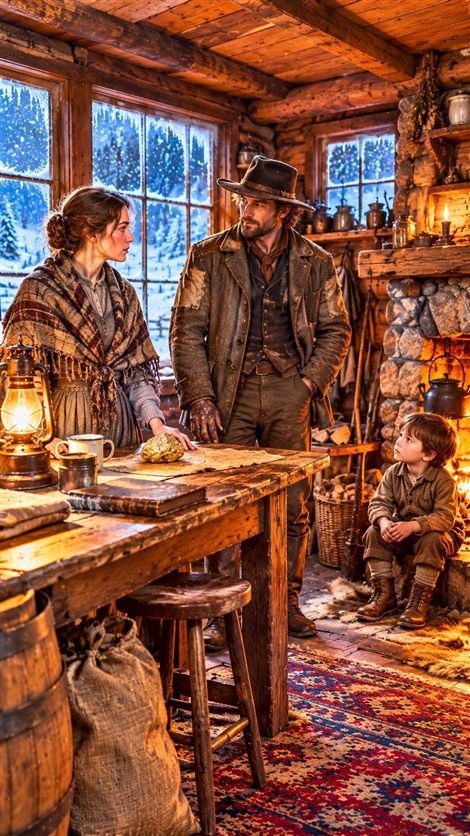
"If we are to boil salt pork in the same kettle with my boots, Julian, you might at least wait until I have finished starching the carrier's collars," Ruth said, her fingers blue-red with the morning damp as she pinned a damp linen strip to the rough cedar doorframe. Julian Fletcher did not drop his eyes from the tallow candle he was scraping over the greased wooden axle-tree; instead, he laughed—a short, barking sound that rattled the tin mugs hanging from the stagehouse rafters—and suggested that a bit of pork grease in the laundry only proved a man's shirts had come from an honest kitchen. The frost of December 1884 lay thick and white over the Puget Sound mudflats, stiffening the marsh grass into brittle quills that snapped whenever the mail hack trundled out toward the timber railhead at Port Madison. Inside the low-ceilinged stage …

The Ink Beneath the Flooring

The cedar boxes on the wash-bench smelled of damp cedar and pressed mountain pennyroyal, a scent Lavinia Prescott had spent three hours cataloging before the midday mule train blocked the alley. She did not look up when the heavy boots creaked upon the dry willow boards of the porch, because she already knew from the rhythmic scrape of the left iron heel that it was the stone-mason Cutler, who walked as though every step were an arbitration between the earth and his own ankles. "If those roots are damp," Cutler said, without taking off his wool cap, "they will mildew before you reach the assay office, and then the botanical society in Denver will think Silverton sends nothing but swamp trash." Lavinia closed her lead pencil into the fold of her ledger and finally raised her chin, her heavy spectacles sliding an eighth of an …

Salt-Seam Granite

“There is no sense putting grease on a wedge that’s already swimming in bay water,” Caroline Bell said. She did not look up from the small earthenware crock she was scraping with a wooden spatula, though she knew George Reynolds had stopped his adze mid-stroke three paces away. The sound of the tool dying in the pine timber was flat—just the wet, heavy thud of cold steel against green cedar. The cook-shed smelled of woodsmoke, wet wool, and the sharp, vinegar tang of salt-risen dough souring in its crock by the iron stove. Outside, the Samish tide was turning, dragging grey-green weed across the mud flats and leaving the pilings of the timber pier sucking at the air with a wet, wet cough. It was late October of 1882, and the rain had settled into a steady, gray wool that seemed to have no beginning …

The Salt Marsh Gate

"We should have turned back at the salt-marsh gate," I told him, though the cedar grease on my mittens made it impossible to grip the reins properly anyway. The sudden, heavy silence that followed my confession settled over the wagon box like wet wool, proving instantly that Levi Cutler never let a poorly chosen remark pass without a deliberate, maddening calculation of its cost. Part 1 The salt-marsh gate had been nothing more than two peeled cedar posts and a rusted iron hinge swinging against the gray drizzle of a December morning in the Puget Sound country, but passing it meant I had traded the four walls of my uncle’s smokehouse at Union City for twenty miles of corduroy road that smelled exclusively of rotting hemlock and wet horse. My name is Adelheid Albright, and by the reckoning of the church elders in Port Gamble …

The White River Gazette

"A town that forgets its own dialect will soon be reading its own obituary." *The sentence sat wet in the galley, and Esther Olsen refused to scrape it out despite the printer's thumbprint smudged across the margin.* * The ink in the roller was always too cold before the stove found its rhythm, smelling of linseed oil and charred walnut hulls that settled in the grain of the floorboards like wood-smoke dust. Esther did not look up when the latch lifted—not because she was guarding her columns from a prying eye, but because the cold air that fell through the door always made the damp news-sheets curl against the tympan. "The frost has caught the late marrow squash," Elijah Gibson said, closing the door with his hip while he balanced a crate of tallow candles. "And the stage from Forsyth isn't coming up the bluff …

The Salt and the Score

The handbill pinned to the plank wall of the Red River general store promised four-part polyphony, genuine German tin-plate lanterns for the evening lantern projections, and an assortment of sacred and secular ballads calculated to soften the hardest settler’s heart between the Washita and the Canadian. It did not mention that the tenor, a seventeen-year-old boy named Orry with ribs like a washboard, could not hold pitch if a bee stung him, or that Susannah Vance’s melodeon had lost its lowest C-sharp somewhere south of Atoka when the left-hand axle dropped into a gumbo rut. Susannah smoothed her slate-gray traveling skirt with fingers that smelled faintly of mutton tallow and lamp oil. She was twenty-eight, an age that in the Chickasaw Nation made a woman either a settled matriarch or an eccentric object of local speculation, and she had long since chosen the shelter of …

The Seed-Frames and the Frost

"If we plant the early Dutch reds before the quarter moon, the frost will take them just as sure as Sunday," Willa Fletcher said, her voice dropping into the quiet well of the cellar before she realized she had spoken aloud. Anthony Mercer did not look up from the wheel hub he was greasing with mutton tallow. He sat on an inverted salt barrel in the dim lean-to behind the river-bottom smokehouse, his shirtsleeves rolled to show forearms mapped with grease and pale sun-bleached hair. "The almanac says nothing about a moon, Willa. It talks about the bottomland damp." "The almanac was printed in St. Louis for people who think the world stops at the Missouri," she murmured, retreating two steps toward the cold-frame sash she had been scrubbing with lye water. Willa was twenty-eight, shaped by three summers of hauling river-silt in lard buckets …

The Well at Tide-End

"Tell them the sky is empty, Miss Pennington, and they will simply pay someone else to fill it." Gideon Prescott did not look up from where he was sharpening his broad-ax against a greasy sandstone block. The salt wind off Puget Sound rattled the dry cedar shingles of the timber office, carrying the sharp, resinous smell of sawdust and the distant, rhythmic clank of the pile drivers down at the wharf. Lavinia Pennington smoothed the grey wool of her mourning skirt over her knees, her fingers trembling slightly against the coarse fabric as she watched the grey mist rolling inland over the mudflats. "Mr. Clough has three wagons of zinc drums and a brass megaphone," she said, her voice dropping into that thin, hurried register she used whenever she felt the entire room weighing her worth against her uncle’s debts. "The town council believes he …

The Season of the Joint-Drawer

"She didn't pack the extra strings, and she knew it before the axle cracked." The words stayed in the gravel of the creek-bed long after Amos Sterling had finished kicking the frozen elm spoke. The Hill Country had gone slate-hard three weeks before Christmas, catching the Pedernales low and greasy with black ice. In the limestone hollow behind the old timber-joiner’s shed, Rosa MacLeod sat on an upturned grease keg, holding a pig-bristle brush above a tin of lamp-black. Her fingers were so swollen from the damp that she had to tuck the handle into the crook of her knuckle like a tavern-keeper holding a pen. She did not look up when Amos dropped the iron wedge into his toolbox with a dull *clonk* that brought a scattering of dead live-oak leaves down from the eaves. "She packed what she could lift without the bay …

The Wooden Company

"We cannot haul three trunks of cedar sawdust and painted pasteboard through a saltwater drizzle that rots the joints." Ransom stopped the team, his sleeve gray with sawdust from the shingle mill behind them. * Part 1 The rain in Port Blakely did not fall so much as it drifted off the salt chuck, sticking to wool coats until the gray fibers looked like sheep-fleece. In the back of the wagon, behind nine painted boxes and a length of green baize that smelled faintly of old camphor and wet sawdust, Tommy blew on his fingers and watched the timber carts go by on their greased skids. "The girl with the blue apron said she'd bring two pence if we showed the dragon," Tommy said. He was nine, small-boned, and had a cough that came off the Puget Sound fogs like steam from a kettle. "The …