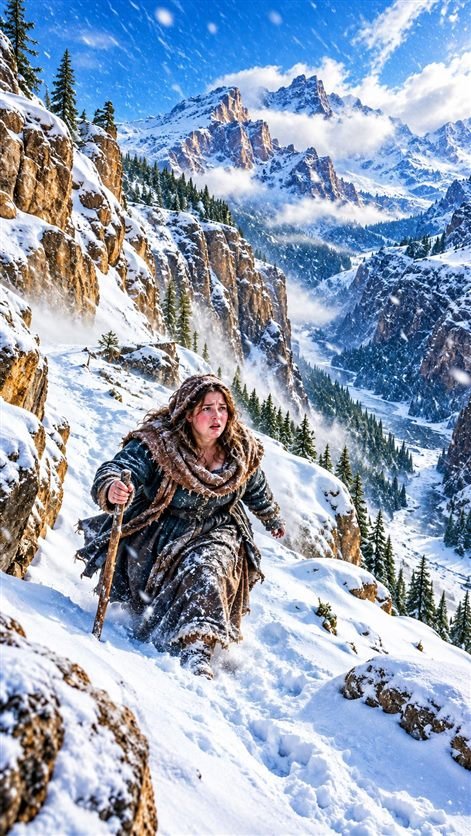
The blade of the wind sliced down the granite gorge of the Cascade Mountains, leaving behind a frozen wasteland where only the dead could find rest. Evelyn Hart opened her eyes to a world painted entirely in white, her breath crystallizing instantly in the merciless air as the final, desperate plea slipped past her frozen lips.
*
The mountain did not take Evelyn Hart by accident. Someone had decided she was the one person they could leave behind in this frozen hell, trading her life for an extra ration of flour and a slightly lighter load on the straining axles of the timber wagon.
The cold truth had crystallized in her chest the exact moment she stepped out from the dense pine timber carrying an armful of damp birch wood and saw the empty clearing. The iron-rimmed wagon was gone. The weary mule was gone. Her father was gone. There was no runaway team, no sudden stampede chased by wolves, no frantic circle of wagon tracks left by a family desperately searching through the falling timber for a lost daughter. There was only a straight, cruel line of fresh wagon tracks disappearing eastward down the winding trail, and a silence far heavier and more suffocating than any formal goodbye.
“Papa?” Evelyn’s trembling voice vanished instantly into the immense, indifferent gorge of the Cascade Mountains, swallowed whole by the vast, howling timberlands.
She called again, panic clawing at her throat like a physical talon, sharp and hot despite the freezing air. “Papa! Margaret! Please!”
Only the rising wind answered her, whistling through the high canopy of ancient firs like a mocking specter. At twenty-two years old, Evelyn stood entirely alone in the high wilderness, hampered by a chronically injured right hip that burned with every shifting weight, clutching a worn oak walking stick, carrying almost no food, and facing a killer blizzard that was roaring down from the northern peaks.
The twin ruts in the snow told a story she refused to believe, yet could not deny. While she had been gathering dry kindling precisely where her stepmother Margaret had ordered her to go—deep inside a sheltered ravine shielded from the camp—someone had calmly turned the heavy wagon around, hitched the mule, and driven away without a backward glance. They had not forgotten her. They had not misplaced her in the flurry of camp breaking. They had planned this moment with mathematical precision, waiting for the precise angle of the slope and the encroaching grey of the storm. And after carefully calculating who mattered most in the desperate winter migration toward the valley settlement… they had decided Evelyn did not make the cut.
Heavy, wet flakes drifted from the darkening sky, beautiful and quiet as they covered the cruel reality beneath them, smoothing out the tracks until no evidence remained of the betrayal. Her knees buckled slightly, a sharp spasm of pain shooting from her damaged hip joint down to her heel. Tears hot with betrayal blurred her vision, washing away the grey smear of the disappearing wagon line until a memory flashed unbidden behind her eyelids, sharp as a drawn knife.
It had happened only weeks earlier, around a dying campfire while the embers spat sparks into the freezing dark. She had been wrapped in a wool blanket just beyond the ring of flickering light, feigning sleep while her father and stepmother spoke in low, venomous murmurs.
“She’s my blood, Margaret,” her father, Caleb, had whispered, his voice laced with a wretched, defensive exhaustion, unaware that Evelyn was listening to every word.
“And she will get us all killed if you keep dragging her through these mountains,” Margaret had replied, her tone as sharp and unyielding as flint. “That injured hip of hers slows us every single day. We have three young children to protect, Caleb. Real children. Not a grown woman who limps like a crippled mule.”
Three children. Not four. Margaret had erased Evelyn from the family census right there in the dark, reducing her existence to an inconvenient arithmetic problem. The silence that followed had been unbearable, stretching out until Evelyn’s heart felt like it had frozen solid in her ribs. Then, Caleb—the father who had taught her to fish in the spring thaw and carried her on his shoulders when the mountain paths grew too steep—had finally broken the silence.
“I’ll think on it,” he had murmured.
Now, shivering in the gathering dusk, Evelyn understood the terrible weight of those four words. He had thought on it, and he had chosen his new life, his new wife, and his other children over the daughter whose body had been broken by a logging accident three winters ago.
The storm grew louder, howling down the canyon like an angry beast. The wind cut through her thin wool coat, turning her skin to gooseflesh as she wiped the bitter tears from her cheeks with stiff, red fingers. Crying would not burn a single calorie or melt an inch of snow. She hoisted the bundle of damp firewood onto her aching shoulder, tightened her grip on the oak walking stick, and began the impossible task of following the fading wagon trail into the whiteout. If she caught them—if her crippled leg could somehow outlast their moving wheels—maybe they would look into her eyes and regret the inhuman thing they had done. If she stayed here in the timber… the mountain would bury her, and her bones would feed the wolves before the spring thaw reached the foothills.
Night arrived with terrifying speed in the high country, swallowing the grey light until the world shrank to a radius of three feet around her boots. Evelyn crawled beneath the sagging branches of an ancient fallen spruce tree that offered a meager, shadowy cave against the driving fury of the gale. She built the smallest, most pathetic fire possible, using dry tinder she had hoarded in her leather pouch and nursing the tiny orange flame with trembling fingers. The weak tongues of fire offered almost no warmth to her freezing limbs, but they gave her one more psychological anchor to cling to, a single glowing eye in the dark that whispered she was still alive.
Her dinner was a cruel joke, barely enough to sustain a sparrow through a cold morning. Half of a hard, stale biscuit softened in a tin cup of melted snow, and one forgotten strip of salted venison she found buried deep in the lining of her coat pocket. It was barely enough to remind her how desperately hungry she had become, gnawing on her stomach lining as the acids burned through empty tissue.
The storm raged around her fragile shelter throughout the long, agonizing night. Every time she drifted toward sleep, a sharp spasm of pain from her damaged hip wrenched her back to consciousness. Margaret had always referred to it with a sneer as “your bad side,” as though Evelyn were a broken household tool rather than a flesh-and-blood daughter, a liability to be discarded when the warranty expired. But that injured leg still carried her forward. It trembled under her weight. It burned with a deep, throbbing ache that radiated up into her lower spine. Yet, miraculously, it moved.
By the second afternoon, the weather had deteriorated from a heavy snowfall into a blinding, horizontal blizzard that scoured the bark from the pine trees. Evelyn had been forced to abandon the last of her damp firewood hours ago, unable to carry the extra weight as her strength waned. Her heavy wool coat was soaked through, the melting snow turning to ice against her skin until her entire body felt encased in a shifting glacier.
Then she remembered an old mountain trader’s grim warning she had heard years ago down in the valley trading post: “The moment you stop shivering… that’s when death is winning.”
She checked herself. She was still shaking. Her teeth clicked together in a rapid, uncontrollable rhythm that made her jaw ache. But the shivers were beginning to slow, turning from violent jerks into deep, bone-rattling shudders that seemed to originate from somewhere outside her own fading consciousness.
When the second evening descended like a lead curtain, Evelyn finally understood the terrifying truth of her situation. She was not going to make it out of the wilderness. There was no fierce anger left inside her, no surging adrenaline to fuel her steps, no strength remaining in her vocal cords to scream out into the gale. There was only a profound, heartbreaking acceptance that washed over her like warm water, dulling the edges of her pain.
She dragged herself between two enormous granite boulders that leaned against each other like giant ribs, forming a narrow crevice where the wind could not reach her quite as directly. There was no fire tonight. No food left to ration. Her fingers had lost all sensation, the skin turning a pale, waxy grey as the frost claimed them. Snow settled quietly over her bowed shoulders, matting her hair and crusting heavily over the toes of her worn leather boots. The mountain was already beginning to claim her, weaving its white shroud around her form with methodical patience.
She closed her heavy eyelids, the lashes freezing together in the draft. “I don’t want to die,” she whispered into the darkness through lips that barely moved.
For a long, agonizing moment, there was nothing in the universe except the deafening roar of the blizzard and the rhythmic thumping of her own slowing heart. Then, miraculously, something shifted in the acoustic landscape of the gorge. It was not the wind howling through the canopy. It was not the loud cracking of frozen tree limbs snapping under the weight of ice.