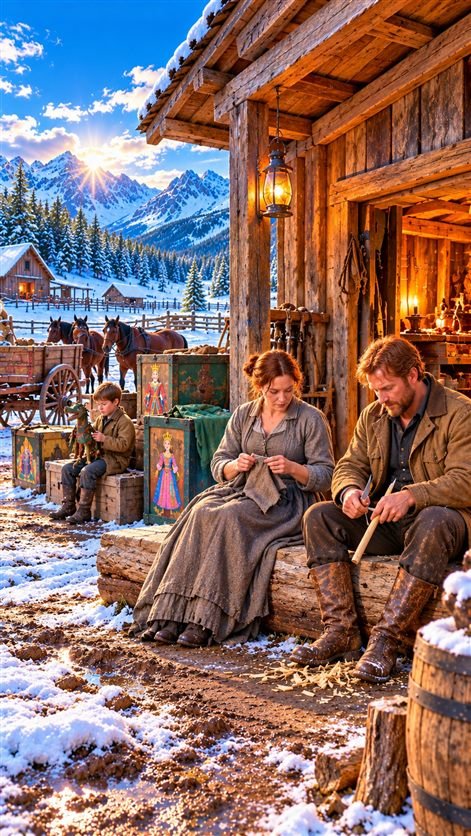
“We cannot haul three trunks of cedar sawdust and painted pasteboard through a saltwater drizzle that rots the joints.” Ransom stopped the team, his sleeve gray with sawdust from the shingle mill behind them.
*
The rain in Port Blakely did not fall so much as it drifted off the salt chuck, sticking to wool coats until the gray fibers looked like sheep-fleece. In the back of the wagon, behind nine painted boxes and a length of green baize that smelled faintly of old camphor and wet sawdust, Tommy blew on his fingers and watched the timber carts go by on their greased skids.
“The girl with the blue apron said she’d bring two pence if we showed the dragon,” Tommy said. He was nine, small-boned, and had a cough that came off the Puget Sound fogs like steam from a kettle.
“The dragon’s jaw is stuck,” Laura said. She did not look up from the leather awl she was using to punch new holes in the marionette’s knee-leather. Her thumbs were stained dark with walnut stain that no lye soap would lift before Sunday. “If I work the wire now, the jaw stays open like he’s shouting at the clouds. Nobody wants a dragon that looks like he’s yawning through an entire battle.”
“He looks fierce,” the boy insisted.
“He looks like he’s waiting for his tea.” Laura Henderson pulled the waxed thread through with a small, dry grunt. She was thirty-two, though the salt air made her skin feel twenty years older, dry and tight across the cheekbones like salted cod. She had come out from Ohio four years ago with an aunt who had died of the chills in a dry-goods box of a cabin near Olympia, leaving her three trunks, twenty yards of ribbon, and a pair of shears that cut tin as easily as lawn. The marionettes—*The Royal Marionette Company of the Sound*—were her third attempt at a livelihood that did not involve boiling mutton for loggers or washing shirts for men who lost their buttons in the timber flumes.
Across the muddy yard, where the tramway crossed the wagon track from the lower camps, Ransom Gentry was shouting at a teamster about hemlock scantlings. Ransom was not a large man, but he had the thick, square shoulders of someone who spent his youth lifting wet cedar bolts. He wore a canvas coat stiffened by three winters of linseed oil and red lead, and his red hair was always damp enough to curl against his forehead in tight, ginger springs.
“You’re on the company right-of-way, Miss Henderson,” Ransom called out over the rattle of a logging truck. He did not take off his hat—nobody took off their hats in the mill-yards because the drizzle would only get into the hair—but he raised his chin two inches. “The manager says if that wagon sits another hour by the donkey-engine, he’s hitching his greys to it and dumping the lot into the bay for wharf-age.”
“The axle’s pinched,” Laura said, her voice dropping into that flat, level tone she used whenever men tried to explain simple mechanics to her as though she had been hatched in a parlor. “Tell your manager the axle is pinched because he let his tram-mules tear up the corduroy.”
“My manager’s name is Skelton, and he thinks painted wood is less useful than cordwood,” Ransom said, walking over through the slush. He looked down into the wagon box, his gray eyes fixing for a second on Tommy’s pale face before flicking to the box of princesses. “That the one with the gold braid?”
“That’s the princess. Her arm fell off in the ferry crossing from Seattle.”
“I’ve got a tallow pot in the blacksmith’s lean-to,” Ransom said, shifting a coil of hemp line from one shoulder to the other. “And I’ve got an hour before the tide brings the logging raft in. Bring the wagon round. If we lift the box with the jackscrew, I can shim the bolster before your pasteboard gets the pip.”
Laura didn’t move immediately. Her fingers stayed tucked into the fold of the green baize. “You did that last month in Snohomish, Mr. Gentry, and you charged us three yards of red fringe.”
“I charged you two yards, and the fringe was greasy.” He grinned, a quick, crooked flash of teeth that made his square face look ten years younger and entirely untrustworthy. “Besides, the boy likes the dragon. If I fix the axle, you let him pull the string for the dragon’s tail during the afternoon show.”
“He’s got a cough,” Laura said, though she was already reaching for the reins.
“The salt air’s good for the lungs,” Ransom said, which was what everyone said in Washington Territory when they didn’t know what else to say about a child who looked like white paper. “Keeps ’em pickled.”
The blacksmith’s shed smelled of burned horn and sour beer. A pair of stray hounds—half retriever and half local nuisance—lay under the bellows, too lazy to move when the wagon wheels crunched over the coal-slack. While Ransom hoisted the rear axle with a screw-jack that groaned like an ungreased winch, Laura sat on an upturned nail keg and stitched the dragon’s wing with green silk thread.
“You’re staying too long in the salt towns,” Ransom said without looking up from the bolster. He was squinting through the gloom at the reach-iron. “The inland folk like a show better. They haven’t seen twelve steam-tugs in a day; they’re still hungry for a bit of gilding.”
“The inland folk want their shows for two cents and a bag of dried plums,” Laura said. “And the roads between here and Ellensburg are mostly elk trails straight up the shale.”
“I’ve got a cousin up near the Naches pass. Runs a sheep ranch, or used to before the scab took his rams. He’s got a big barn with a floor as flat as a dining table.” Ransom dropped the wrench with a dull *clink* into the dirt. “He’d give you half the mutton and a dry corner for the boxes if you brought the little king that drinks the wine.”
“The king doesn’t drink wine, Mr. Gentry. It’s colored vinegar, and it rots the pine throat.”
“Whatever he drinks, the herders like it. They haven’t seen a play since the circuit rider broke his leg in ’78.” He straightened up, wiping his red wrists on his trousers, and looked directly at her. His gaze wasn’t the kind that measured a woman for marriage or a dance; it was the look a man gave an old crosscut saw—estimating how many knots were left in the blade before it snapped. “You’re killing yourself with that box, Miss Henderson. You and the boy. You haul it six miles, you set it up in a drafty vestry, you play to twenty people who spend half the night arguing about the timber tax, and then you pack it back in the rain.”
“And what do you do?” Laura asked. Her needle stayed poised half an inch above the green silk. “You roll cedar logs into the salt until your shoulders look like sides of salt beef. Is that grander?”
“It pays for the salt beef,” he said easily. “That’s the difference between us. You’re trying to make kings out of scrap pine.”
“They’re not scrap. My uncle carved the king in Cincinnati before the war.”