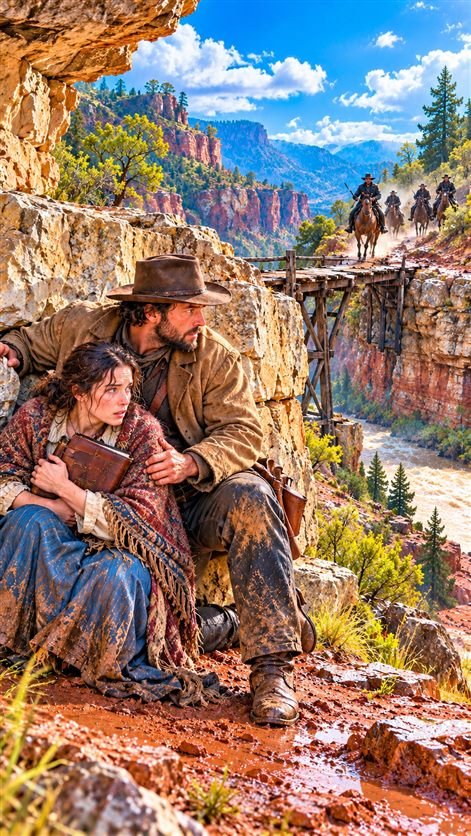
The stonecutter came looking for silence and an abandoned quarry lease. He discovered a woman hiding behind a pile of green cedar ties with a telegram clutched in her bleeding thumb.
The freight wagon slewed through the deep red gumbo mud of the river bottom with a dry, screeching groan of ungreased iron axles, stopping dead beside the loading platform where the rain had pooled into rust-colored mirrors. Elias Quaid climbed down from the high wooden seat without looking at the station agent, his boots sinking two inches into the viscous clay before his heels found the gravel footing. He wore a canvas coat stiffened by years of lime dust and mortar splatter, his face weathered to the color of seasoned walnut by high-altitude exposure and dry winds. He had not come for company or a soft bed; he had come to inspect the shipment of squared limestone blocks brought down from the ridge quarries for the new rail terminal. Instead, tucked behind the stack of fragrant cedar ties, he found Blythe Holst trying to muffle her breath against the damp wool of her shawl. Her fingers were gray with stone dust up to the wrists, and her lower lip was bitten raw where she had tried to check a nervous hesitation in her speech whenever the telegraph ticker in the station office clicked out its rhythmic chatter.
“They’re looking at the manifests,” she said, her voice catching on a sharp intake of breath before she forced the words past her teeth. “Morgan’s men. They saw the telegram before it cleared the wire-boy’s desk.”
Elias did not offer a sweeping gesture of chivalry or crowd her space. He merely shifted his heavy limestone mallet from one gloved hand to the other, the hickory handle worn satin-smooth by his palm. He looked past her shoulder toward the rail spur where a string of empty flatcars sat rusting under the gray Oklahoma drizzle.
“Let them look,” Elias said, his voice a low, gravelly baritone that seemed to absorb the ambient noise of the depot. “Paper rots faster in this red mud than a well-laid course of ashlar. What’s your name, woman?”
“Blythe,” she whispered, her chin lifting with a stubborn, defensive angle that betrayed years of being overlooked or dismissed as an awkward hand at the quarry tables. “Blythe Holst. And I’m not hiding because I’m scared. I’m hiding because that manifest in your coat pocket proves Morgan doctored the weight tickets on every ton of stone shipped to the junction.”
Elias touched the heavy paper tucked inside his canvas breast pocket, feeling the crisp, sharp edge of the waybill against his ribs. He studied her for a long, deliberate moment—the way her dark hair escaped its pins to cling damply to her temples, the soot smudged across her cheekbone from the depot stove, and the quiet, unyielding steadiness in her gray eyes. She was no fragile depot bride waiting for a gentleman with a bouquet; she was a stonemason’s daughter who had spent half her life squaring blocks in the dark.
“Then we’d better get moving before the freight agent finishes his pipe,” Elias said, turning back toward the wagon. “Climb up. You can hold the brake lever while I see to the mules.”
* * *
The red clay track climbed steeply out of the river bottoms into the scrub-oak hills where the soil gave way to jagged limestone ledges and dense thickets of wild persimmon. They traveled in silence for the first three miles, the rhythmic clatter of the wagon wheels muffled by the thick mud. Blythe sat with her hands clamped tightly around the iron brake lever, her shoulders hunched against the damp chill that rose off the creek beds. Elias kept his eyes fixed on the wet rumps of the mule team, his thoughts anchored to the weight of the incriminating manifest and the dangerous proximity of Morgan’s hired riders.
As the sun dipped toward the jagged treeline, turning the heavy overcast to the color of bruised slate, Elias pulled the wagon off the main trail into a natural rock shelter formed by an overhanging ledge of red sandstone.
They led the pack mules up a narrow ledge trail, blindfolding the lead animal with a burlap sack to keep it steady against the sheer drop into the dry creek bed below. Sticky red Oklahoma clay caked onto the mule’s hocks like ochre, slipping slightly on the wet shale before Elias reached out with his free hand to steady the animal’s flank, his knuckles brushing Blythe’s fingers where she held the lead rope.
“Careful here,” Elias said, his voice dropping into the quiet cavern of the rock. “The shale breaks clean under a iron shoe.”
“I know how rock breaks,” Blythe replied, though her voice lacked its earlier defensive snap. She knelt beside the lead mule, untying the burlap blindfold once they reached the safety of the dry floor beneath the sandstone overhang. She pulled a tin cup from her pack, scooped water from a small seepage trickling down the rock face, and held it out to the panting animal before turning her attention to the camp.
Working by the dim gray light filtering through the curtain of dripping ferns, Elias dragged dry driftwood from the high-water mark of the wash while Blythe struck a flint against a piece of rusted iron hoop. Within minutes a small, hot fire of dried willow and scrub oak was crackling against the back wall of the alcove, throwing long, flickering shadows across the rough-hewn stone.
True to the frontier sustaining craft of the region, Blythe mixed a handful of coarse yellow cornmeal and a pinch of salt in a tin pan with water from the seep, dropping spoonfuls of the batter directly onto a heated flat stone resting in the coals. The cornmeal ash-cakes hissed softly, filling the damp air with the rich, toasted scent of rendered pork fat Elias smeared across the stone from his saddle kit. She flipped the cakes with the blade of her pocket knife, her movements precise and practiced, untouched by the nervous twitch that troubled her speech.
Elias watched her over the rim of his tin mug of black chicory coffee, noting the way the firelight softened the tired lines around her eyes. Without a word, he reached across the small space between their bedrolls, caught the edge of her woolen shawl where it had slipped loose from her damp collar, and drew it snugly around her throat. His calloused fingers brushed the sensitive skin just below her ear, lingering for a fraction of a second before he pulled back to tend the fire.
“Eat,” Elias said simply, pushing a steaming corn cake toward her on a flat piece of clean bark. “We have twenty miles of high limestone before we hit the trail junction tomorrow. Morgan’s men won’t follow us into the roughs after dark, but they’ll be waiting where the creek narrows.”
Blythe took the warm bread, her fingers brushing his again. “Why are you helping me, Elias? The manifest is my concern. You could have handed me over to the depot agent for the reward.”
Elias stared into the glowing embers, his face hard in the firelight. “My brother helped build that rail spur. When the bridge went down in sixty-eight, Morgan blamed the timber framing to cover his own forged supply lists. My brother died under a cloud of debt he never owed. I didn’t come to the territory for charity, Miss Holst. I came to see every ledger balance out.”
The intimacy of the campfire and the raw honesty of his confession hung in the thin air between them, bridging the distance of their separate griefs.
* * *
Morning broke with a hard, gray frost that glazed the red clay ruts to porcelain. They broke camp before the first pale fingers of sunlight crested the eastern ridge, pushing the mules hard up the narrowing canyon toward the old timber bridge that spanned the Red Fork gorge.
The rope bridge sagged ominously over a fifty-foot drop of churning brown water, its weathered hemp cables straining against the weight of the damp air. Wild persimmon trees clung desperately to the limestone gorge lip on either side, their bare branches rattling in the rising wind.
“You go first with the lead mule,” Elias instructed, checking the cinch on his saddle with a sharp yank. “Keep your weight centered on the cedar planks. If the cable snaps on the far side, don’t look back—jump for the bank.”
Blythe nodded, her jaw set. She took the lead rope of the pack mule and stepped onto the trembling bridge. Every plank groaned under her boots, the damp hemp stretching with an alarming wet snap as the wind gusted up the canyon. Halfway across, a sudden cross-draft caught the pack load, swinging the bridge violently sideways. Blythe stumbled, her left boot slipping off the narrow wooden track. Her breath caught in a sharp gasp as she swung out over the roaring water, her hands burning against the rough hemp rope.
Elias was across the gap in three lunging strides. He didn’t waste time with words; he dropped flat onto the frosted planks, slid forward on his stomach, and hooked his heavy arm around her waist just as her grip began to fail. With a brutal heave of his broad shoulders, he hauled her back onto the solid footing of the platform, pressing her against the cold cedar rail while the bridge vibrated like a plucked harp string.
For a long, breathless heartbeat they stayed locked together against the railing, the roar of the river deafening beneath them. Elias’s hand came up, his broad palm gently brushing a damp, stray curl away from her temple and tucking it securely behind her ear. His thumb lingered on her cheekbone, tracing the line where the soot had faded into pale skin.