I came to the Idaho high country seeking a home, only to find a debt-ridden man who looked at me like an intruder. The faded pages of my grammar book held the true record of the land that ended his isolation forever.
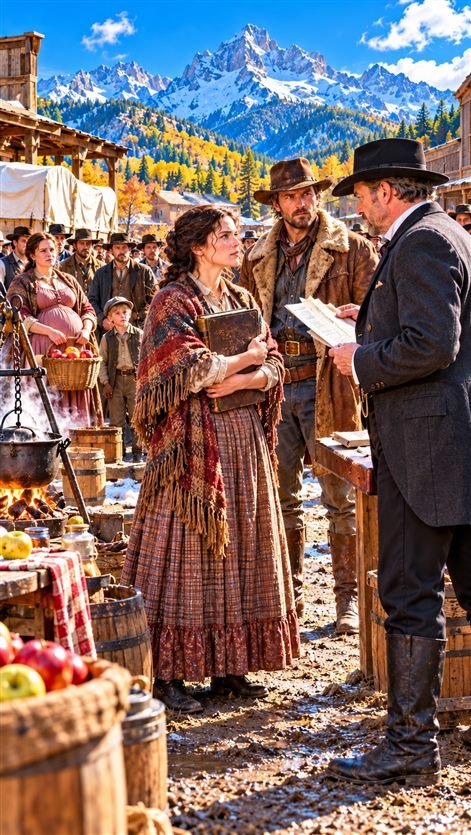
The smell of scorching pine pitch and sulfurous wood-smoke drifted down the draw, warning Tamsin Albright that the valley’s brief autumn was ending in violence long before she ever reached the Sutherland ranch-house door. She clutched a water-stained copy of Webster’s Elementary Spelling Book against her coarse wool shawl, her boots sinking inches deep into the frost-rimed loam of the Idaho foothills. Behind her, a battered freight wagon rattled with her meager belongings while her bitter half-sister, Corinna, hissed complaints from the wooden bench about the unpaved wilderness and the broken promise that had brought them west. Ambrose Sutherland stood by the split-rail corral fence, his broad shoulders squared against a bitter northerly gale, his sheepskin coat scarred by grease and weather. He had sent for a housekeeper to manage his isolated camp, not a pair of destitute women dumped by a crooked stage agent on the wrong side of the Sawtooth range. When Tamsin stepped down from the wagon, slipping on a patch of greasy clay, Ambrose did not rush forward with courtly grace; instead, he spat a stream of dark tobacco into the weeds and crossed his arms over his chest, his grey eyes narrowing beneath the brim of a battered felt hat. “The ledger said one person with strong hands,” Ambrose rumbled, his voice rough as river gravel. “Not a pair of mouths to feed while my wool-clip rots and the valley council threatens to foreclose on the south meadow.” Tamsin pulled her shawl tighter, her chin lifting with defensive pride despite the stinging wind that whipped stray strands of dark hair across her pale cheeks. “I was told there was an opening for someone who could manage numbers and keep order, Mr. Sutherland, and I am quite capable of earning my keep without your charity,” she retorted, her voice steady and clear against the whistling pines. Corinna scrambled down behind her, whining about the cold and the lack of a proper parlor, instantly antagonizing the solitary sheepman who valued silence above all else. Ambrose shook his head, muttering an oath under his breath as he turned back to his wooden press frames, where late-season clover honey and crushed orchard comb lay sticky and exposed in the gathering chill. “You’ll find no soft beds here, Miss Albright,” he called back over his shoulder, his boots crunching on the frozen rime. “If you can’t haul water from the creek and scrub the tallow grease off these press blocks before dark, you’ll be sleeping in the supply wagon.” The harsh reality of the frontier closed in around them like a tightening noose, setting the stage for a bitter winter of labor, suspicion, and survival in the shadow of the peaks.
—
The crisp morning air bit sharply into Tamsin’s fingers as she stood beside the cast-iron boiling kettle, skimming the pale foam from the bubbling apple mash and golden honey combs while the October sun struggled to pierce the towering Douglas firs. Ambrose Sutherland approached silently, his boots soundless on the pine needles, carrying a heavy sack of raw wool fleece that needed sorting before the damp set in. For the past week, they had maintained an uneasy truce forged through relentless, grueling physical labor that left their muscles aching and their palms calloused raw. Tamsin scrubbed the wooden tables with harsh lye soap, her arms burning with effort, while Ambrose hauled heavy stones to reinforce the foundation of the orchard press-house against the coming mountain freeze. “You’re wasting good wax in that skimming,” Ambrose murmured, pausing to wipe sweat from his weathered brow with the back of a calloused hand. “The valley market wants clear comb, not dark scrapings.” Tamsin straightened up, resting her knuckles against her lower back to ease the strain, her dark eyes flashing with independent spirit. “If you leave the dark comb in, Mr. Sutherland, the fermentation ruins the batch before the frost even hits the lower pasture,” she replied sharply, gesturing to the stacked wicker baskets filled with bruised autumn fruit. For three hours, they worked in synchronized silence, hauling water from the mountain stream, splitting dry pine kindling, and kneading heavy rye dough in the wooden trough inside the cramped kitchen. The scent of woodsmoke, baking bread, and sweet crushed apples filled the air, creating a deceptive domestic warmth that masked the underlying tension of their enforced partnership. Corinna lounged by the hearth, refusing to lift a finger, leaving Tamsin and Ambrose to shoulder the entire burden of the homestead chores. Ambrose watched Tamsin from across the room as she deftly mended a torn canvas flour sack with precise, even stitches, her slender fingers moving with a grace that contrasted sharply with the rough-hewn cabin walls. “You move like someone who spent time in a schoolroom rather than a kitchen, Miss Albright,” Ambrose observed quietly, leaning against the doorframe while whittling a cedar peg. Tamsin paused, her needle hovering over the coarse fabric as a shadow crossed her face. “My father believed a girl should know letters as well as labor, Mr. Sutherland, even if it left us with nothing when he died,” she answered softly. The shared physical toil began to strip away their initial hostility, revealing a mutual respect born of grit, endurance, and the quiet dignity of honest work performed against the unforgiving backdrop of the Idaho wilderness.
—
The mid-point crisis struck with the suddenness of an autumn squall when the valley council’s bailiff rode up to the ranch gate accompanied by armed men, bearing an eviction notice signed by Alderman Henderson. Ambrose slammed his fist against the wooden sorting table, the heavy iron scales rattling as he faced the corrupt magistrate’s hirelings who claimed the Sutherland grazing leases and orchard rights were void due to unpaid back taxes. “I paid those levies in gold last November, and I have the receipts in my lockbox!” Ambrose roared, his face darkening with suppressed rage as he stepped in front of Tamsin to shield her from the hostile men. The bailiff smirked, pointing to the empty wall desk where the official county ledger was supposed to reside. “The county records show no such payment, Sutherland, and without the entry in the master book, your land reverts to the municipal pool by sundown tomorrow,” the bailiff sneered before wheeling his horse around in a cloud of dust. Despair hung heavy in the drafty cabin as evening fell and the temperature plummeted toward freezing. That night, trapped by the rising gale that howled down the canyon, Tamsin and Ambrose sat close together on the wooden bench near the glowing embers of the hearth, sharing a single scratchy wool blanket to keep the mountain chill at bay. The physical closeness, born of stark necessity, dissolved the last of their emotional defenses. Ambrose stared into the flickering flames, his big frame tense with bitter guilt. “It’s my fault,” he whispered hoarsely, his voice breaking slightly as he looked down at his rough hands. “Two years ago, during the timber rush, my partner left me to manage the county filings while he went south; he vanished on the trail, and I trusted the town clerk to record my payments. I can’t read the fine print in those legal books, Tamsin—words were never my weapon.” Tamsin reached out, her small, calloused hand resting gently over his massive, scarred fist. “You don’t need to read the fine print when you have someone who knows how to read between the lines,” she whispered, her eyes shining with fierce loyalty. Utilizing her hidden Keystone skill—exceptional literacy and an encyclopedic memory for handwriting and legal scripts—Tamsin pulled her old school workbook from her trunk, flipping open the flyleaf where she had copied samples of every municipal clerk’s signature in the territory during her years as a scrivener’s assistant. By the flickering light of a tallow candle, she began comparing the forged tax stamp on the bailiff’s notice with the authentic ink strokes of the 1878 land registry. Her heart raced as she spotted the fatal discrepancy: the signature on the eviction order was dated three weeks before the clerk had even assumed office. “Look here, Ambrose,” she breathed, tracing the ink with her finger. “Henderson didn’t just lose our records; he manufactured this notice to steal your water rights for his silver syndicate.” Ambrose stared at her in stunned silence, the profound vulnerability of his confession giving way to a fierce, protective awe as he realized that this quiet, underestimated woman had just saved his entire life’s work.