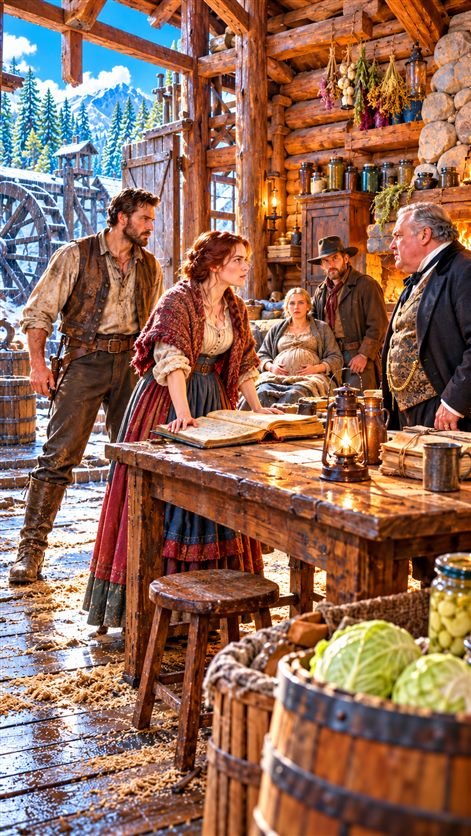
Can a ledger forged in dry ink withstand the freezing torrents of the high pass? The mountain doctor’s buggy brought a silent bride to a mill whose timber framework hid an altered survey, and only a woman who knew the alchemy of winter stores could keep them all alive when the spring thaw broke their isolation.
—
The Arizona spring rain did not fall in gentle, domestic drops; it battered the cedar-shingled roof of the Sutherland mill with the flat, metallic sound of buckshot. Dorothea Sutherland pulled her heavy wool shawl tighter around her shoulders, her fingers brushing the damp tallow candles lined up on the rough-hewn pine table. Outside, the world had dissolved into an opaque curtain of slate-gray mist and roaring water. The canyon freight road, usually choked with alkaline dust and creaking mule trains, was now a churning brown wash racing down toward the swollen Verde River. The stage station down the track had already reported three overdue freight wagons stalled in the mud, their axles groaning under tons of sodden wool and iron castings. Dorothea did not look at the storm; she looked at the cold iron stove and the three stone jars of pickled winter cabbage sitting in the corner. Her marriage to Orrin Sutherland, solemnized three days ago in the drafty justice of the peace office while tallow dripped on their boots, had been a contract born of legal necessity and mutual desperation. She had come to the mill expecting a partnership of quiet industry, but the wedding-night confession he had dropped over a cup of chicory coffee—that he could not read a single word of the land-grant deeds locked in his iron strongbox—had turned her world upside down. Now, as the wind rattled the heavy oak rafters, she forced her mind past the insult of her upbringing, remembering how her father had forbidden her schooling while spending every dime on his own speculations, leaving her to master the quiet, unrecorded science of survival through sheer observation.
Orrin Sutherland stood by the draft-heavy window, his broad shoulders silhouetted against the flash of distant lightning, scraping dried mud from his boots with a hunting knife. His silence was not the sullen quiet of an ordinary man, but the heavy watchfulness of a millwright who spent his life listening for the splinter of a stressed gear before it shattered the entire waterwheel. He tossed the knife onto the workbench with a dull clatter that startled the pregnant neighbor woman, Martha Gable, who had sought shelter in their loft two hours before the flash flood hit the canyon floor. Martha winced, clutching her swollen abdomen as another spasm of pain rippled through her frame, her breath hitching in the damp chill of the room. Orrin turned his weathered face toward Dorothea, his eyes narrowing against the pale light of the grease lamp. “The high-line flume is taking too much weight from the runoff,” Orrin said, his voice a low gravelly rumble that cut through the hiss of the rain. “If that bulkhead gives way before dawn, the whole mill race will scour out the foundations, and Gable’s crew will have us by the throat with their injunctions.” Dorothea did not flinch from his gaze, though she felt the familiar, bitter weight of her denied education prickling at her skin. “A bulkhead doesn’t fail because of the water, Orrin; it fails because the tongue-and-groove joints were cut green and swelled unevenly,” Dorothea replied, her voice steady and clear as she picked up a whetstone to sharpen her paring knife. “You brought me here to keep the books and mend your shirts, but you forgot that a woman who can budget a winter’s rations on five pounds of flour can read the stress points of pine just as easily as a man who spends his days swinging an adze.” Orrin stared at her, his wry mouth twitching with a mixture of stubborn pride and reluctant respect as he grabbed his oilskin slicker from the peg. “Then prove it, Mrs. Sutherland, before the river takes the mill and everything we’ve built upon it,” he muttered, stepping out into the howling deluge to fight the rising crest.
—
The physical labor of the mill was a relentless, bone-weary discipline that tested every sinew of Dorothea’s body. Working alongside Orrin’s trusted, albeit divided, head hand—a lean, shiftless fellow named Vance whose loyalties seemed to shift with the price of milled lumber—Dorothea spent the next twelve hours hauling three-inch oak planks and heavy iron drift-bolts through knee-deep mud. The air smelled of wet sawdust, rancid machine grease, and the sharp, coppery tang of ozone from the storm. Her palms, already calloused from years of scrubbing floors and tending kitchen gardens, quickly blistered and broke open against the rough-hewn timber, but she refused to slow her pace or ask for quarter. Inside the mill, Martha Gable’s labor pains intensified, turning the corner of the dry-goods storeroom into a sanctuary of frantic care where Dorothea applied her deep domestic chemistry. Boiling water in a battered copper kettle, she shredded dried raspberry leaves and wild mint into an earthenware crock, testing the temperature against her wrist with the precision of an apothecary. “Drink this slowly, Martha,” Dorothea instructed softly, wiping the sweat from the younger woman’s pale forehead with a cool linen rag. “It will ease the griping and steady your blood.” Martha clung to Dorothea’s wrist with surprising strength, her eyes wide with terror in the dim lantern light. “My husband… the alderman… he said he’d clear this land if I didn’t sign the quit-claim, Dorothea,” Martha whispered between gasps, her voice trembling. “He knows the survey was altered at the county seat.” Outside, the steady rhythm of Orrin’s adze echoed against the roar of the river as he and Vance labored to shore up the weakened timber framing, their axes flashing in the gray dawn light.
The friction between Orrin and Vance grew palpable as the morning sun failed to pierce the heavy canopy of storm clouds hanging over the Arizona canyon. Vance heaved a heavy pine cant against the mud-bank, wiping his forearm across his brow and spitting into the froth of the floodwaters. “We’re throwing good timber after bad, Sutherland,” Vance shouted over the roar of the spillway, his eyes darting suspiciously toward the upper trail where a horseman in a fine wool coat had just appeared through the mist. “Alderman Gable’s legal hounds are already riding up the canyon road with the sheriff’s writ in their saddlebags. You can’t fight a court order with a waterwheel and a handful of pickled cabbage.” Orrin did not pause in his work; he drove an iron spike into the oak sill with a single, massive blow of his sledgehammer that sent a spray of dark water flying. “The only writ that matters on this creek is the one carved into the boundary stone by the original government survey of sixty-two, Vance, and Gable’s men aren’t touching it while I have breath in my lungs,” Orrin snapped, his face dark with fury as he leveled a warning glare at his hand. Dorothea stepped out from the mill doorway, a steaming cup of chicory coffee in one hand and her heavy ledger tucked securely under her arm. “Vance is right about one thing, Orrin—we can’t fight them with muscle alone,” Dorothea said, her voice cutting through the rising wind with absolute authority. “The survey they’re using at the land office lists the section marker at the old cottonwood tree that washed out three winters ago. But if you look at the tax tallies in this ledger from eighteen-sixty-five, the acreage was assessed twenty rods further north, right where the bedrock forms a natural bulkhead.” Orrin lowered his hammer, staring at her with a profound, dawning realization that shifted the entire dynamic between them from a marriage of convenience to an alliance of unshakeable equals.
—
The midday crisis struck with the suddenness of a mountain squall when the high-line flume finally groaned, fractured along an old rot-line, and sent a torrent of water crashing directly toward the mill’s main storage shed. Inside, Martha Gable let out a sharp cry as labor reached its critical zenith, her body arching in the dim light of the lantern while the walls shook from the impact of the water. Dorothea did not hesitate; leaving Vance to gape in paralyzed cowardice at the bursting flume, she seized a heavy coil of hemp rope and a iron-shod crowbar, rushing out into the blinding sheet of rain where Orrin was already waist-deep in the churning race. “The grain stores!” Orrin roared over the deafening din of splintering wood. “If the water gets into the winter seed stock, we’ll starve before the first frost!” Dorothea scrambled across the slick, rain-drenched top timbers of the flume, her skirts soaked and clinging to her legs as she drove the iron crowbar into the jammed sluice-gate. “Help me lever this brace, Orrin! We have to divert the current into the bypass channel before the foundation washes out completely!” Together, their muscles straining against the immense hydraulic pressure of the mountain runoff, they threw their combined weight against the iron bar. With a deafening crack of tearing oak and groaning iron, the jammed gate sprang open, shooting a massive arc of white water away from the buildings and down into the empty gravel beds of the canyon. Panting and soaked to the bone, they collapsed against each other in the mud, the raw, visceral terror of the near-disaster giving way to an intense, overwhelming wave of physical relief. Orrin’s strong, calloused hands gripped Dorothea’s waist to steady her against the slippery timber, his gaze burning down into hers with an unguarded tenderness that defied all his gruff frontier defenses. “You’re more iron than the machinery, Dorothea,” he murmured against her ear, his breath warm against her chilled skin. Inside the storeroom, a sharp, healthy infant cry pierced the roar of the receding storm, signaling the birth of Martha’s child and drawing them back to the fragile warmth of the hearthside.