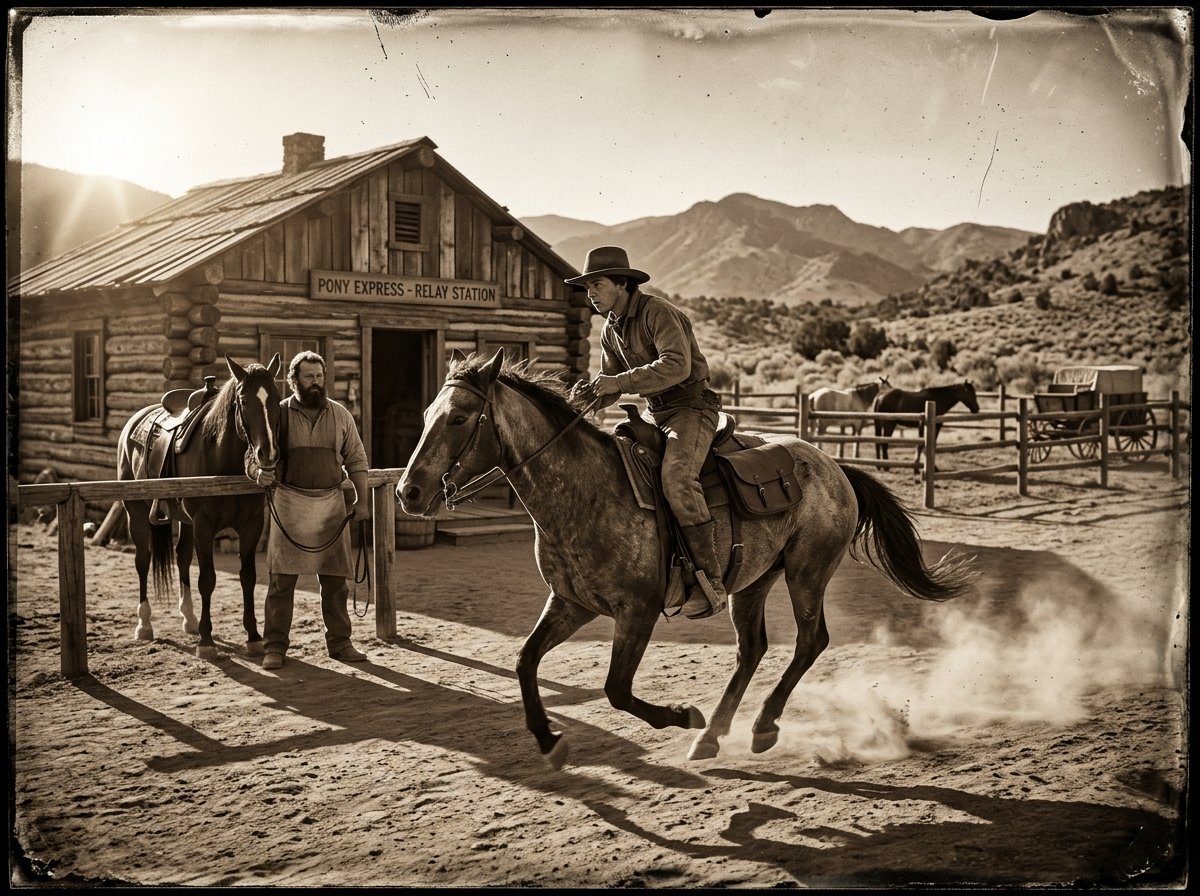
📜 Frontier Fast Facts: The Pony Express
Operational Duration: Exactly 19 months (April 3, 1860 – October 26, 1861).
Route Dimensions: 1,900 miles from St. Joseph, Missouri, to Sacramento, California, traversing six territories and mountain ranges.
Speed Record: Delivered Abraham Lincoln’s Inaugural Address in March 1861 across 1,900 miles in just 7 days and 17 hours.
Rider Specifications: Orphan boys, under 18 years old, weighing less than 125 pounds, hired under a solemn oath not to curse, gamble, or drink liquor.
No venture in American frontier history burned more brightly, captured the global imagination more intensely, or vanished more swiftly than the legendary Pony Express. Operating for just nineteen months from April 1860 to October 1861, this audacious relay of young riders, thoroughbred horses, and remote desert stations achieved what contemporary engineers had deemed impossible: linking the Atlantic and Pacific oceans with transcontinental communications in under ten days.
The Crisis of Transcontinental Communication (1860)
In the spring of 1860, the United States stood on the precipice of civil war. The industrial cities of the East and the immense gold wealth of California were separated by nearly two thousand miles of untamed prairie, desert, and mountain ranges. News traveled agonizingly slowly. Overland stagecoaches took twenty-four days to complete the southern journey, while steamships carrying mail via Panama required over three weeks.
Recognizing the urgent geopolitical need to bind California to the Union cause, the freighting magnates of Russell, Majors, and Waddell devised an extraordinary plan. Without receiving a federal postal subsidy, they invested their own corporate fortune to create the Central Overland California and Pikes Peak Express Company — the formal business entity behind the Pony Express.
The Masterpiece of Logistics: Stations, Mochilas, and Mounts
The logistical engineering behind the Pony Express was staggering in scope and execution. Across 1,900 miles of wilderness stretching from St. Joseph, Missouri, to Sacramento, California, the company established 190 relay stations spaced ten to twelve miles apart — the exact distance a horse could sustain a dead gallop without collapsing.
Stations were divided into two operational categories:
- Relay Stations: Minimalist desert outposts manned by two stock tenders, housing fresh mounts, water, and grain. Riders paused for less than two minutes to transfer the mail pouch to a fresh horse.
- Home Stations: Larger fortified compounds spaced seventy-five to one hundred miles apart, where riders completed their shift, ate a hot meal, and rested before riding the return leg.
To eliminate every superfluous ounce of weight, Israel Landis designed the patented Mochila — a lightweight leather blanket designed to fit directly over the saddle horn and cantle. The Mochila contained four padlocked hard-leather pouches (cantinas) holding up to twenty pounds of mail written on ultra-thin tissue paper. When arriving at a station, the rider simply grabbed the entire Mochila and slung it across the fresh saddle, leaping onto his new mount without wasting a second.
The Riders: Youth, Grit, and the Solemn Oath
The company placed famous recruitment advertisements throughout Western newspapers: “WANTED: Young, skinny, wiry fellows not over eighteen. Must be expert riders, willing to risk death daily. Orphans preferred.” The average rider weighed between 100 and 125 pounds, dressed in light woolen trousers and buckskin shirts, carrying only a horn to signal upcoming stations and a Colt revolver for defense.
Alexander Majors, a deeply religious man, required every employee to sign a strict moral pledge: “I agree not to use profane language, not to get drunk, not to gamble, not to treat animals with cruelty, and not to do anything incompatible with the conduct of a gentleman.” Every rider was presented with a leather-bound pocket Bible, which they carried on every mission.
Riders faced ferocious challenges: howling blizzards across Nebraska plains, blinding alkali dust storms in the Great Basin, and deadly skirmishes during the Paiute War of 1860. Legendary exploits entered frontier folklore. “Pony Bob” Haslam completed a continuous 380-mile round trip through hostile territory in Nevada after finding his relay stations burned and stock tenders killed, arriving on schedule with only nine hours of rest.
The Lightning Wire and Historical Legacy
The death of the Pony Express was as rapid and definitive as its rides. On October 24, 1861, workers connected the final poles of the Transcontinental Telegraph in Salt Lake City, Utah. For the first time, electronic Morse code messages could travel from New York to San Francisco in seconds.
Two days later, on October 26, 1861, the Pony Express ceased operations. Economically, the enterprise was a catastrophe for Russell, Majors, and Waddell, leaving them with debts exceeding $200,000. Yet historically, the Pony Express was a monumental triumph. Over 350,000 miles were ridden and nearly 35,000 pieces of mail delivered with the loss of only a single mochila. Most importantly, it kept California securely aligned with the Union during the critical opening months of the Civil War, cementing the immortal legend of the young riders of the West.
Historical Provenance & Archival Standards
Wild West Stories Historical Research Division • Primary Source Cross-Referenced
This historical monograph is compiled from digitized records preserved at the National Archives and Records Administration (NARA), the Library of Congress Prints and Photographs Division, and Western state historical registries. All dates, geographic coordinates, and legal proceedings have been verified against original 19th-century newspaper archives and territorial government registries.