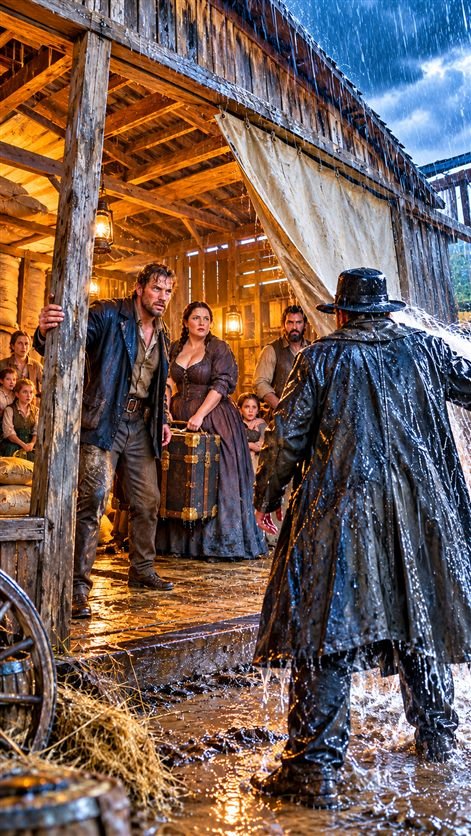
The iron latch of the grain shed cut into Caleb’s palm as the rising floodwaters below slammed another uprooted cedar against the footings, threatening to tear the temporary refuge from the hillside. If the river claimed this slope tonight, four strangers who had crossed half a continent to become his family would drown in the dark before they even learned to share a hearth.
The cold Nebraska rain beat a frantic tattoo against the corrugated tin roof of the grain shed, drowning out the murmurs of the displaced families huddled along the damp interior walls. Outside, the dark, swollen current of the river tore at the edges of the ridge road, gnawing away the last tether connecting this isolated refuge to the rest of the county. Caleb Penrose stood near the open double doors, his wool coat soaked through to the skin, watching the muddy gray waves churn against the foundation stones. His knuckles were raw and white where he gripped the wooden frame, the bitter taste of silt and failure stinging the back of his throat. He had promised his brothers a fresh start, had promised the marriage agency a capable farmer with a finished home, and instead he had delivered them all into a watery purgatory with nothing to offer but wet grain and hollow excuses.
Behind him, the rustling of straw and the quiet, heavy breathing of exhausted travelers filled the damp air. His three brothers were sitting near the rear wall, trying to coax a feeble warmth from a small brazier of dry corncobs. Harlan, the eldest and most pragmatic, was methodically sharpening a skinning knife with a oil stone, his jaw set in a hard, stubborn line. Peter, whose gentle disposition had always made him the caretaker of injured animals and stray dogs, was staring blankly at a bouquet of wild asters he had picked that morning, now bruised and broken in his fist. Nathan, barely nineteen and shivering violently in his thin shirt, kept glancing toward the corner where the four women sat in absolute, unbroken silence.
Four brothers had gone down to the muddy landing expecting four mail-order brides recruited by a distant agency in Chicago, each dreaming of a domestic salvation that would civilize their rough-hewn bachelor lives. Instead, they had found four women who looked almost unsettlingly alike, bearing identical features of dark hair, sharp cheekbones, and unyielding eyes. They had stepped off the ferry not as hopeful maidens eager to admire the sunset, but as an impenetrable phalanx guarding a single, water-stained steamer trunk. Not one of the women would let the heavy leather-bound box out of her sight, clinging to its battered brass corners as if the vessel held their very souls. When Caleb had first reached for the trunk to help lighten the sinking boat, the tallest woman, Adeline, had pinned him with a glare so fierce it had momentarily stopped his breath.
Caleb turned away from the storm and walked back toward the women’s corner, his heavy boots squelching against the mud-tracked floorboards. The atmosphere around them was thick with a heavy, unspoken tension that even the crying children and frightened livestock in the shed seemed to respect. Adeline sat with her back straight against the rough timber wall, her hands resting flat and protective over the lid of the trunk. Her three sisters flanked her like sentinels, their dark eyes tracking Caleb’s every movement with a wariness that bordered on hostility. They had barely spoken three words since leaving the ferry, save for quiet, sharp consultations among themselves in a dialect that Caleb could not quite place, though it sounded faintly eastern, clipped and careful.
Caleb stopped a few paces away, mindful not to crowd them, though space in the crowded shed was a luxury none of them possessed. He wiped a hand across his wet forehead, smearing mud and rainwater over his brow.
We are going to lose the grain if the water rises another foot tonight, Caleb said quietly, pitching his voice so only the sisters could hear. My brother Harlan has a wedge of dry ground further up the ridge behind the old limestone kiln. We can move the bedding up there before full dark if we pack light.
Adeline did not blink. Her gray eyes, remarkably clear in the dim, lantern-lit gloom of the shed, studied him with an exhausting intensity. And the trunk, Mr. Penrose? Does your dry ground accommodate luggage that cannot be replaced?
Caleb let out a slow, heavy breath, feeling the ache in his ribs from where he had heaved the flour sacks off the ferry earlier that afternoon. I told you down at the landing. We left half our winter provisions in the mud because there wasn’t room for them and your box. My brother Peter carried those flowers for three miles because he wanted to make you feel welcome. We have given up everything we brought down that hill, and still you look at us as if we are jailers.
The second sister, whose name he had learned was Clara, shifted slightly, her fingers twitching toward the hem of her dark wool skirt. You do not know what is inside, she whispered, her voice carrying a dry, raspy edge that suggested days without water. If we leave the trunk behind, we leave ourselves. It is as simple and as brutal as that.
Nathan appeared at Caleb’s elbow, holding a tin cup of lukewarm chicory water. He offered it hesitantly to Clara, his young face earnest and open in a way that made Caleb’s heart ache with protective dread. Here, he said softly. It is not much, but it warms the chest.
Clara stared at the tin cup for a long moment before taking it with stiff, trembling fingers. Her skin was unnaturally pale, bruised-looking under the eyes, a stark contrast to the healthy, sun-browned farm girls Caleb was accustomed to seeing in the Platte River valley.
Before Caleb could press the matter of the trunk further, a commotion near the entrance of the shed drew their attention. The heavy canvas flap was shoved aside, letting in a violent gust of wind and stinging spray. A man stood framed in the opening, bundled in a sodden canvas slicker that dripped muddy water onto the floorboards. He was older, thick-set, with a bowler hat pulled low over a narrow, sharp-featured face that seemed entirely out of place in the rugged wilderness of the Nebraska frontier. He shook water from his brim like a wet hound and peered around the crowded shelter, his small, dark eyes darting from face to face with professional greed.
Looking for travelers from the east packet, the man called out, his voice sharp and carrying easily over the roar of the river. Four females. Traveling alone with a brown leather trunk with brass corners. State authorities are offering a reward for information leading to their whereabouts.
A collective hush fell over the grain shed. Families huddled closer together, pulling their children out of the newcomer’s line of sight, retreating into the instinctive tribalism of the frontier where strangers were almost always harbingers of trouble.
Adeline froze. The color drained entirely from her face, leaving her skin the gray-white of river limestone. Her hands clamped down so hard on the lid of the trunk that her knuckles turned translucent. Beside her, the youngest sister, a slight girl named Martha whose hair was braided with faded ribbons, let out a tiny, choked sob and buried her face in Clara’s shoulder.
Caleb stepped half an inch to his left, casually shifting his broad frame to block the newcomer’s line of sight toward the women’s corner. He hooked his thumbs into his belt, affectation of casual rural slowness masking the hard spike of adrenaline drilling into his chest.
Mister, you are a long way from the county seat, Caleb said, his voice level and entirely devoid of hospitality. The roads are washed out back to the junction. If you are looking for passage across the river, the ferryman tied up his boat hours ago.
The stranger squinted through the dim light, trying to peer around Caleb’s shoulder. I am not looking for a boat, friend. I am looking for four runaway wards of the state who skipped out on a court-ordered transfer out of Philadelphia three weeks ago. They are carrying stolen property belonging to the Commonwealth.
The silence in the shed grew so heavy that the patter of rain on the tin roof sounded like rattling gravel. Harlan rose slowly from his place by the brazier, the skinning knife still in his hand, though he held it loosely at his side with the blade turned down. Peter stood beside him, his expression hardening from gentle sorrow into a quiet, dangerous resolve.
Caleb did not look back at his brothers. He kept his eyes locked on the stranger in the doorway. There are no runaways here, mister. Just homesteaders waiting out a June flood. You want to find criminals, you had better retrace your steps back to the railhead before the bridge goes out.
The agent, recognizing the solid wall of four large, wet, armed farm boys standing between him and the dark corner of the shed, weighed his options. The river outside was still rising, drumming a frantic warning against the pilings. He cursed under his breath, pulled his slicker tighter around his throat, and backed out into the rain, letting the canvas flap slam shut behind him.
For several seconds, no one moved. The storm raged on, but inside the shed, the air felt thin and exhausted.
Caleb turned slowly to face Adeline. She was staring down at the wooden slats of the trunk, her breath coming in shallow, ragged gasps. The newspaper clipping that Caleb had glimpsed earlier—the one with the four small portraits and the dark block of text—was half-peeling out from beneath the frayed lining where she had frantically tried to tuck it away.
You heard him, Caleb said quietly, his voice devoid of accusation, filled only with a heavy, aching curiosity. State wards. Stolen property.
Adeline looked up, and for the first time, her formidable composure cracked. Tears spilled silently over her lashes, tracking clean paths through the soot and dust on her cheeks. She did not wipe them away. She simply reached out, hooked her fingers under the edge of the lining, and pulled the folded newspaper entirely free, holding it out to him like a confession written in blood.