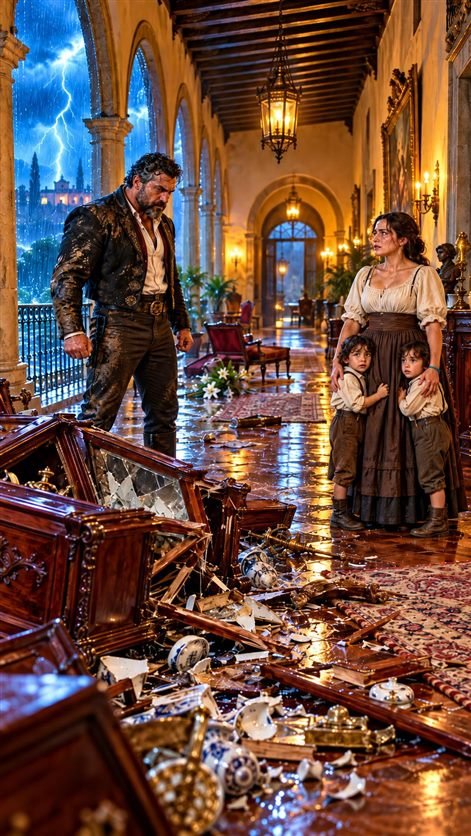
The shattered glass of the mahogany cabinet tore through the heavy silence of the Jalisco night, leaving the two boys huddled in a pool of dark, spreading liquid that Don Mateo instantly knew was not wine. In the stifling corridor outside the master suite, the rancher’s breath hitched as he stared down the barrel of a polished revolver held in a trembling, familiar hand.
The rain hammered against the massive stone facade of Santa Aurora Ranch, turning the Highland soil into a treacherous mire. Inside, the grand corridors—usually as silent and lifeless as a mausoleum since the death of Doña Lucía three years ago—were alive with the kind of frantic energy Don Mateo Arriaga had never expected to witness again. Only two weeks earlier, he had stormed into his immaculate kitchen, furious at the sight of his sons sitting on the flagstones with soapy pots and wet rags, laughing with a wild, infectious abandon that felt like a direct assault on his grief-stricken household. That afternoon, he had banished them to their rooms and bellowed at the young widow, Rosa Morales, whose only crime had been bringing a fragile pulse of warmth back into a place that had forgotten how to breathe.
Don Eusebio Montelongo, the silver-haired administrator who had managed the ranch’s finances and iron discipline for three decades, had warned Mateo from the very first day that outsiders brought complications. Yet it was not Rosa who had brought chaos to Santa Aurora; it was the suffocating weight of Mateo’s own silence, a silence he had worn like armor ever since Lucía took her last breath without him shedding a single tear. The townspeople whispered of Don Mateo’s iron constitution, praising his stoic resilience, but his nine-year-old twins, Julián and Diego, had withered inside that emotional fortress. They had stopped running, stopped asking questions, and eventually stopped speaking altogether, retreating into a gray world that no expensive physician or imported medicine could touch.
Then Rosa arrived, carrying little more than her small son Nico and the quiet grace of a woman who had already lost everything when her husband Aurelio succumbed to typhus. She did not challenge the ranch’s strict hierarchy. Instead, she slipped through the heavy oak doors like sunlight through a cracked shutter, offering Julián a raw piece of piloncillo to sweeten his bitter afternoons and brewing warm atole for Diego when night terrors kept him awake. She listened when no one else would. One afternoon, Julián had pointed to the faded blue bracelet with three knots tied around her wrist, asking why she never took it off. Rosa had smiled with a deep, sorrowful resonance that lingered in the boy’s mind, explaining how she had tied that very thread when Nico was at death’s door and she had no money for a doctor, vowing never to leave him.
Those simple threads of empathy had quickly woven themselves around the boys’ hearts, much to the alarm of Doña Mercedes, Mateo’s imperious older sister who visited from Guadalajara specifically to police the family’s social standing. Mercedes had cornered Mateo in the library, her sharp eyes flashing with disdain as she poured brandy into a crystal tumbler. She warned him that the kitchen help was overstepping her boundaries, planting the seed of suspicion that Rosa was deliberately engineering a surrogate motherhood to secure a permanent foothold in their estate. The poison took root in Mateo’s guarded mind. When Julián proudly placed a tiny blue thread on the white damask dinner table one evening—explaining that Rosa said it helped when your heart hurt—Mateo had felt a sudden, violent surge of displacement. His enormous wealth had purchased the finest livestock, the most sprawling pastures, and every material comfort known to the province, yet a penniless widow had effortlessly bought what he could not: his children’s comfort.
That realization had driven Mateo to the brink of madness, trapped between his icy public persona and the raw, festering void inside his chest. He had resolved to dismiss Rosa at the end of the month, convincing himself it was for the good of the estate’s discipline, even as the prospect filled him with a strange, unaccountable dread. But the ranch’s deep isolation in the Tepatitlán highlands meant secrets rarely stayed buried in the valley. Two nights after the dinner table confrontation, the heavy iron front gates—usually bolted shut against the nighttime rustlers who prowled the Jalisco hills—creaked open under the weight of an uninvited guest whose arrival would violently shatter whatever fragile peace remained at Santa Aurora.
It began with the frantic barking of the guard dogs near the stables, followed by the dull, rhythmic thud of hoofbeats splashing through the rain-soaked courtyard. Mateo had bolted upright in his massive carved-wood bed, his hand instinctively reaching for the heavy-caliber pistol resting on the nightstand. Before he could pull on his boots, a frantic pounding shook the front doors, accompanied by a voice that made the blood run cold in his veins—a voice belonging to a man Mateo had not seen in five years, a man supposedly rotting in a federal penitentiary far to the south.
Ignacio Fuentes. The former partner who had embezzled half the ranch’s capital before vanishing into the criminal underworld of Michoacán.
Mateo had thrown open his bedroom door just as Eusebio rushed up the grand staircase, his face pale as chalk, gasping that the back perimeter fence had been cut. But before the administrator could offer details, a masked figure emerged from the shadows of the upper landing, a cold steel blade gleaming in the dim wall sconce light. It was not Ignacio himself, but one of his ruthless enforcers, come to finish a decades-old grudge regarding land deeds that Mateo thought he had legally secured. The intruder lunged with terrifying speed, forcing Mateo backward into the dark corridor while Eusebio stumbled and fell against the banister.
The struggle was vicious and silent, a desperate dance of muscle and desperation on the polished oak floors. Mateo managed to wrench the blade away, but the intruder had already triggered the panic alarm connected to the estate’s secondary safe room, where the family archives and gold reserves were kept. Footsteps echoed from below as the household awoke. Rosa appeared at the end of the hallway, her face white with terror as she clutched little Nico tightly to her chest, whispering frantic reassurances to the boy while trying to guide the twins toward the safety of the linen closets.
“Stay back!” Mateo roared, his voice cracking with a raw, desperate fear he had not felt since the day Lucía died. He shoved the intruder away, but the man pulled a heavy iron fireplace poker from a nearby decorative stand, swinging it with bone-crushing force toward Mateo’s head. At that exact moment, a small, dark shadow darted across the floor. Julián, ignoring his father’s previous orders to stay hidden, threw himself directly into the path of the swinging iron, aiming a heavy brass candlestick straight at the intruder’s shins. The man cursed, losing his balance on the slick wood, and crashed down hard, shattering the antique mahogany display cabinet that held generations of Arriaga family porcelain.