He looked them dead in the eye, wiped his sweat-beaded brow with the back of a flour-dusted forearm, and said clearly: “Abby built this.”
By noon, the cash box rattled with over a hundred dollars in hard silver and crisp greenbacks. By the time the autumn sun dipped below the jagged western horizon, painting the Kansas sky in bruises of purple and gold, the count had reached an astonishing $214.
The climax of the day arrived just as the lanterns were being lit. A heavy-set man in a tailored wool suit—a regional purchasing manager for the Union Pacific railway lines—sampled a heel of Abby’s warm honey-apple sourdough, closed his eyes, and chewed slowly. Within five minutes, he had produced a contract from his leather folio.
A six-month supply agreement. Forty artisanal loaves delivered every single week to the railway construction camps up north.
It was a financial lifeline of staggering proportions. For the first time in its blood-soaked, debt-ridden history, the Callahan Ranch possessed a future that did not depend on Silas Mercer, local banks, or the mercy of the weather.
Yet the most transformative moment of the day happened far away from the cheering crowds, on the bumpy, dust-choked wagon ride back to the ranch under a canopy of blazing stars.
The horses plodded steadily along the rutted track, the rhythmic creak of the wagon bed providing a soothing counterpoint to the quiet night. Nate reached over, resting his calloused hand on the wooden seat between them, his eyes fixed on the horizon.
“I want Whitmore Kitchen registered in your name,” he said quietly, his voice devoid of pride, filled only with a raw, hard-earned humility.
Abby turned her head, the stenciled moonlight catching the sharp plane of her cheekbone. She stared at him in the darkness, her breath hitching. “Mine?”
“You built it,” Nate said, turning to look straight into her eyes, letting her see every barred door of his heart standing wide open. “You own it. And I should have understood that a hell of a lot sooner.”
The man who had once dragged her to a failing ranch under the cynical delusion that a wife existed merely to sweep his floors and keep his accounts was now actively helping his wife forge an empire that belonged exclusively, undeniably to her.
*
Weeks bled into the crisp bite of late autumn. The debt was restructured under the railway contract, Mercer’s false tax claims on Abby’s twelve private acres were thrown out of the Harding circuit court with prejudice, and the ranch breathed a deep, collective sigh of relief.
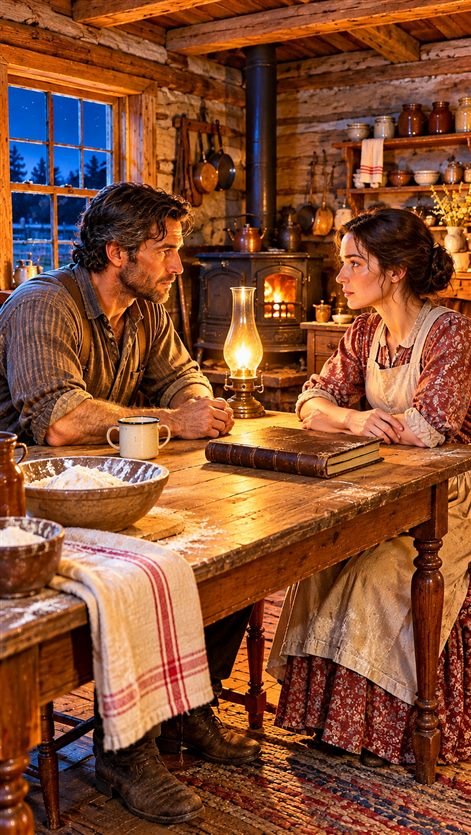
The kitchen was quiet now, save for the steady, rhythmic ticking of the wall clock and the soft hiss of the wood-burning stove settling into its coals. Nate sat across the scarred wooden table from Abby, the yellow glow of the hurricane lamp cutting deep shadows across his weathered face.
“When you first came here,” Nate murmured, staring down at his broad hands, “I thought I needed a wife because the ranch needed managing.” He swallowed hard, his throat tightening as he forced the confession past his teeth. “I was wrong.”
Abby did not move. She sat with her hands folded over her ledger, her expression unreadable, waiting for him to finish the journey he had started weeks ago in the dark.
“I love you,” Nate said, the words finally breaking free, heavy and absolute, carrying the weight of every wall he had torn down. “I’m not asking you to stay because you married me under some legal contract. I’m asking whether, if you were completely free to choose again… would you still choose this life with me?”
Silence stretched across the room, thick and pregnant with possibilities.
Abby let her gaze wander slowly around the kitchen. She looked at her leather-bound ledger, filled with neat columns of her own hard-won profit. She looked at the heavy crockery bowl where her grandmother’s sourdough starter bubbled quietly, alive and thriving. She looked at the business papers, the legal deeds, the iron skillet she had scrubbed with her own hands—everything that belonged to her, not by marriage, not by inheritance, but because she had fought tooth and nail to keep it that way.
Then, she raised her eyes and looked directly at the man across the table.
She saw the proud, stubborn rancher who had tried to lock the world out, but she also saw the man who had picked up an axe, washed greasy pans, and surrendered his stubborn dominance to stand beside her as an equal. He had finally learned the hardest lesson of his life: love was not a possession to be managed or a house to be kept. It was a partnership forged in fire and mutual respect.
A slow, knowing smile touched the corners of Abby’s mouth.
“I have one condition,” she said, her voice steady and clear in the quiet room.
Nate’s breath caught, a flicker of nervous tension flashing in his eyes. He braced himself, willing to pay any price she named. “Name it.”
Abby leaned forward, resting her elbows on the scarred wood, her dark eyes shining with quiet triumph. “You wash the baking pans every single Tuesday night for the rest of our natural lives.”
For a long, suspended second, Nate stared at her in stunned silence. Then, a slow, deep chuckle broke from his chest—a rich, genuine sound that chased every ghost from the old house.
He reached across the table, sliding his large, rough hand over hers, sealing a pact far stronger than any legal document ever written.
“Every Tuesday,” Nate promised, squeezing her fingers. “And twice on Sundays.”