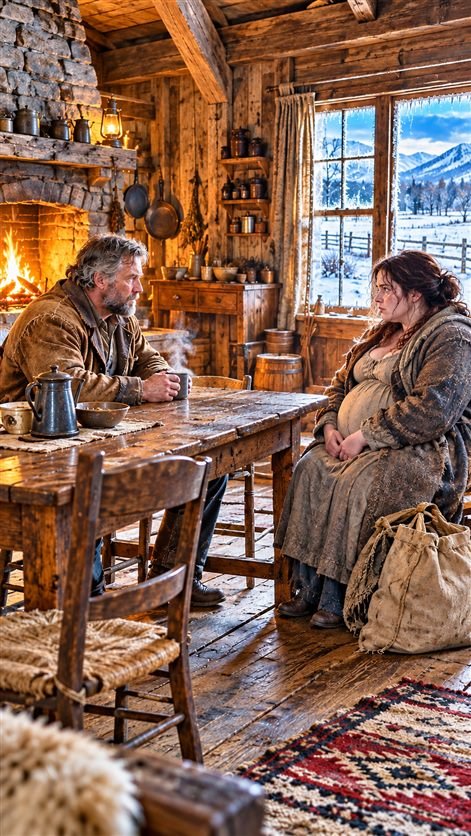
The cold morning air bit through her thin sweater as she stared down into the empty wooden crib, wondering whose blood stained the floorboards. She had only wanted a warm place to sleep, but the shadows in the farmhouse were hiding something far more sinister than a grumpy old man.
By Friday afternoon, I had stopped being afraid of hunger. There was something far more terrifying gnawing at my insides, a cold and creeping dread that transcended the mere absence of food. My unborn baby had not moved since morning. Not once. I kept telling myself the child was sleeping, that active growth sometimes required long stretches of motionless rest, but deep beneath my ribs, a terrible instinct whispered otherwise. It told me that the quiet inside me was not the quiet of peace, but the silence of an ending. I had already knocked on three doors in the village behind me, desperate for shelter, for a coin, for a fraction of human decency. The first door slammed shut in my face before I even finished asking for work, the heavy oak vibrating with finality. At the second, a woman with tight, suspicious eyes cracked open her screen door just enough to push a single copper coin out toward me as though poverty were a highly contagious disease. At the third, no one answered my frantic, bleeding knuckles, though I heard the distinct metallic click of a deadbolt sliding into place from the inside.
So I stopped begging. I walked. Soon the town vanished behind me, swallowed by the gray embrace of an encroaching autumn afternoon. My nearly empty canvas bag dragged heavily against my shoulder, scraping my hip with every step. My feet throbbed inside worn, paper-thin shoes that offered no protection against the freezing dirt, and my winter coat could no longer close around my swollen, aching belly, leaving me exposed to the sharp, unforgiving wind. Then the wind carried something unexpected across the barren landscape. Peaches. It was a rich, heavy scent that seemed entirely out of place in this desolate region. It was sweet at first, carrying memories of warmer months and orchards heavy with summer sun. Then it turned sour, sharp and vinegary, the unmistakable odor of fermentation and rot. I crested a small rise and saw it. An orchard gate stood half open, its rusted hinges groaning in the breeze. Hundreds of peaches lay split and rotting beneath the gnarled trees, their bright flesh turning brown and buzzing with insects, while more sagged heavily from neglected branches, overripe and darkening like bruises against the gray sky.
I had worked in commercial kitchens for eleven years before the restaurant went under and my life unraveled. I immediately understood what I was seeing. It wasn’t merely spoiled fruit scattered by bad weather. It was an entire winter’s food supply being wasted, thousands of pounds of potential nutrition left to rot into the earth because there was no one to harvest it. Then I noticed the rancher sitting on the porch of the dilapidated farmhouse nearby. He wasn’t reading, or smoking a pipe, or tending to tools. He simply stared across his dying land with the hollow, defeated expression of a man who had already lost too much to expect anything better from the world. I stood at the edge of the orchard for a long moment, weighing my exhaustion against my desperate need. Pride had brought me this far, keeping me upright through three rejections and miles of gravel roads. But pride wouldn’t feed my baby. Pride wouldn’t bring life back to the still weight beneath my ribs. I gathered the last tattered shreds of my courage and walked up the creaking wooden steps toward the porch.
You are losing your winter stock, I said, my voice hoarse from the wind. His eyes moved slowly from my face down to my worn canvas bag, then finally rested on my protruding stomach with a dull, unreadable gaze. I can save what is left, I continued, stepping a little closer despite my trembling knees. Dry it. Preserve it. Turn it into enough food to last you through the winter months. He remained entirely silent, as if words were a luxury he could no longer afford. I swallowed hard, feeling the bitter taste of defeat rising in my throat. If you let me stay, I whispered, my voice breaking slightly, until the baby comes. For a long, agonizing moment, he studied me, searching my features for lies or hidden dangers. Finally, Luke Mercer spoke, his voice like grinding stones. There is nothing here for you. Try town. I didn’t tell him I already had. I didn’t have the strength to explain that town was a graveyard of locked doors and cold shoulders. Instead, without another word, I turned away from the porch and walked toward an old, weathered storage shed tucked beneath the shadow of the peach trees.
Inside were dusty shelves covered in cobwebs, empty wooden crates stacked haphazardly, a few forgotten canning jars, and a dry, splintered wooden floor. That was enough. That was sanctuary. I spread my thin winter coat over the rough boards and carefully lowered my aching body down, curling my aching frame around my center. Then, just before sleep finally claimed my exhausted mind, the baby moved. Once. A faint, unmistakable flutter against my palm. I wrapped both arms tightly around my belly, breathed a shaky sigh of relief, and closed my eyes. Before sunrise, I was awake, shivering in the predawn chill. By the dim light of a kerosene lantern I had found on a dusty shelf, I began sorting the peaches. Good ones. Spoiled ones. Bruised but salvageable ones that could be cut and dried. My fingers moved with the practiced speed of my old kitchen days, sorting through the sticky, fragrant decay. Footsteps eventually crunched on the gravel outside, stopping abruptly in the open doorway. About forty percent is still good, I said without looking up, my hands working steadily. Maybe more underneath if we start hauling them in now.
Luke stood in the doorway, his silhouette dark against the lightening sky, staring down at the meticulously organized crates I had filled during the night. Then his gaze dropped to my folded coat on the floor, noting the makeshift bed I had carved out of the abandoned space. Without a word of acknowledgment, he turned away into the shadows. Minutes later, strange, muffled sounds drifted from the main house. Boxes scraping across wooden floorboards. Heavy furniture being dragged. A door opening and closing with a dull thud. When the morning cold finally stiffened my fingers to the point of numbness, I carried a heavy crate of salvaged fruit toward the kitchen, hoping to find a stove to warm my hands. And I stopped dead in my tracks. The small room adjacent to the kitchen, which yesterday I had seen piled high with dusty cardboard boxes and old newspapers, was wide open. Now it was completely empty. Against one bare wall stood a narrow, sturdy wooden bed. On top of it lay a freshly laundered, neatly folded wool blanket.
I stared at the room, my breath catching in my throat. Luke had never explicitly said I could stay. He hadn’t offered a single word of comfort since I arrived. He hadn’t spoken a single kind or welcoming phrase. Yet somehow, silently and without fanfare, a room was waiting for me. I stood there for a long time, the heavy crate of peaches biting into my arms, wrestling with the strange, jarring kindness of a man who looked like he had forgotten how to feel. Slowly, cautiously, I set the crate down and began to quietly make coffee on his old stove, placing a steaming mug on the scarred wooden table. Luke entered the kitchen a few minutes later, his face gray and lined with fatigue. He looked at the coffee, then slowly pulled out a chair and sat down. Outside, the gray morning fog swallowed the remaining orchard trees, wrapping the world in a damp, isolating blanket of white. Inside, the wood stove crackled softly, casting a warm, flickering glow across the room. Neither of us spoke for a long time, the silence filled only by the hiss of the fire.
Then Luke wrapped both of his large, calloused hands around the steaming mug, drawing the warmth into his frozen fingers. His heavy eyes lifted slowly, fixing directly upon mine. Something in his expression had shifted, an invisible wall cracking ever so slightly. And when he finally opened his mouth, he asked the one question I had been praying from the bottom of my soul he would never ask. How long have you been carrying that bag, Clara? His voice was too soft, entirely devoid of the gruff harshness he had used the night before. I froze, my hand hovering over the edge of the kitchen counter. My name isn’t Clara, I said, my voice dropping to a nervous whisper. You never asked my name. My name is Sarah. Luke didn’t flinch. He didn’t look surprised. Instead, he took a slow, deliberate sip of his coffee, his eyes never leaving my face. Clara used to make coffee like that, he said, his tone flat, distant, carrying the weight of a ghost. Every morning at dawn, right after checking the south orchard. She left two years ago. Said the isolation was driving her mad. But she left her canvas bag on the porch when she ran off into the night.