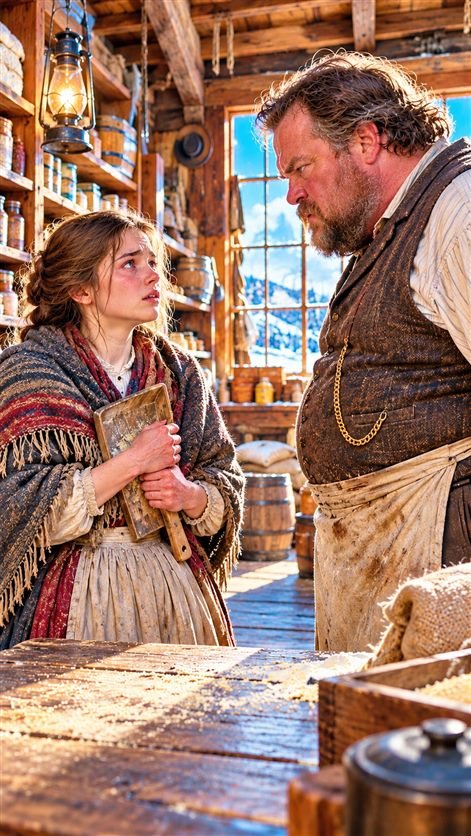
Justice delayed is merely a cruel prelude to an astonishing reckoning. She was cast aside as a worthless burden, yet she possessed the quiet strength that would ultimately reshape an empire.
*
The grease-spotted tallow candle sputtered on the rough-hewn pine counter, throwing long, skeletal shadows across the lard-stained flour sacks. Philippa drew her wool shawl tighter around her thin shoulders, shivering against the biting draught howling through the warped floorboards of the Elkhorn Mercantile. Her knuckles, split and raw from eighteen-hour shifts scrubbing horse-troughs and salting pork barrels, throbbed in rhythm with her heartbeat.
“Don’t you dare scrape the barrel bottom, you clumsy little charity case,” bellowed Barnaby O’Shea, his massive frame blocking the flickering amber glow of the lantern. His heavy gold watch chain swung menacingly across his protruding belly as he stepped closer, the sharp smell of stale bourbon and cheap bay rum preceding him. “That cornmeal is for paying customers, not for orphans who couldn’t earn their keep if their lives depended on it.”
“I was only sweeping up the spillings, Uncle Barnaby,” Philippa whispered, her voice cracking from days of enforced silence. She clutched a splintered wooden dustpan to her chest like a shield.
“Silence!” Barnaby struck the counter with a ham-like fist, sending a cloud of white dust swirling into the air. “You owe this family every drop of sweat for the roof over your head and the scraps off our plates! Now take that slops bucket out to the pigpen before I find a proper use for that switch behind the door.”
Humiliation burned behind Philippa’s eyelids, hotter and sharper than the winter frost scraping at the glazed windowpanes. For four agonizing years, ever since her father’s mysterious death left her penniless and entirely at the mercy of her mother’s bullying half-brother, she had endured this slow erasure of her spirit. Barnaby treated her as a half-witted drudge, a convenient drudge who worked from dawn until midnight without pay, comfort, or kindness. The townsfolk of Pine Valley looked through her as if she were made of glass, whispering behind her back about her impoverished lineage and her lack of prospects. She was twenty-one years old, her hands ruined, her youth fading into the shadows of a mercantile storehouse, and her soul quietly starving for a single kind word.
With trembling fingers, she picked up the iron-handled slops bucket and trudged toward the heavy back door. The snow outside was knee-deep, sparkling coldly under a brilliant Wyoming moon in the bitter winter of 1884. As she stepped off the porch into the freezing drift, a dark, imposing shadow detached itself from the hitching post. A tall man, broad-shouldered and wrapped in a heavy buffalo-hide coat caked with frost, stood holding the reins of a magnificent bay gelding. His face was weathered, deeply lined by harsh winters and solitary mountain air, with striking amber eyes that caught the moonlight.
It was Thaddeus Vance, the reclusive owner of the High Laramie Cattle Ranch up in the foothills. Rumor in town said he was a hardened, silent widower who spoke only to his horses and bought supplies without exchanging more than three syllables. Yet as Philippa stumbled on a frozen rut and nearly spilled the slops, strong, calloused fingers caught her elbow before she hit the ice. His grip was firm, steady, and utterly respectful—not the crushing, cruel grasp of her uncle.
“Careful, miss,” Thaddeus said, his voice a low, gravelly baritone that seemed to vibrate straight through her chilled bones. He didn’t let go immediately, but looked down at her red, chapped hands, then up into her wide, startled eyes. There was no pity in his gaze—only a piercing, intelligent assessment that made Philippa feel, for the first time in years, entirely visible. “A night like this can freeze a person right down to the bone. You shouldn’t be out here without proper boots.”
“My uncle says boots cost more than my labor is worth, Mr. Vance,” Philippa murmured, looking down at her split leather shoes, stuffed with rags.
Thaddeus’s jaw tightened, a muscle jumping in his stubbled cheek. He glanced back toward the glowing mercantile window where Barnaby’s silhouette loomed. Without another word, the rancher reached into his heavy wool coat, pulled out a pair of thick, lined elk-hide mittens, and pressed them gently into her frozen palms. “Keep those. And tell O’Shea his freight delivery from Cheyenne is delayed until Tuesday. I’ll be back then.”
Before Philippa could stammer a reply, he swung effortlessly into his saddle, turning his mount into the swirling wind. She stood in the snow, the warm elk-hide mittens pressed against her burning cheeks, watching him ride away into the dark frontier night. It was the first act of uncalculated kindness anyone had shown her since her father died.
Three days later, during the bustling Tuesday midday market rush, Thaddeus Vance returned. Instead of heading straight to the counter, he walked directly to the back storage alcove where Philippa was desperately trying to inventory a shipment of heavy iron skillets. Barnaby was hovering nearby, oily smile plastered across his face, eager to flatter the wealthiest landowner in the county.
“Vance! Fine afternoon, fine afternoon,” Barnaby brayed, wiping his palms on his greasy apron. “Can I interest you in some prime salt pork or perhaps a new harness rig?”
Thaddeus ignored the merchant entirely. He leaned against the rough wooden shelf, looking down at the ledger book open before Philippa. The book was a mess of smudged ink and crossed-out figures, a deliberate trap set by Barnaby to prove her incompetence. Yet Thaddeus’s amber eyes noticed something else: neat, precise calculations squeezed into the narrow margins where Philippa had meticulously corrected her uncle’s deliberate accounting errors.
“You calculated the freight tariffs incorrectly by four dollars and thirty cents per hundredweight, O’Shea,” Thaddeus said quietly, his voice cutting through the noise of the store. “Or rather, your ledger claims you did. But Miss Philippa’s marginal notes here show the correct ledger balance down to the penny.”
Barnaby’s face flushed a mottled, furious purple. “That girl doesn’t know a cipher from a plowshare! She’s simple-minded—”
“She has a sharper mind for numbers than you have for honesty, Barnaby,” Thaddeus interrupted, standing up to his full, intimidating height. He turned his gaze to Philippa, his expression softening with a startling gentleness. “I need a capable bookkeeper and manager for the High Laramie ranch house. Someone who can keep the hands honest and the accounts straight. I’m offering forty dollars a month, full board, and a private room in the main house. Do you accept, Philippa?”
The silence in the mercantile became absolute. Several customers near the cracker barrel stopped chewing. Barnaby sputtered, his mouth opening and closing like a landed trout. “Now see here, Vance! She’s my indentured ward—”
“She is an adult of legal age,” Thaddeus replied coldly, stepping in front of Philippa as if to shield her from her uncle’s wrath. He looked back down at her. “Well, Philippa? Pack your things. My wagon is waiting outside.”
Philippa looked from her furious, sputtering uncle to the rugged, steadfast rancher who had offered her an unthinkable escape. A fierce spark of long-suppressed courage ignited deep within her chest. She closed the ledger with a sharp snap.
“I accept, Mr. Vance,” she said clearly, her voice ringing out in the silent store.
The transition to the High Laramie ranch was nothing short of miraculous, yet it terrified her. Perched in a sweeping, sheltered mountain valley surrounded by towering pines and snow-dusted peaks, the ranch was a sprawling operation of stone, timber, and roaring hearths. Her room was clean, smelling of fresh cedar and lavender soap, featuring a real feather mattress and a tall oak wardrobe. For the first days, Philippa jumped at every sudden sound, half-expecting Barnaby to burst through the door with a wooden switch.
Thaddeus observed her quiet caution with infinite patience. He never forced her to talk about her past, nor did he demand more than honest work. Instead, he showed his care through quiet, meaningful actions: a steaming mug of hot cider left on her desk when she worked late into the night over ranch ledgers; a sturdy pair of handmade leather riding boots waiting on her porch; and, most importantly, the steady, unquestioning trust he placed in her judgment.
Within a month, Philippa was not merely keeping books; she was reorganizing the entire ranch supply system, negotiating fair prices with traveling cattle buyers from Denver, and even tending to minor injuries among the ranch hands with a steady hand and herbal poultices. The rough cowboys, initially suspicious of a woman in the office, quickly learned to respect her sharp intellect and unshakeable fairness.
One crisp spring afternoon, as they sat on the wide front porch watching the sun dip behind the jagged peaks of the Laramie range, painting the sky in strokes of bruised purple and burning gold, Thaddeus finally spoke of his past.
“My wife died five years ago, Philippa,” he said softly, staring out into the darkening pines, his fingers idly turning a silver pocket watch. “In this very house. People in town whispered that I worked her to death, that my silence drove her into the winter storms. They weren’t entirely wrong. I didn’t know how to reach past my own grief to warm her.” He turned his amber eyes toward her, filled with a raw, vulnerable honesty that took her breath away. “I swore I’d never bring another soul into this isolated place to suffer my shadow. But watching you stand up to O’Shea… watching how you carry your dignity through every trial… you brought light back into these old timber walls before I even realized it was dark.”