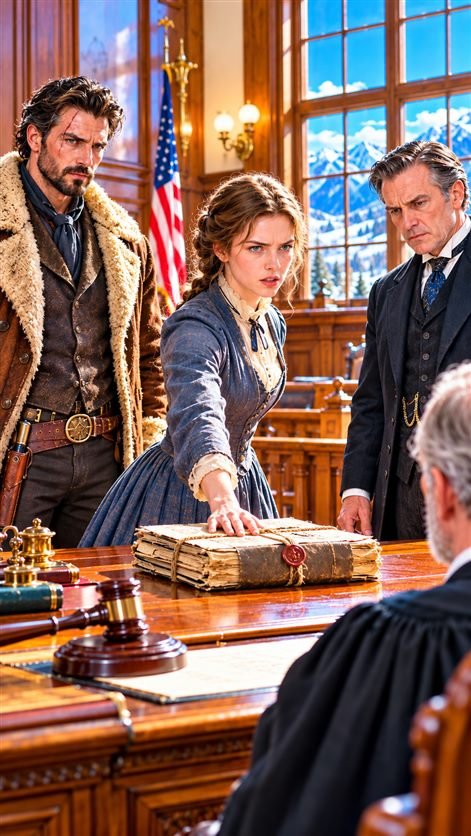
They whispered that a bastard child of sin deserved no more than the stinging bite of an ash-wood switch and the cold draft of a winter storm. Now, the very girl they tried to erase from the ledger of the living has returned to claim not just their mercy, but the entire empire they stole.
*
The ash-wood switch cracked against the frozen floorboards of the cellar, and twenty-year-old Clara Finch flinched, curling tighter around the torn flour sack she used for a blanket. Above her, the heavy boots of her uncle, Arthur Vance, thudded against the kitchen floor of the Vance homestead outside of Laramie, Wyoming.
“Clear out those ashes, Clara, before the morning stage rolls past, or you’ll go another twenty-four hours without so much as a crust,” Arthur’s voice boomed down through the floor grates, harsh and merciless as a prairie blizzard.
Clara did not weep. She had spent the last four years weeping, ever since her mother died in a drafty lean-to, leaving her in the custody of an uncle who viewed her only as a perpetual debt to be worked off. Clara was a slight woman with heavy, dust-brown hair and eyes the startling gray of an oncoming storm, but her spirit had been systematically beaten down by starvation, exhaustion, and relentless humiliation. Her wrists were raw from scrubbing heavy cast-iron skillets with lye soap, and her threadbare wool dress hung off her collarbones like a shroud.
She crawled across the dirt floor of theroot cellar, her fingers brushing against her most prized possession: a small, leather-bound accounting ledger that had belonged to her father, a man Arthur claimed had died penniless and deeply indebted. Clara knew better, though she dared not speak it aloud. She had spent the midnight hours by the flickering glow of a tallow candle studying her father’s neat, meticulous handwriting. She knew every column of figures, every cattle brand, and every land patent that Arthur kept locked away in the upstairs iron safe. She was poor, exhausted, and despised by the townfolk who believed Arthur’s tall tales of her rebellious nature, but she was far from stupid.
When morning broke, dragging a pale, sickly light across the frozen Wyoming plains, Clara hauled the heavy ash bucket out to the side of the road. Her breath plumed in the freezing air. As she emptied the gray soot into the snow, a low rumble of iron-rimmed wheels drew her gaze upward.
A high-sided freight wagon pulled by four massive black Percherons creaked to a halt. Sitting atop the bench was a man whose presence seemed to silence the very wind. He wore a heavy sheepskin coat darkened by snowmelt, a wide-brimmed felt hat pulled low over a face carved from seasoned granite. A jagged, faded scar cut through his left eyebrow, giving him an expression of permanent, brooding severity. This was Julian Vance—no relation to her uncle, despite the shared name—the reclusive owner of the Broken Arrow Ranch, a vast spread stretching deep into the Laramie foothills. Julian was thirty-five, a widower of five years who lived like an anchorite, speaking to few and trusting fewer.
Julian pulled the team to a stop, his piercing dark eyes locking onto Clara. He didn’t look at her with the cruel amusement of the town boys, nor with the cold indifference of her uncle. He looked at her the way a seasoned stockman evaluated a thoroughbred: with quiet, intense assessment.
“You’re Arthur’s niece,” Julian said, his voice a low, gravelly baritone that seemed to vibrate in Clara’s chest.
“I am,” Clara murmured, her chin lifting instinctively despite the humiliating patch on her elbow.
Julian climbed down from the wagon with slow, deliberate grace. He reached into the bed of the wagon, pulled out a thick, dry wool blanket that smelled of cedar and woodsmoke, and walked directly toward her. Before Clara could flinch or step back, he draped the heavy blanket over her trembling shoulders.
“A horse doesn’t work in a freeze without a blanket, Miss Finch,” Julian said quietly, his gaze steady on her wide gray eyes. “And neither should you. Tell Arthur I’m hiring you for the spring calving season at Broken Arrow. Be at my gate by dawn tomorrow, or I’ll come collect you myself.”
Without waiting for an answer, he climbed back onto the wagon and urged his team forward. Clara stood frozen in the snow, the heavy wool radiating a sudden, staggering warmth against her skin.
That evening, when Arthur learned of the proposition, he flew into a rage, smashing a ceramic mug against the hearth. “You think you’re too good for my floor, do you? Julian Vance doesn’t take charity. If he wants you, it’s for cheap labor, and you’ll bring every cent back to this house!”
“I am not coming back, Uncle,” Clara said, her voice dropping an octave, steady and chillingly clear.
Arthur lunged forward, his hand raised to strike her, but Clara didn’t cower. She stepped inside his reach, her eyes flashing with a sudden, fierce intelligence that made the older man pause. She didn’t have a weapon, but she had the ledger tucked securely inside the waistband of her skirt, and for the first time in her life, she realized that her uncle was a coward hiding behind closed doors. She slipped out the back door into the freezing night, walking the four miles toward the foothills under a canopy of blazing winter stars.
*
The Broken Arrow ranch house was a sprawling fortress of hand-hewn pine and river stone, surrounded by corrals that hummed with the energy of a thousand cattle. When Clara arrived at dawn, Julian was waiting on the wide wraparound porch, a steaming tin cup of black coffee in his calloused hand.
He didn’t offer grand speeches. He led her into the warm, spacious kitchen, where a robust housekeeper named Martha set a plate of bacon, eggs, and freshly baked biscuits before her. Clara stared at the food, a lump rising in her throat. She hadn’t eaten a hot meal in three days.
“Eat,” Julian instructed gently, pulling out a chair opposite her. “Then Martha will show you to the dry quarters above the tack room. It’s warm, it has a lock on the door, and no one will bother you.”
For the first two weeks, Clara worked from dawn until dusk, throwing herself into the grueling labor of the ranch with a quiet tenacity that stunned the hired hands. She mucked stalls, branded calves, and mended harnesses with steady, capable hands. But Julian quickly discovered that her true value lay far beyond physical labor.
One evening, as Julian sat at the heavy oak desk in his study struggling over a stack of cattle purchase orders and feed receipts, Clara knocked softly and entered with a ledger of her own.
“Mr. Vance,” she began hesitantly, holding her worn leather book close to her chest. “I couldn’t help noticing the tallies from the Laramie Mercantile. You’re being overcharged on salt-lick blocks by nearly twenty percent. And your freight charges from the railhead don’t match the tonnage.”
Julian looked up, his dark eyes narrowing in surprise. He gestured for her to step closer. For the next three hours, by the amber glow of a kerosene lamp, they poured over the numbers together. Julian watched in quiet fascination as Clara’s finger traced columns of figures with effortless speed, her mind parsing complex arithmetic that had given him headaches for months.
“Where did you learn to cipher like that?” Julian asked, his voice softening as he looked at her face, illuminated by the lamplight.
“My father,” Clara whispered, looking down at her hands. “He was the original bookkeeper for the county before… before he died. He taught me before the world narrowed down to Arthur’s cellar.”
Julian reached across the desk, his warm, heavy hand covering her ink-stained fingers. “Your father was a good man, Clara. And Arthur Vance is a thief.”
The touch sent a jolt of electricity through Clara’s veins. Over the following weeks, their professional partnership blossomed into a profound, unspoken romance. Julian was a man of few words, but his actions spoke volumes. He brought her books from town—volumes of poetry, histories of the frontier, and advanced treatises on agriculture. He watched her with a fierce, protective tenderness that slowly melted the jagged edges of his own guarded heart.
One afternoon in early spring, as the snow melted into rushing mountain streams, Julian took her riding up to a high plateau overlooking the entire Laramie valley. The wind whipped her hair across her face as she reined in her chestnut mare, laughing—a bright, musical sound that Julian had never heard from her before.
He dismounted, walked over to her horse, and reached up to lift her down. Instead of setting her immediately on her feet, he kept his hands on her waist, holding her close against his chest.