The pliers clicked twice against the cold staple before the wind snatched the metallic ping away into the white-fringed cedar breaks.
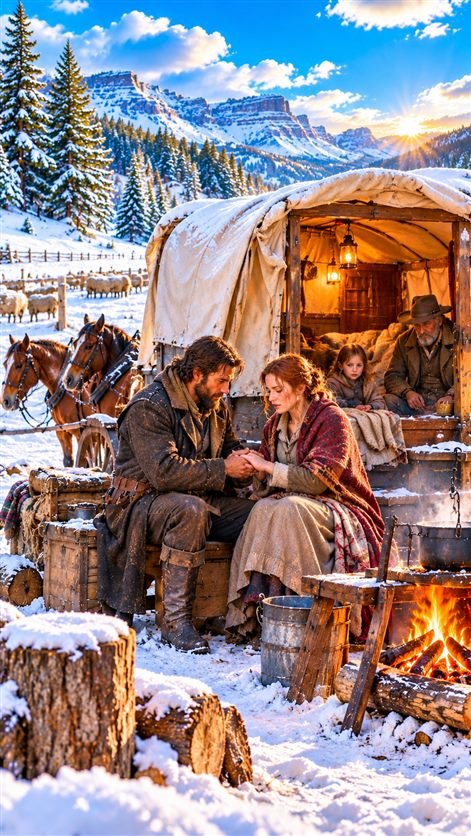
Imogen Sutherland braced her left boot against the base of a post, her stiffened wrist throbbing where an old mill-gate had crushed the bones three winters ago, and hauled upward on the nine-gauge strand until the barbed wire sang a thin, frozen note. The sleet was turning to rime, coating the limestone ledges of the upper Current River valley in a hard, gray glaze that made every step on the slope a hazard. Behind her, seven-year-old Clara huddled beneath a heavy canvas slicker inside the lee of the sheep wagon, blowing on her fingers and watching the treeline where Hargrove’s riders had been seen since noon.
“Pull it taut, Imogen, or the sheep will have the whole span down before moonrise,” Ned called out from the wagon box, where he was lashing down a tarpaulin over the salt blocks. The old teamster’s beard was iced with frozen breath, his skin the color of parsniped clay. “Hargrove didn’t send his ditch-riders out into this norther just to admire our knotwork. They want that spring box dry before the week’s out.”
Imogen did not answer with words; she simply bit the inside of her lip until the metallic taste of iron broke through, and swung the claw hammer with her right hand to drive the staple home. Her palm was blistered raw beneath her wool glove, the hide worn thin where the timber grease had rotted it months ago when she worked the ledger desks for Hargrove’s freight syndicate—before she walked off the job with unpaid wages and a price on her reputation for knowing too much about their water-diversion ledgers.
“Let me take those pliers,” a low, gravel-rough voice said from directly behind her.
Magnus Langford didn’t wait for her to nod. His large, work-roughened hand closed over hers, his skin radiating a dry, furnace-like heat that seeped straight through her wool mittens. With a single effortless heave of his thick forearms, he wrenched the slack out of the wire until the cedar post groaned in its socket, then drove three staples in quick, rhythmic succession. He smelled of woodsmoke, wet wool, and the bitter pine resin of the high Ozark ridge.
“You’ll snap what’s left of those wrist ligaments before we’ve got the perimeter half-strung,” Magnus muttered, his eyes fixed on the darkening timberline where the shadows of the post-oaks stretched long and black across the snow. “Go back to the fire. Ned and I can finish the lower run.”
“The sheep are drifting toward the gully, Magnus,” Imogen said, her voice small and steady against the gale. “If the wire isn’t double-stapled by dark, they’ll break through into the frozen sumac and we’ll lose half the lambs to the timber wolves before dawn.”
“They won’t break through,” Magnus said, turning his head just enough for her to see the hard line of his jaw and the gray-green flecks in his eyes—eyes that looked at her not with the pity she had grown accustomed to in every settlement from Batesville to Yellville, but with a flat, immovable reverence. “Not while I’m standing this fence line. Get inside with the girl. I mean it, Imogen.”
* * *
By midnight, the blizzard had settled into a steady, howling whine that rattled the canvas top of the sheep wagon and sifted fine gray snow through every crack in the cedar-board flooring. Inside, the kerosene lamp cast a yellow, wavering glow over tin plates where a thick, savory potage of venison and wild turnips simmered in an iron pot hung above a small sheet-iron stove, sending up the sharp, rich scent of cracked black peppercorns and dried winter savory.
Clara sat cross-legged on a wool blanket, spooning up broth with a pewter spoon while her eyes blinked heavy with sleep. Ned snored softly from a pallet near the water barrel, his boots propped up close to the stovepipe to dry.
Imogen sat on the bench opposite Magnus, holding a steaming tin cup between her palms. The iron tuning hammer—her only inheritance from her father, who had tuned pianos in the river towns before the fever took him—lay on the rough deal table beside a small box of steel pins. She was rubbing a bit of mutton tallow into her stiff left wrist, her fingers moving in slow, rhythmic circles over the pale, puckered scar tissue.
Magnus watched her hands from across the narrow table. Without a word, he reached out and took her left hand in his, cupping her cold, crooked fingers entirely within his broad palm. He didn’t speak; he simply held her hand steady against his chest, right over his heart, letting the deep, heavy thud of it warm her bones while his thumb traced the stiffened tendon of her wrist with infinite gentleness.
“It won’t ever straighten out all the way,” Imogen whispered, staring down at where his dark woolen sleeve met her frayed cuff. “The bone healed crooked in the press.”
“It does what it needs to do,” Magnus replied, his voice dropping into that low, rumbling register that seemed to vibrate through the floorboards. “You held that wire today. That’s enough for me.”
“Hargrove isn’t just cutting fences, Magnus. I saw the map rolls in his office before I left,” she said, her voice dropping lower so Clara wouldn’t hear. “It’s not about the sheep range. It’s the subterranean limestone flume that feeds the whole valley settlement below the ridge. If he dams the spring head and diverts the water into his company’s timber flume, three hundred homesteaders down-river will be bone-dry by spring planting. That’s why he framed me for the ledger theft—so no one would believe my tally if I went to the circuit court.”
Magnus’s thumb stopped its slow circle on her palm. His gaze hardened, the gray-green light in his eyes turning as sharp and cold as the flint ridges outside. “Then we make damn sure he doesn’t reach the spring head. We’ve got the high ground, and we’ve got the drift.”
* * *
Dawn broke raw and blinding, the sun hitting the crust of the snow with a glare that burned the eyes. At first light, Magnus and Imogen drove the sled down toward the creek bottom where the lower wire met the north ravine, leading old Ned’s team through drifts that reached the horses’ bellies.
The scene at the drift fence made Imogen stop the team short. A dozen head of ewes lay frozen against the lower wire where Hargrove’s men had driven them during the night, their carcasses half-buried in the drift, their gray wool frosted white. A few yards away, three live yearlings stood trembling, their tongues swollen and cracked from biting at the frozen wire and crusted snow.
“Bring the bucket, Magnus,” Imogen said, her voice dropping into a hard, level tone that had no room for grief. “We need to clear this span before the rest of the flock crowds down.”
Magnus jumped down from the sled, his boots crunching through the crust. With a few swift strokes of his axe, he notched the frozen fence post and pried the lower wire loose while Imogen knelt in the snow beside the nearest yearling, opening her canvas bag to pull out a flask of warm willow-bark tea and a jar of rendered mutton fat.
She worked with quiet, practiced concentration, her stiff fingers moving with surprising dexterity as she swabbed the cracked, bleeding tongue of the frightened animal with the soothing fat, speaking low and steady to it until the sheep’s frantic trembling subsided into a soft, rumbling breath.
Magnus stood above her, holding a heavy Henry rifle in the crook of his arm, watching the way the pale winter light caught the red-gold strands of hair escaping from her knitted wool cap. He didn’t offer to take the rag from her; he simply stood guard against the gray cedar line, a massive, unyielding wall between her and the timber.
“You’ve got more grit in your little finger, Imogen Sutherland, than half the marshals they send out of Little Rock,” Magnus said, his eyes scanning the ridge.
“Grit doesn’t pay back wages, Magnus,” she said, looking up at him with a faint, dry shadow of a smile. “And it doesn’t clear a name once a syndicate judge signs an injunction.”
“We aren’t done yet,” he said.
Just then, a sharp, metallic clatter echoed from up the ravine—the unmistakable sound of a horse’s iron shoe striking a limestone boulder. Through the gray sumac thickets rimed with frost, three horsemen appeared on the ridge above the creek, leading a pack mule loaded with heavy iron wedges and sledgehammers. At the head rode Hargrove himself, his silver-mounted riding crop catching the pale sun, his coat smelling faintly of expensive cedar-scented hair oil even across fifty yards of freezing air.
” Langford!” Hargrove shouted across the draw, his voice carrying thin and sharp over the snow. “You’re trespassing on company right-of-way! That fence comes down by noon, or we bring the sheriff up with a writ of ejectment!”
Magnus didn’t raise his voice, but it rolled across the gully like gravel shifting down a chute. “You bring whoever you like, Hargrove, but the first man who touches that wire gets his hide salted!”
Imogen stood up slowly beside the yearling, wiping her greasy fingers on her apron, her eyes fixed not on Hargrove, but on the pack mule’s load—specifically on the iron-strapped timber box lashed to the off-side pack. It was the exact dimension of the sluice-gate key used to operate the subterranean limestone control valve three miles up at the creek head.
She turned to Magnus, her breath pluming white in the freezing air, her eyes wide with a sudden, electric realization. “Magnus,” she whispered, her fingers closing hard over the iron tuning hammer in her pocket. “They aren’t just cutting the fence today. They’re going to drop the limestone gate at the main spring right now. I know the acoustic pitch of that cavern. If we get to the piano in the old abandoned timber station before they reach the valve, I can match the resonance and trip the lock from the inside.”