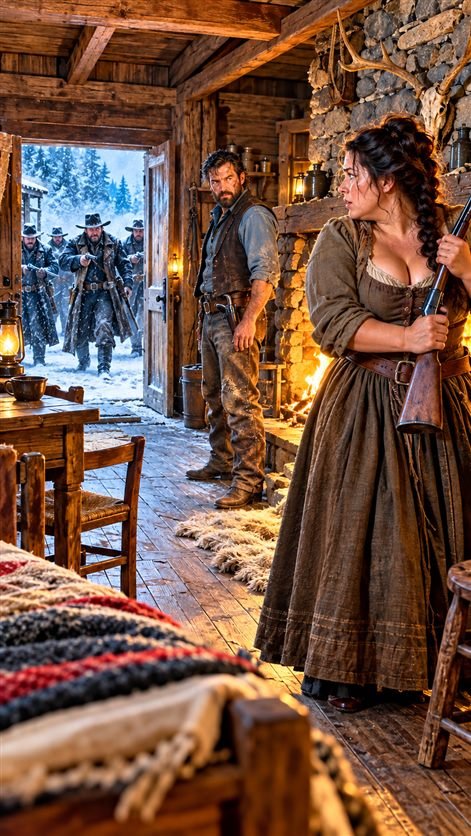
A drifting rider appeared out of the wilderness smoke to offer comfort, but his arrival would tear away every safe truth Leonor thought she had built. The quiet Montana wind carried secrets heavier than lead, and by the time the snows fell, the homestead would hold a reckoning no prayer could stop.
The sound of saddle leather outside her cabin was enough to make Leonor Salazar tighten her grip on the rifle until her knuckles turned a hard, bloodless white. For nearly a year, she had lived entirely alone beside the restless waters of the Musselshell River, where the spring wind moved endlessly through the cottonwoods and carried the raw smells of wet earth, damp firewood, and distant smoke from some unseen campfire on the distant plains. Since her father, Don Mateo Salazar, died from an untreated fever that left him delirious and begging for water that never seemed to cool his skin, Leonor had learned one hard and unforgiving truth: a woman alone in the vast, untamed territory of Montana could not afford to trust easily. Men passed through these parts with murder in their eyes, desperation in their pockets, and stories that shifted like the prairie dust.
She stepped slowly onto the splintered porch, her boots making no sound against the wood, and raised the heavy rifle straight ahead, keeping the barrel steady and leveled at the chest of the rider waiting in the yard. Six meters away, a tall stranger sat calmly on a bay horse that showed only mild agitation at the drawn weapon. He slowly raised one gloved hand in a gesture of absolute surrender, his eyes meeting hers with an unflinching directness that immediately set her teeth on edge.
I didn’t come to cause you any trouble, ma’am, he said in a deep, steady voice that seemed to vibrate against the stillness of the afternoon. I saw the smoke from your chimney and thought perhaps someone might need help.
Leonor kept the rifle raised, her finger resting lightly against the curved trigger guard, ready to release the hammer at the slightest twitch of his reins. Are you alone?
Yes, ma’am, he replied, his voice calm, untouched by the panic she usually detected in travelers caught trespassing.
She studied him carefully from beneath the brim of her father’s old felt hat. His beard was rough and unkempt, his denim shirt was covered in a thick layer of prairie dust, and a profound exhaustion showed clearly in the deep lines around his eyes. Yet, despite the grime of the trail, her sharp eyes took in the contradictory details that did not fit a common drifter or a desperate runaway. His boots were worn thin by miles of walking but kept clean and conditioned, his horse was surprisingly well-fed with a glossy coat and strong flanks, and his posture belonged to a man accustomed to hard physical work and military discipline rather than cattle rustling or highway robbery.
I’m fine, she finally said, lowering the rifle only slightly, though her muscles remained coiled like a struck spring.
The stranger dismounted with practiced ease, letting the reins drop to the dirt so the animal would stand ground. My name is Juan Bravo. I was headed north to Fort Benton to sell a bundle of winter furs, but last week’s unexpected blizzard delayed me in the hills, my horse lost a front horseshoe in the rocky creek bed, and I haven’t had anything hot to eat in two full days.
Leonor hesitated, her gaze dropping to the horse’s left hoof where the missing iron shoe was indeed glaringly absent, then returning to the man’s dust-streaked face. He wasn’t begging, and he wasn’t spinning elaborate lies to win her sympathy. He was simply bone-tired, hungry, and stranded in a territory where the wrong turn could easily prove fatal.
You may give your horse some water from the rain barrel, she said, her voice softening by a fraction. I have a pot of rabbit stew inside.
Juan removed his hat, revealing dark hair plastered with sweat against his forehead, and bowed his head respectfully. I truly appreciate it, Doña Leonor.
She froze, the rifle slipping a fraction lower. You know my name?
You called out to your father once in your dreams, he said smoothly, offering a small, self-deprecating smile that did not reach his tired eyes. I heard it when I passed by your south fence yesterday evening to check if the cabin was inhabited before making camp in the brush. I meant no disrespect.
Leonor felt a sudden prickle of cold sweat trace the line of her spine. He had been watching her for a day before showing himself, yet he had waited until she was visible to make his approach. It was the tactical move of a cautious man, or perhaps a dangerous one. But the hunger in his frame was real, and the loneliness pressing down on her own ribs had become an unbearable weight.
They ate together on the porch as the sun sank slowly over the rolling fields, casting long, bruised shadows across the overgrown grass. Juan didn’t devour the food like a desperate traveler who hadn’t seen a meal in days. He ate slowly, deliberately, and respectfully, holding his wooden bowl with calloused hands as though he understood exactly what Leonor had sacrificed to keep herself fed through the bitter winter months. When he finished every last drop of the broth, he looked up and smiled gently.
You cook better than any inn between here and Benton.
Leonor gave the faintest, almost imperceptible smile in return. It was the first one she had shown to another human being in a very long time, and her facial muscles felt stiff and unaccustomed to the motion.
That evening, sitting beside the crackling fire pit she had dug behind the root cellar, Juan carefully asked how long she had been living out here entirely by herself.
Since last May, Leonor answered quietly, her eyes fixed on the leaping orange flames that danced against the gathering darkness. My father became ill after the spring thaw. His lungs filled with fluid, and he never got back up. We buried him beneath the large cottonwood down by the riverbank.
And you’ve done all this heavy work yourself? The garden, the livestock, the repairs?
There was no other choice, she said, her voice hardening slightly as pride surged through her chest. The dead do not plant corn, and the river does not wait for a grieving daughter to find her courage.
Juan looked around at the meticulously tended garden, the patched corral, the reinforced woodshed, and the newly repaired chicken coop with a look of genuine reverence. You’ve got a rare kind of courage, Doña Leonor. Most people, men and women alike, would have sold everything for a fraction of its worth and fled back east the moment the first frost threatened to crack the foundation.
I never wanted the east, she replied, her gaze wandering toward the dark silhouette of the distant mountains. I like the silence. It doesn’t lie to you.
For a moment, neither spoke, leaving the night sounds of crickets and distant coyotes to fill the space between them. But the silence between them felt fundamentally different than the crushing isolation she had endured for months. For the first time since her father’s agonizing death, the night didn’t seem quite so heavy, and the shadows lurking beyond the reach of the campfire felt less like approaching ghosts and more like ordinary darkness.
Leonor gave Juan a thick wool blanket and an old burlap sack stuffed with clean straw so he could sleep in the safety of the barn. She locked her heavy cabin door behind her, sliding the iron bolt into place, but for the first time, she did not place the loaded rifle beside her narrow cot.
The next morning, before the pale dawn had fully chased the mist from the river valley, Leonor woke to the rhythmic, comforting thud of an axe striking dry pine. She hurried to the window and pushed the wooden shutter open to find Juan out in the yard, stripped to his undershirt, rhythmically splitting logs with her father’s heavy maul. Sweat glistened across his broad shoulders and muscular back, tracing the deep scars that crisscrossed his skin like old roads carved into stone. Before the day was over, he had repaired every weak point in the north fence, patched the leaking roof of the chicken coop, and cleared the irrigation ditch of choking river silt that had threatened to drown her emerging spring greens.