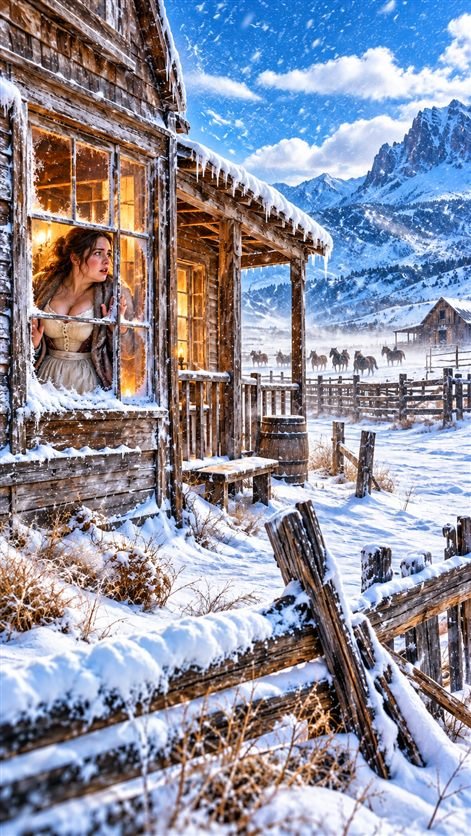
The cold wind screamed through the rotting floorboards of the ranch house, carrying the unmistakable scent of burning cedar and approaching ruin. Faith pressed her back against the frosted windowpane, her breath fogging the glass as she watched the silhouettes of riders circling the northern pasture under a dying New Mexico sun.
She had survived her father’s passing, three consecutive seasons of drought, and a debt collector who carried a loaded Colt, yet none of it prepared her for the trap waiting at her own wedding altar. The air in Summers Crossing smelled of dust, impending betrayal, and cheap whiskey, and Faith knew that by nightfall, either her family’s legacy would be safe or she would be standing on the dirt road with nothing.
The wind howled across the parched expanse of the New Mexico Territory in the autumn of 1875, rattling the loose shingles of the Summers Crossing Ranch house until it sounded like a dying man’s teeth chattering in the dark. At twenty-two, Faith Summers stood alone as the final keeper of a thousand acres of sun-baked heartbreak. The spread was a ledger of failures: broken cedar fences that allowed stray heifers to wander into neighborly disputes, a main irrigation ditch choked with silt and dry tumbleweeds, and a ledger of debts held by the territorial bank that seemed to multiply faster than rabbits in spring. Her father had spent his final months coughing blood into a stained rag, muttering about promises and salvation, leaving her only a single, desperate telegram clutched in his dead hand.
Thomas Xavier is coming. Arranged marriage. He will save the ranch.
Faith had pictured Thomas Xavier through weeks of sleepless nights as a grizzled, weathered pioneer with iron-gray hair, cracked leather skin, and eyes dulled by decades of fighting alkali dust and Comanche raids. She imagined a man old enough to be her father, someone who would bring stability and silence to a house that felt increasingly haunted by her mother’s early death and her father’s spiraling debts.
Then a lone rider appeared on the western horizon, cutting a sharp, dark line against the pale, bruised sky.
He didn’t spur his horse into a dramatic gallop; he rode with the unhurried, rhythmic confidence of a man who owned the miles beneath his hooves. When he reached the dilapidated front porch, he checked his mount with a flick of the reins, dismounted with a fluid grace that made the loose floorboards groan, and stepped into the sharp glare of the afternoon sun.
Young.
Broad-shouldered.
Deep blue eyes that missed nothing.
Are you Faith Summers? the stranger asked, his voice low, resonant, and entirely lacking the gravelly rasp of an aging cattle baron.
I am Faith, she replied, her fingers tightening around the hem of her flour-sack apron.
He removed his wide-brimmed hat, running a gloved hand through dark hair damp with trail dust. Thomas Xavier. Everyone calls me Ty.
Faith stared, her mind flatly refusing to reconcile the image of the young, striking man standing before her with the elderly savior she had conjured from her father’s dying telegram.
Ty’s mouth curved into an amused, slightly crooked smile that reached the crinkles beside his eyes. Were you expecting an old man?
Heat rushed into her cheeks, a fierce, unwanted flush that burned from her collarbones to her hairline. She hated the sudden flutter in her chest, the way her breath hitched in her throat, and the humiliating realization that she looked every bit the desperate, overworked orphan she was.
That’s me—young, and yours if you’ll have me, Ty said softly, his gaze steady and unblinking.
And somehow, standing there in the swirling wind of the New Mexico badlands, the situation became infinitely more dangerous to Faith’s heart than any bankruptcy or foreclosure ever could.
Over the following days, Ty proved that he was not merely a name on a telegram or a stranger fulfilling a grim legal obligation. He worked as though Summers Crossing already belonged inside his blood. He hauled heavy timber from the creek bed to shore up the collapsing root cellar, wrestled the stubborn water pump back to life with grease-stained hands and sheer stubbornness, and rode out alongside Sid, the ranch’s ancient, perpetually suspicious foreman, to investigate a series of fresh, suspicious tracks along the northern boundary where cattle had been mysteriously vanishing by the dozen.
Faith cooked massive iron pots of beans and salt pork, managed the rapidly disintegrating ranch books by the flickering amber light of a tallow candle, and tried unsuccessfully not to notice Ty whenever he removed his heavy leather gloves and washed the day’s grime from his forearms beside the kitchen water barrel. She watched the flex of muscle beneath his sweat-dampened shirt, the sharp line of his jaw, and the quiet intensity with which he studied the horizon, as if searching for an enemy only he could see.
Slowly, against every instinct of self-preservation and bitter experience, something unexpected and terrifying happened inside Faith’s guarded chest. She began wondering whether marrying Thomas Xavier might actually save more than her ranch. She found herself listening for the heavy thud of his boots on the porch, waiting for the brief, teasing smile he reserved just for her amid the crushing weight of their daily labor.
Then came the afternoon before the wedding, shattering the fragile peace like a dry twig under a boot heel.
Faith rode into town to purchase a few yards of frayed white lace for the high-necked collar of her mother’s wedding dress, tying her mare to the hitching post outside Patterson’s General Store. The interior was cool, smelling of raw tobacco, molasses, and rotting potatoes. As she approached the counter, the muffled sound of voices drifted from the cluttered back storage room, separated from the shop floor by a grease-stained burlap curtain.
It was Bert Carter’s voice, oily and dripping with cruel amusement.
Let her marry Xavier, Bert sneered, the sound cutting sharply through the dusty air. During the celebration tomorrow night, I’ll read the land-sale document her father supposedly signed over to us. A desperate bride won’t argue in front of the whole town when the sheriff and half the council are sitting right there eating her beef.
Faith froze, her hand hovering over a barrel of salted herring. The blood drained from her face, leaving her skin as cold and white as lard.
Patterson’s voice followed, thin and nervous. That paper doesn’t even have her father’s real signature, Bert. What if she calls our bluff? What if Xavier checks the county registry?
Bert’s dry, rasping laugh chilled her to the very marrow of her bones.
The crowd won’t study the signature, Patterson. They’ll only watch her tremble. By the time they figure out it’s a forgery, the courthouse will be closed, the deed transferred, and Summers Crossing will be ours, lock, stock, and barrel.
Faith understood everything in that single, agonizing heartbeat. The missing cattle, the sudden refusal of the local banks to extend her father’s loans, the strange men loitering near the property line—none of it was random misfortune. The Carters weren’t trying to purchase Summers Crossing fairly; they intended to use public humiliation and forged parchment to steal her ancestral home right out from under her feet while the entire town watched and applauded.
She didn’t scream, and she didn’t storm into the back room to claw at Bert Carter’s throat. With trembling fingers, she backed away from the counter, slipped out the front door, and untied her mare with motions so mechanical they felt carved from stone.
She quietly rode home, her mind racing through the labyrinth of secrets her father had left behind.
Inside her father’s heavy cedar trunk in the drafty attic, Faith tore through packets of old tax receipts, land grants, and faded photographs until her fingers brushed against a false bottom. Beneath it lay the real correspondence between her father and Ty’s father—letters discussing a joint venture, a mutual protection pact, and the true, unencumbered title of Summers Crossing. With them lay the original water-rights map drawn in waterproof ink, the actual ranch debt ledger detailing how Bert Carter had systematically bought up her father’s notes through shell companies, and her father’s heavy, engraved silver fountain pen.