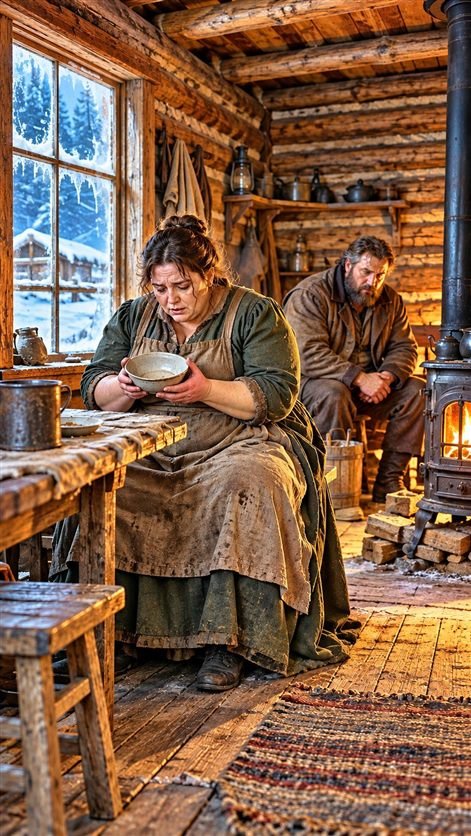
The heavy oak door slammed against the interior wall with a sound like a rifle shot, rattling every glass jar on Elowen’s crowded shelves. Outside, the valley air was already freezing their lungs, and the first screams from Briar Hollow were beginning to rise through the howling dark.
The laughter carried all the way up the hillside, long before the cold arrived to freeze it in their throats. Below, outside the weather-beaten trading post in Briar Hollow, settlers had pointed toward the broad roof of Elowen Harrow’s cabin, where hundreds of thin apple slices gleamed beneath the blazing June sun. From a distance, the roof looked as though someone had scattered pieces of gold across it. And everyone in town thought Elowen had finally lost her mind. Look at that, one man had scoffed, leaning against a horse rail and spitting a stream of amber tobacco juice into the dust. Maybe sorrow finally got to her, another had muttered, nudging his companion. Another laughed, his voice sharp and mocking in the midday heat. What kind of fool prepares for winter in June? Their voices had drifted uphill on the warm wind, light and mocking. Elowen had heard every word, every jeer, every casual dismissal from people who believed the world owed them an endless summer. She kept working, her broad hands steady as she turned another apple beneath the sunlight, checking that both sides would dry evenly. They could laugh all they wanted, because she remembered what they had deliberately chosen to forget. Four years earlier, winter had almost taken everything from her, scraping her life down to the bare bone until only grief and shadow remained. That was why her cabin now smelled constantly of smoke, salt, dried fruit, herbs, and preserved meat, a rich and heavy wall of scent that pushed back against the damp floorboards. From sunrise until her hands cramped and swelled at night, Elowen prepared with a fanaticism that bordered on devotion. She sliced apples and pears until the juices stained her fingers a permanent, sticky brown. She smoked strips of tough venison over smoldering hickory wood in the stone lean-to behind the shed. She packed beans into rough burlap sacks, measured salt by the pound, sealed vegetables inside glass jars with melted beeswax, and counted every portion twice, sometimes three times, whispering the numbers in the dark. Nothing was ever wasted in her home, not a scrap of fat, not a pea hull, not a bitter seed. When the wooden shelves along the kitchen walls finally filled to bursting, she stacked extra supplies beneath the rope beds where she and Gideon slept. When the heavy wooden trunks at the foot of the children’s cots became crowded with dried corn, she tucked smaller packages along the baseboards, making the very walls of the house thick with rations. Her husband, Gideon, occasionally watched her from the doorway with a quiet, shadowed concern in his eyes. Elowen, he murmured one evening, leaning his shoulder against the rough pine jamb while the kettle hissed, we have enough. Her hands stopped their rhythmic scrubbing of a turnip. For several seconds, she said nothing at all, listening to the quiet tick of the clock and the steady breathing of their children in the next room. No, she finally whispered, her voice rough and flat. We don’t. Because she could still hear the breathing, thin and rattling, echoing from a nightmare that refused to stay buried in the past. Four winters earlier, snow had begun falling one December morning with an almost innocent softness, drifting down in lazy white flakes that coated the pine boughs and the wagon tracks. By afternoon, however, it was five feet deep, packing against the windows and sealing the doors shut. Then it simply refused to stop, turning the sky an unbroken, glaring white that hurt the eyes. For three brutal weeks, Elowen, Gideon, and their two young children were imprisoned inside their cabin while the world beyond their windows disappeared beneath a crushing, silent weight. Firewood vanished frighteningly fast as the temperature inside the room plunged below freezing. Gideon finally pulled on his heavy wool coat, his face grim as he reached for the latch. I’m going out, he said, his breath pluming white. No, Elowen grabbed his sleeve, her fingers digging into the thick wool with desperate strength. Please. We’ll burn something else. We need wood, Elowen, the stove is stone cold. Gideon, you can barely see the barn, the wind will swallow you whole! He went anyway, stepping out into a white roaring void that seemed to swallow his form instantly. When he returned hours later, ice coated his clothing in thick, rigid sheets, and his boots had frozen nearly solid to his swollen feet. Elowen dragged him toward the hearth, terrified by how violently he trembled, his teeth clicking together like castanets. He survived the frostbite, but afterward, something in him was never quite the same, a quiet, hollow shell remaining where a warm, laughing man had lived. Soon the last of the split oak firewood was entirely gone, leaving them shivering in the dark. They burned the chairs first, feeding the painted pine and hickory legs into the greedy mouth of the stove one by one. Then they burned the heavy dining table Gideon had built with his own hands after their wedding, watching the carved edges curl and blacken into ash. Next came the spare shelves, the rough wooden crates, and finally the polished wooden bookcase holding Elowen’s treasured poetry volumes, the pages flaring bright and brief before turning to soot. One by one, pieces of their life, of their history, became flames that barely took the edge off the killing frost. Yet cold was not what haunted Elowen most when she closed her eyes at night. Hunger was. On the twelfth day of isolation, the grain bin ran completely empty, not a single kernel remaining at the bottom. Elowen scraped together the absolute final portions of flour, mixed them with a handful of rendered grease and water, divided them between her children, and placed the small, gray bowls before them on the floor. One child stared down at her empty hands, her stomach rumbling audibly in the silent room. Mama… where’s yours? Elowen forced her face into a wide, reassuring smile, blinking back the hot tears that threatened to freeze on her lashes. I already ate, she lied smoothly. The lie nearly broke her heart, tasting of ash and failure. That night she lay awake beside them in the dark, listening as the storm battered the wooden shingles of the cabin like a thousand angry fists. Her children’s cheeks had become hollow and gaunt, their skin stretched thin over delicate bone. Beneath thick wool blankets, their small bodies seemed impossibly fragile, like birds hollowed out by the frost. Then she noticed their breathing, and a cold dread gripped her throat. Weak. Slow. Different. Elowen stared into the absolute darkness of the room, counting every fragile, shallow breath as if her own will could force air into their lungs. She never forgot that sound, the rattling sigh of a body running out of fuel. So four years later, while Briar Hollow mocked her beneath a peaceful, sun-drenched summer sky, Elowen prepared as though every single jar and sack might someday mean another sunrise for someone she loved. By September, there was barely room to walk through the cabin without brushing against hanging food. Dried fruit hung from the hand-hewn oak beams like heavy autumn fruit still clinging to the branch. Smoked meat filled the pantry until the shelves groaned under the weight. Grain sacks crowded the corners of every room, turning the cabin into a labyrinth of survival, while glass jars lined every available shelf down to the floorboards. Neighbors continued laughing when they rode past, shaking their heads at the eccentric woman stacking firewood and grain like a squirrel hoarding nuts for a winter that would never come. Then autumn arrived strangely and violently early, bypassing the gentle golden weeks of October. Birds vanished south weeks ahead of their usual schedule, leaving the forests preternaturally silent and empty. Mountain animals, deer and elk and even predators like wolves and cougars, descended into the valley far earlier than the elders had ever recorded, their coats thick and wild. Morning frost appeared on the grass while the leaves on the maples and oaks were still green and supple, biting the vegetation before it had time to turn. Elowen noticed every single sign, reading the landscape like a weathered map of impending doom. The others in Briar Hollow didn’t, too busy drinking at the tavern and arguing over the price of autumn wool. Then, one evening just as dusk was turning the sky a bruised purple, Gideon stepped outside the cabin door and stared long and hard toward the northern mountains. A wall of clouds had swallowed the horizon, banking up so high it seemed to touch the stratosphere. Not ordinary storm clouds that brought rain and quick squalls, but something enormous, ink-black, and bruised with green and violet undertones. Something unnatural and ancient was rolling down from the high peaks. The temperature dropped so quickly and drastically that his breath suddenly appeared before his face in a dense white cloud. Elowen, he called back into the warm kitchen, his voice tight and breathless. She came outside immediately, wiping her flour-dusted hands on her apron. Neither spoke a word for a long, heavy moment. Far across the valley, down where the lights of Briar Hollow were just beginning to flicker in the gathering dark, the first single snowflake fell from the sky, drifting lazily through the still air. Then another. And another. Within minutes, the mountains disappeared completely behind a roaring wall of white, and the wind began to howl through the valley like a wounded beast. Elowen slowly turned her head away from the storm and looked back toward the overflowing cabin behind her, her heart hammering a heavy, rhythmic beat against her ribs. Down in Briar Hollow, people were still laughing inside the warm tavern, raising their mugs to the start of a long, cozy season. They had no idea what was coming, no comprehension of the white death descending upon their roofs. And before this winter was over, those same neighbors would be fighting through towering mountains of drifting snow toward Elowen Harrow’s door, weeping and praying the woman they had mocked had stored enough food for them too.