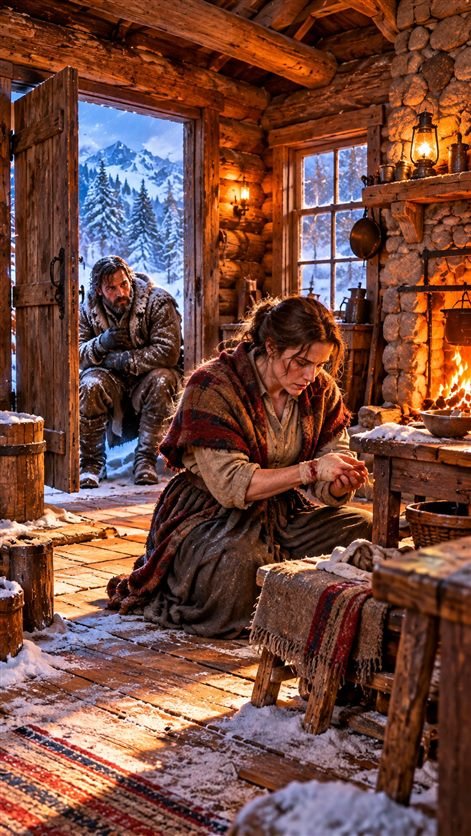
The floorboards groaned beneath a heavy pair of blood-stained boots as the giant framed in the doorway cocked his Winchester rifle with a terrifying, metallic snap. In a mining town built on hollow promises and cheap liquor, tonight would be the night the silver-dust finally settled in blood.
The saloon doors slammed open with a force that killed the tiny piano music in an instant. A giant of a man stood in the doorway, draped in scarred wolf skins, a Winchester rifle slung over one shoulder, two long hunting knives resting at his hips. In his massive, dirt-stained hand, he held a half-eaten slice of sourdough bread like it was evidence of a crime. WHO BAKED THIS BREAD? He roared. The sound didn’t belong to a man. It was the bellow of a wounded animal—a booming shout that rattled every tin cup in the room. Back in the sweltering kitchen, a terrified cook squeezed her eyes shut and prayed for mercy. The year was 1882. Silver Plume, Colorado—a mining town where dreams went to be ground into dust, where the air tasted of pulverized rock and cheap whiskey, and the people were just as harsh.
Her name was Henrietta Hattie Coulter. Hattie was an extraordinarily large woman, massively overweight yet strikingly beautiful, in a world that routinely starved people down to their bones. She had a soft, abundant, unmistakably feminine figure, with enormously broad hips, thick thighs, full rounded arms, a heavy soft belly, and an exceptionally large, voluptuous bosom. Her face was beautifully feminine, with warm hazel eyes, full lips, softly rounded cheeks, and thick chestnut-brown hair usually pinned into a practical loose knot. She wore a faded gingham frontier dress that had been washed and repaired countless times. Its full skirt wrapped around her broad hips and heavy legs, while the fitted bodice followed the generous shape of her upper body closely. A modestly low square neckline framed the pronounced upper swell of her abundant cleavage. And in the cruel whispers of this town, she was a target. Men joked that she took up two seats on the stagecoach. The sharp-tongued parlor girls snickered when she squeezed past them in the hallway. Hattie bore it all in silence, burying her sorrow in the only place she held absolute power—the dough. Her sourdough starter, a fifty-year-old family heirloom she called Bessie, was the only living thing in Silver Plume that didn’t judge her.
Just minutes before the doors burst open, Jebidiah Caldwell, the greasy, penny-pinching owner of the boarding house, had sneered at her. You burning the roast again, you heavy-footed cow? Don’t waddle out there tonight. You scare off paying customers. Hattie swallowed the humiliation, the way she always did. She simply pulled four golden loaves from the oven and sent them out with the serving girl. That’s when everything changed. The man in the doorway was Grayson Cade. The townsfolk called him Grizzly Cade—a towering, six-foot-four frontiersman with a jagged scar slicing through his eyebrow. Rumors said he’d killed three men with his bare hands. He came down from the mountain only twice a year, and when he did, grown men stepped off the boardwalk to avoid him. He had taken one bite of Hattie’s bread. And then he stopped completely. His jaw locked. His hand began to tremble. Now he stood in the middle of the dining room, towering, wild-eyed, demanding to know who had made it, as if the bread itself had wounded him.
Jebidiah Caldwell stammered, pale as a ghost. Now, Mr. Cade, if the bread is bad, I’ll fetch you— I didn’t ask if it was rotten, you pathetic worm, Grayson snarled, stepping closer, the floor groaning under his weight. I asked who baked it. Tell me now, or I’ll tear this place down to the bedrock. In the kitchen, Hattie’s blood ran cold. Her heart slammed against her ribs. She stood frozen beside the worktable, her enormous figure wrapped in the faded gingham dress and flour-dusted apron. The fitted bodice stretched across her exceptionally full chest as her frightened breathing quickened. He hates it, she thought, panic rising in her throat. He’s going to drag me out there and beat me in front of the whole town. She had spent her whole life apologizing for existing. She knew exactly what men did when they were angry—her own father once threw a cast iron pan at her head for burning a stew when she was twelve. She could run. She could hide. Or she could let Caldwell take the blame and lose her job, her home, everything. But something in her, some small, stubborn ember, refused to stay silent. No, she whispered to herself. It is good bread. It is my grandmother’s bread.
With trembling hands, Hattie pushed open the swinging kitchen doors. The squeak of the hinges drew every eye in the room. Grayson Cade whipped his head toward the sound. His wild, feral gaze locked onto her, and the entire saloon fell into a silence so complete you could hear the wind howling outside. Hattie stood framed in the kitchen doorway. Her faded gingham dress followed the abundant curves of her enormous body, from her broad hips and soft belly to the exceptionally full bosom framed by its square neckline. But beneath the flour, exhaustion, and worn clothing, she was strikingly beautiful. I did, Hattie said, her voice trembling but clear. I baked the bread, sir.
Grayson stared at her. Then, slowly, he began walking toward her, each heavy footstep sounding like a death knell. The miners pressed themselves against the walls. Caldwell ducked behind the bar. Grayson stopped just two feet in front of her, towering, blocking out the lantern light completely. Hattie squeezed her eyes shut, bracing for a blow, a curse, anything. Look at me, he commanded. And when she opened her eyes, what she saw on the face of the most feared man in the territory was something she never, ever expected.
Grayson’s eyes were glistening with unshed tears. The fierce, terrifying mountaineer looked not with rage, but with an agonizing, desperate disbelief. He reached out with a massive, calloused hand—a hand that had choked wolves and broken bones—and gently, almost reverently, touched the sleeve of her gingham dress. Where did you get that starter? he whispered, his voice cracking like dry timber.
Hattie blinked, her heart hammering against her ribs. It is my grandmother’s, she stammered, backing up half a step before his intensity. Bessie. We brought her from Missouri twenty years ago. The old woman’s starter. My mother passed her down to me before she died in the winter freeze of seventy-four. Grayson shook his head slowly, his jaw working as if he were trying to swallow glass. Missouri, he breathed. Your mother… was her name Sarah? Sarah Coulter?