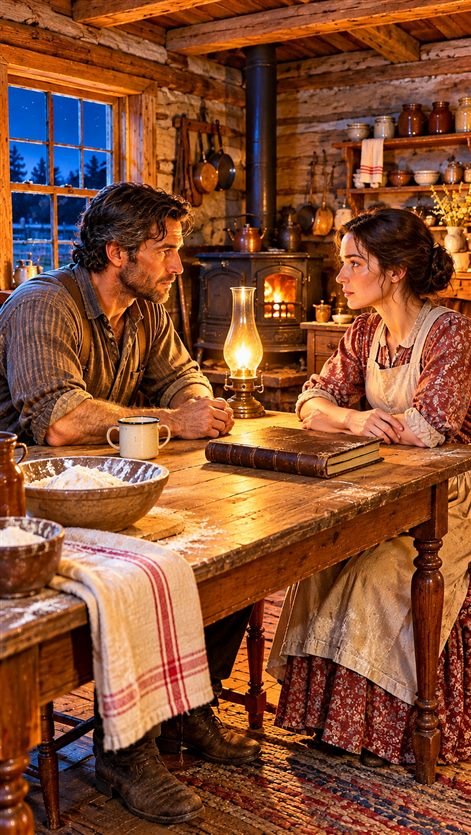
The ledger burned in Nathaniel Callahan’s hands before he even opened the cover, smelling faintly of lamp oil and the despair of men who knew they were about to lose everything.
“Fifteen dollars, Mr. Callahan,” the voice had said from across the splintered desk in Harding, Kansas, cool and devoid of any feminine flutter or hesitation, “or you’re negotiating with yourself.”
Now, four years after burying his first wife in frozen ground and swearing off the burden of human affection forever, Nate stared across the midnight kitchen at the woman who had upended his entire ruinous existence. The kitchen smelled of sour mash, charred cedar, and the rich, yeasty promise of the honey-apple sourdough she baked in the dead of night. His failing ranch hung by a fraying thread of overdue grain notes and Silas Mercer’s tightening financial noose, but the immediate crisis was sitting right there on the oilcloth table: a crisp, predatory buyout offer signed in Mercer’s looping, venomous hand. Two hundred dollars to make the false tax claims vanish. Two hundred dollars to save the Callahan Ranch.
The catch?
Abby’s grandmother’s recipe, the starter she had carried all the way from Missouri, and the entire burgeoning baking business would belong to Silas Mercer.
“You’re considering this?” Abby’s voice cut through the shadows, sharp as a whetstone drawn across cold steel.
She stood in the doorway of the pantry, her apron streaked with unbleached flour, her dark eyes flashing with a dangerous, quiet fury that made Nate’s chest tighten. He looked down at the paper, the ink still fresh, his throat dry as alkali dust.
“I’m trying to save the ranch,” Nate rasped, the words tasting like ash.
Abby stepped closer, the floorboards groaning beneath her boots. “You’re trying to save your ranch by selling something that isn’t yours.”
Nate went entirely silent, the accusation hanging in the damp air between them like a drawn blade. He had brought her to this isolated, wind-scourged patch of Kansas with a singular, brutal mandate—to keep the house, feed the brutalized hands, and manage the books without sentimentality. He had believed a good wife was nothing more than an efficient domestic tool, a necessary shield against domestic chaos. But as Abby stared down at him with a gaze that stripped away every last one of his defensive walls, he realized with a sickening lurch of his stomach that he had completely misjudged the woman he had wed.
She didn’t just manage his house; she had become its spine. And now, by even entertaining Mercer’s extortion, he had betrayed the very foundation of what she had built from scratch.
“This is exactly what you keep doing,” Abby whispered, her voice trembling with a grief that hurt worse than anger. “Deciding alone. Protecting people by making choices for them. You married me because you thought you needed a woman to manage your house. But you still haven’t learned that having a wife doesn’t mean owning her work.”
Before Nate could find the breath to defend himself—before he could tell her that he would burn the ranch to the ground before he let Mercer touch her legacy—Abby snatched the paper from the table. She didn’t tear it. She folded it with agonizing precision, slipped it into her pocket, and walked out into the cold Kansas night.
Nate sat frozen in the dark. He reached for his pen, dragged a fresh sheet of paper toward him, and scrawled a frantic note to slide beneath the ledger she had left behind: *I didn’t sign it. I won’t. Whatever happens to the ranch, your grandmother’s recipe stays yours.*
He left it there on the table, praying to a God he hadn’t spoken to in years that she might read it and understand. For the first time since he had lost his first wife to the cruel winter feuds, Nate felt a cold, hollow terror grip his soul—not of losing the land, but of losing the woman who had made the land feel like home.
*
The storm broke eight days before the Harding Harvest Festival, and Silas Mercer struck with the precision of a coiled rattlesnake.
With a single word to the regional freight handlers, Mercer cut off the Callahan Ranch’s commercial grain supply, aiming to starve their operations just as the seasonal rush reached its peak. But Mercer had reckoned without the steel in Abby’s spine. Anticipating the sabotage before the ink on his threat had even dried, Abby had already quietly secured an alternative, high-grade wheat shipment smuggled in by wagon from Dodge City under the cover of a moonless night.
She had channeled every ounce of her defiance into her masterstroke: the Harding Harvest Festival booth.
Two long trestle tables groaned under the weight of her legendary honey-apple sourdough, heavy dark molasses bread, spiced fruit preserves, churned golden butter, and delicate hand pies that perfumed the autumn air for a hundred yards. The townspeople of Harding drifted toward the scent like pilgrims to an altar.
And then Nathaniel Callahan did something that sent a wave of stunned disbelief rippling through every rancher and farmer within twenty miles.
He didn’t stand back in the shadows with a scowl, nursing a cup of black coffee and waiting for the women to finish their labor. Nate rolled up his sleeves, stripped off his wool coat, and went to work beside her. He hauled fifty-pound crates of flour from the wagon. He split thick oak logs for the portable stove with brutal, rhythmic swings of his heavy axe. He scrubbed greasy iron pans until his knuckles rawed, and when the stove threatened to flare too hot, he monitored the dampers with an anxious, watchful eye.
When local merchants and curious cattlemen approached the booth and asked who was masterminding the booming enterprise, Nate didn’t offer his usual defensive, dismissive mutter.