The town swore Elspeth O’Shea had abandoned her homestead to a fraudulent surveyor’s decree. They never checked the inked alphabet inscribed inside her schoolchild’s primer.
—
The official decree was read aloud on the sun-baked steps of the Eureka land office while the August heat shimmered off the alkali flats, its merciless proclamation of eviction dropping like a weighted chain. Elspeth Sutherland—known by the locals as the stubborn widow O’Shea—stood tall against the scorching wind, her fingers clenched so tightly around the wooden handle of her ledger satchel that her knuckles turned ash-white. Magistrate Pendleton, sleek in his charcoal waistcoat despite the shimmering Nevada dust, cleared his throat with a dry rattle of paper and announced that the southern half of the timber-claim and its permanent water spring legally reverted to the county commission due to an unfulfilled residency clause. The crowd gathered under the hitching posts muttered among themselves, some shaking their heads in heavy, regretful sympathy, while others eyed the dusty mule tied to the trough. Elspeth did not flinch, though the injustice burned like lye in an open wound; she had spent four grueling years clearing boulders from that soil, planting winter rye, and teaching the motherless children of the foothills how to read from battered primers by the light of tallow dips.
“You’ve no right to cite a residency break, Pendleton,” Elspeth said, her voice carrying clear and steady over the bawling of distant cattle, cutting through the heavy air with the precision of a carpenter’s chisel. “I was driven from this very land three years ago by a staged arson fire that destroyed my cabin, yet I returned before the solstice moon to plant the required acreage.” Magistrate Pendleton only smirked, adjusting his wire-rimmed spectacles and tapping the stamped parchment bearing the seal of the district court. “Paperwork is an unforgiving taskmaster, Mrs. O’Shea, and the ink on the county index shows your signature lapsed long before the ashes cooled.” The sharp ring of a heavy-shod boot striking the pine floorboards of the boardwalk interrupted him, and Elspeth turned her head to see a towering figure stepping out from the cool shadows of the harness shop. It was Linus Prescott, his broad shoulders filling the doorway, his denim shirt darkened with sweat from hauling granite blocks, and his quiet, bruised gray eyes locking instantly onto hers across the sun-drenched street. Five long years had passed since the bitter day they parted ways over a foolish, whispered lie in the valley, yet here he stood, unchanged in his massive frame but weathered by silent years of frontier labor.
Linus did not look at the magistrate; his gaze remained fixed on Elspeth, searching her features with a mixture of guarded agony and slow-dawning recognition that made her breath hitch in her throat. “She’s not leaving the claim,” Linus rumbled, his deep baritone rolling across the gravel street like distant thunder. “And neither am I, seeing as how my name is still on the original patent alongside hers.” Pendleton sneered, folding the document with a sharp snap. “You abandoned that claim, Prescott, the winter your first wife died and you took your machinery north.” Linus stepped down from the boardwalk, his heavy boots crunching into the dust, and moved to stand directly beside Elspeth, his presence radiating an unyielding warmth that pushed back the August chill of her isolation. “I didn’t abandon anything; I was driven off by forged warrants written by the same hand that holds that pen today,” Linus said, his jaw tightening into a hard line of muscle. As the crowd began to disperse, murmuring over the unexpected alliance between the estranged homesteaders, Linus reached out with a scarred, calloused hand to steady the handle of Elspeth’s satchel, their fingers brushing for a brief, electric second. Without another word of argument, Linus turned the mule’s head toward the dusty track leading up into the silver foothills, and Elspeth, with her chest aching from old grief and new resolve, fell into step beside him as they began the long, grueling climb back toward the disputed cabin.
—
The journey up the winding, sun-baked trail into the Nevada silver foothills was a grueling test of endurance under the heavy weight of an unmerciful summer drought. Dust rose in choking clouds with every step of the mule, settling into the weave of their clothing and coating their throats with grit, but neither Linus nor Elspeth spoke as they navigated the steep, boulder-strewn switchbacks. When they finally reached the small clearing where Elspeth’s half-rebuilt cabin stood against the jagged backdrop of granite cliffs, the heat radiated from the dry pine logs like an open oven. Linus immediately set to work unhitching the pack mule, his large hands moving with practiced efficiency as he stripped the heavy wooden pack-saddle and led the exhausted animal to the stone trough. Elspeth didn’t waste a moment standing idle; she strode briskly toward the storage lean-to, grabbing a heavy iron bucket and setting off down the overgrown path toward the creek bed to haul water for the evening meal. The physical rhythm of frontier labor took over their movements, grounding their turbulent emotions in the solid reality of survival. Linus swung a heavy double-bitted axe against a fallen Douglas fir, splitting seasoned logs into clean, uniform lengths for the hearth, the rhythmic *thunk-crack* echoing off the canyon walls. Every swing of his muscular arms reminded Elspeth of the quiet, deliberate strength she had once loved before mistrust and the cruel pressures of isolation tore them apart.
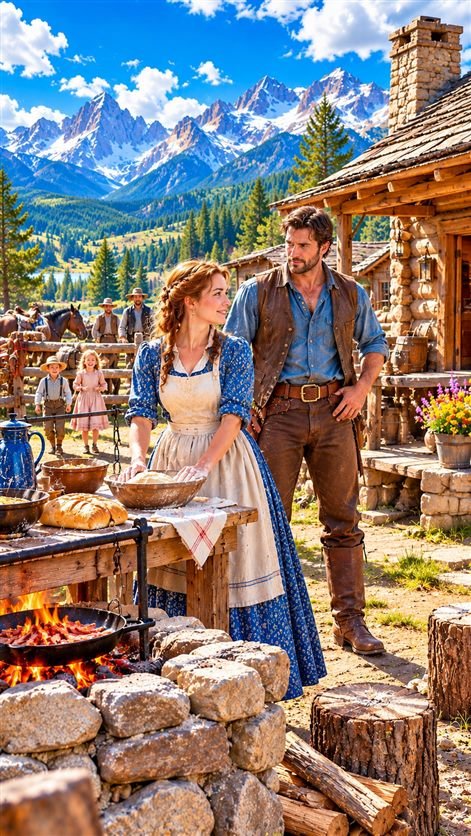
As the sun began to dip behind the jagged western ridge, painting the sky in violent streaks of bruised purple and burnt orange, they gathered around the small open-air stone hearth behind the cabin for evening camp hearth craft. Elspeth worked with practiced economy, kneading a rough-hewn sourdough in a scarred wooden trough while rendering salt-pork in a heavy cast-iron skillet over glowing embers. The smell of frying pork and rising yeast filled the crisp evening air, masking the dry scent of drought-stressed sagebrush. Linus approached quietly, carrying an armload of dry pine kindling, and dumped it neatly beside the hearth before sitting heavily on an overturned cedar stump. “The well is holding about three feet of seepage, but if this dry spell holds another week, we’ll have to haul from the river,” Linus said, his voice low and raspy from thirst as he wiped his brow with the back of a thick forearm. Elspeth glanced up from the dough board, her flour-dusted hands resting on her hips as she surveyed him with a critical, measured eye. “We won’t need to haul from the river if we clear the upper spring-box of the silt slide Pendleton’s men pushed into it last spring,” she replied, her tone cool but laced with practical determination. Linus offered a dry, wry chuckle that reached his eyes, softening his rugged face into something dangerously familiar. “You always were too stubborn to admit when a job was too big for one pair of hands, Elspeth Sutherland.” “And you were always too proud to ask for help when a timber frame was buckling,” she retorted instantly, though the sharp edge of her words was blunted by the flickering warmth of the firelight dancing between them.
The physical labor of sharing the domestic and outdoor chores forced an uneasy, healing truce between the two estranged souls. While the evening meal simmered, Elspeth carefully measured out dried sage and wild mountain mint into a tin pot for tea, her movements steady despite the awareness of Linus watching her every gesture from across the hearth. He rose to help her lift the heavy cast-iron Dutch oven off the coals, their shoulders brushing briefly in the confined space of the outdoor kitchen, sending a familiar jolt of heat through Elspeth’s veins that had nothing to do with the cooking fire. They sat side by side on a rough wooden bench to eat their meager supper of sourdough biscuits and salt-pork, the silence between them no longer hostile, but heavy with unexpressed apologies and the weight of five lost years. “The children asked about you, down at the lower settlement,” Linus murmured softly into the gathering dusk, staring down at his tin plate. “Little Timmy still carries the horn-handled slate pencil you gave him when you taught him his letters.” Elspeth’s breath hitched, and she looked down at her own calloused fingers, her throat tightening against a sudden surge of unshed tears. “I missed them,” she whispered, her voice barely audible over the rising night wind sighing through the pines. “I missed teaching them… and I missed this land, Linus, no matter how hard it tried to break me.” Linus reached out, his rough, warm thumb gently brushing a stray smudge of flour from her cheek, a gesture so tender and uncalculated that Elspeth froze, her heart hammering wildly against her ribs as the ghosts of their past began to retreat before the undeniable pull of the present.