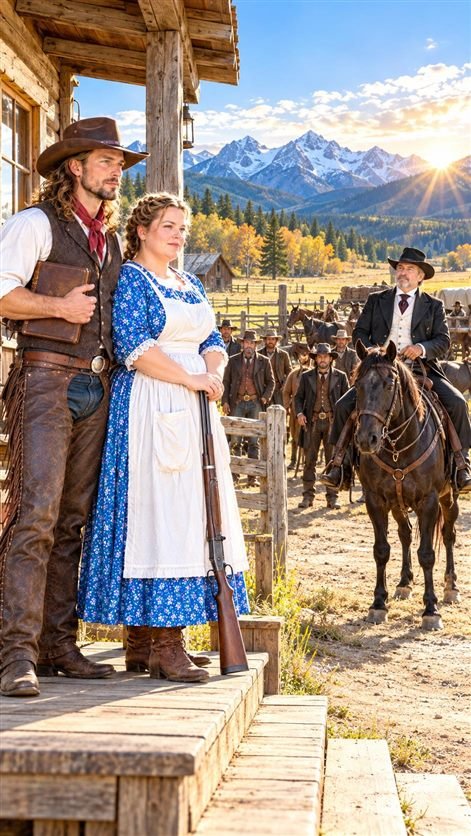
The heavy snap of a branch shattering behind her left shoulder told Clara Whitmore that the men from the valley had stopped shouting. In the high, freezing timber of the Montana range, silence was never a sign of peace; it was the sharp intake of breath before the knife came down. She crouched lower behind a deadfall of rotting pine, pressing her hand hard against the heavy, grease-wrapped envelopes pressed flat beneath her woolen coat. The federal water claims were still dry, but her palms were slick with cold sweat. Every instinct in her body screamed that she had made a fatal miscalculation by trusting the county clerk’s back door, yet she refused to let the panic settle in her chest. She had crossed nine hundred miles of broken earth with one suitcase and blistered feet, and she was not about to let a hired gang of cattle thieves bury her in a shallow grave three miles short of the man who needed her.
The stagecoach had dropped her into the dust of the town three weeks earlier like an unwanted parcel tossed from a wagon, and the world had judged her instantly. A local hand had reached out to grab her elbow without permission, and she had rewarded him with a blow that had turned the main street dead silent. The townspeople had stared, then laughed at her size, her plain blue dress, and the hard, unyielding set of her jaw. Ethan Walker, the grieving rancher who had sent out the mail-order bride advertisement, had never even shown up at the station to meet her. So she had walked nine miles into the mountains alone, her boots soaking through with blood by the time she saw the disaster she had agreed to marry into.
Black Hollow Ranch was a weeping sore on the landscape. Broken fences, a sagging homestead, thin cattle crowding around a foul, muddy watering hole, and Ethan Walker standing amidst the wreckage like a man who had already attended the funeral of his own future. When he saw her standing in the yard, his face had fallen.
“I know that look,” she had told him, her voice level.
“What look?” he muttered.
“The one that says I’m not what you pictured.”
Ethan had stared at her for a long, heavy second, his eyes hollow with exhaustion. “I’m not going to tell you you’re too big or too plain. I’m going to tell you something worse. You shouldn’t have come.”
His wife had died four years before, and his father before that, leaving Ethan to watch the property collapse while a wealthy, ruthless cattle baron named Samuel Crow circled like a vulture, waiting for the bank note to come due. But Clara had refused to look at the ruin as an ending. Stumbling through the dark back office that very first night, she had pried open a trunk of old ledgers written in the cramped, meticulous hand of Ethan’s father. Thirty years of bloodlines, winter survival rates, and pasture rotations. While Ethan saw only the ghost of an exacting patriarch, Clara saw a hidden blueprint. She had looked out over the dying herd and asked the question that started it all: why were the cattle standing in the mud?
Because Ethan had stopped moving them. Forty acres of untouched grass sat just over the ridge, ignored while the animals starved in a trampled corral. Clara had set to work immediately, dragging Ethan out of his stupor by sheer force of will, demanding he mend the fences, clear the ditches, and trust the old man’s records. But the true revelation had come when she discovered the forgotten spring box buried high on the north ridge—a gusher of cold, pristine mountain water that ran even when the valley below baked into dust. It was then she realized why Samuel Crow wanted Black Hollow so badly. Crow’s sprawling empire controlled the lower river, but during a drought, that river dwindled to a sluggish trickle. Black Hollow’s four mountain springs were the lifeblood of the entire basin. Crow wasn’t just waiting for the ranch to fail; he was actively helping it along through midnight fence-cutting and mysterious fires, all to force a foreclosure he could control.
Now, crouching in the black timber with the cold Montana wind howling through the canopy, Clara heard the crunch of gravel close by. A horse whinnied softly, its breath pluming white in the freezing air.
“She went this way,” a low voice muttered, rough with malice. “Crow wants those papers back before sunrise, or we don’t see a dime of that bonus.”
“And the woman?” the second voice asked.
A brief, chilling pause hung over the clearing. “He said she doesn’t need to come back.”
Clara’s heart dropped, but her grip on the double-barreled shotgun tightened until her knuckles turned bone-white. They were close—so close she could smell the stale tobacco and sweat on their wool coats. She eased the hammer back with a faint, metallic click that sounded deafening in the stillness. Let them think she was just a plain, oversized mail-order bride who didn’t belong in the rough country. Let them underestimate the grit it took to survive a childhood in the coal towns of Pennsylvania and a cross-country journey with nothing but her own wits. She stepped out from behind the deadfall, leveling the barrels directly at the chest of the lead rider as his horse reared in surprise.
The blast echoed through the canyon like a cannon shot, lighting up the dark trees in a blinding flash of orange. The lead horse shrieked and bolted, dumping its rider into the briars, while the second man cursed wildly, scrambling to draw his revolver. Clara didn’t wait for him to clear leather; she sprinted hard through the timber, boots pounding against the frozen earth, knowing every twist and hollow of the ridge better than the men hunting her. She scrambled up a steep embankment, sliding on loose shale, and lunged into the dense thicket of spruce that led down toward the Black Hollow boundary line. Behind her, angry shouts and a wild pistol shot tore through the branches, clipping the bark inches from her head, but she kept moving, her lungs burning, the federal papers pressed tight against her ribs like a shield.