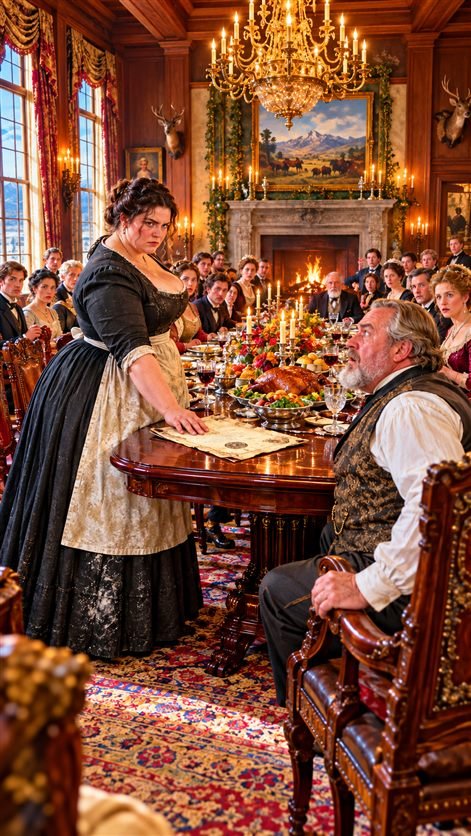
Blood dripped from the tip of the heavy steel carving knife as the sudden, dead silence stretched across the dining room, holding twenty-three gasping relatives frozen in place. The immediate threat of humiliation hung thick in the air, but beneath it thrummed a terrifying, unyielding current of retribution that no one in the room had anticipated.
The sharp click of metal against porcelain echoed through the dining room like a gunshot. Twenty-three pairs of eyes blinked in synchronized disbelief. At the head of the long mahogany table, surrounded by the steam of fourteen hours of grueling labor, Uncle Harland shifted his weight from one foot to the other, his collar suddenly feeling too tight. The smell of roasted venison, buttered potatoes, and rich brown gravy hung in the warm air, taunting everyone with its rich, savory promise. But no one dared reach for a fork. Sarah Miller stood at the periphery of the light, her knuckles white around the bone handle of the knife, her posture rigid as iron. She had spent the last fourteen hours standing over a hot stove while her skin blistered and her back screamed in agony, all to provide a magnificent Thanksgiving feast for the people who looked down on her. And now, they expected her to take her meal among the hay and dust.
Aunt Ruth cleared her throat, a sharp, dismissive sound designed to reassert order over a world that was suddenly tilting off its axis. She adjusted the heavy gold necklace that rested against her collarbone—a piece of jewelry that had belonged to Sarah’s grandmother before it mysteriously vanished into Ruth’s collection years ago.
“Don’t be dramatic, Sarah,” Ruth said, her tone dripping with the condescending patience one might use with a stubborn child. “You know how crowded it is. We had to seat the adults and the paying guests first. The barn is perfectly comfortable, and frankly, it keeps everyone else from having to stare at you while you chew. Honestly, it’s for your own benefit.”
A ripple of nervous, muffled laughter passed among a few of the younger cousins, though several of the older relatives kept their gazes fixed firmly on their plates. They had lived under Harland and Ruth’s thumb long enough to know when a storm was brewing, even if they were too cowardly to stand in its path.
Sarah did not blink. Her eyes, pale and steady, locked onto Ruth’s face. “There are twenty-three chairs around this table, Aunt Ruth. And twenty-three people in this room. Not one of those chairs was set for me.”
“Because you weren’t counted in the seating chart,” Ruth snapped, her patience wearing thin. “Now stop making a scene in front of the family. Go on out to the barn. Your food is getting cold.”
“I think,” Sarah said, her voice dropping an octave into a register that sent a shiver down Harland’s spine, “I’ll be eating right here.”
“There isn’t a seat for you,” Ruth repeated, crossing her arms over her silk blouse.
Sarah turned her head slightly, her gaze locking onto her cousin Adeline, who sat near the center of the table nervously twisting a cloth napkin between her trembling fingers. “Adeline. Go into the parlor and bring me a chair, please.”
Adeline flinched as if she had been physically struck. She looked wildly from Sarah to her mother, paralyzed between two terrifying forces. “Mama said—”
“I heard exactly what your mother said,” Sarah interrupted, her voice as smooth and cold as river ice. “I asked you to bring a chair.”
“Nobody is bringing a chair,” Ruth bellowed, slamming her palm flat against the mahogany surface. Plates rattled, and gravy spilled over the rim of the boat. “This is *my* house. This is *my* dining room. And you will not come in here barking orders as if you belong at the head of anything!”
“Your house?” Sarah asked softly. She stepped closer to the edge of the light, letting the warm oil lamps illuminate the flour dusting her apron and the dark, bruised circles beneath her eyes—the permanent trademarks of her endless servitude on the ranch. “Is that what Harland told you? That this is your house?”
Harland stepped forward, his face flushing a deep, mottled purple. He raised a large, calloused hand, the hand of a man who had spent decades playing the benevolent patriarch while quietly strangling everyone else’s livelihoods. “Now, hold on just a minute, Sarah. Let’s not say things we’re going to regret. Ruth didn’t mean it like that. We’re all family here. Let’s just sit down, say grace, and—”
“You knew there were only twenty-three chairs,” Sarah cut him off, her words striking with the precision of a scalpel.
Harland froze. His mouth remained half-open, a defensive retort dying on his tongue.
“You watched me set the table,” Sarah continued, stepping closer until she stood directly beside him. She could smell the expensive bourbon on his breath, bought with money that should have fed an army, while she lived on scraps in the tenant cottage. “You watched me count the settings. You knew when you sat down that there was no place for me. You didn’t forget, Uncle. You planned it.”
The silence in the room grew so profound that the crackle of the wood in the massive stone fireplace sounded like thunder. Harland swallowed hard, his eyes darting away from hers. That tiny hesitation, that split second of cowardice and guilt, was all the proof the room needed. He had known. Every cruelty, every calculated humiliation, had been orchestrated with his silent, cowardly blessing.
Ruth realized they were losing control of the narrative. Panic flashed in her eyes, quickly masked by a fresh surge of venom. “Get out!” she screamed, pointing a trembling finger toward the front door. “Get out of my dining room, and pack your meager belongings out of that tenant cottage tonight! By sunrise tomorrow, you won’t even have a barn to sit in! You’re homeless, Sarah! You’re nothing without our charity!”
Gasps echoed around the table. Several of the aunts clutched their pearls. To evict family on Thanksgiving night—even the family drudge—crossed a line, yet no one dared to speak up against Ruth’s absolute tyranny. They watched, mesmerized and horrified, waiting for Sarah to break, to weep, to fall to her knees and beg for mercy as she had done a hundred times before.
Instead, Sarah smiled. It was a terrifying, mirthless expression that didn’t reach her eyes.
“Charity,” Sarah murmured, tasting the word as if it were poison. She reached up, untied the knot of her flour-covered apron with deliberate slowness, and folded it into a neat square before placing it gently beside the carved turkey. “You call it charity, Ruth. For ten years, I’ve scrubbed your floors, mended your clothes, tended your livestock, and cooked your feasts, all while being told I was a burden living off your kindness.”
“Because you *are* a burden!” Ruth shrieked, half-rising from her chair. “Your parents left you with nothing! They died in debt, and Harland out of the goodness of his heart took you in and gave you a roof over your head!”
Sarah didn’t flinch. She reached slowly into the deep pocket of her dark wool dress. Her fingers brushed against a stiff, crackling package wrapped in heavy, oil-stained cloth—an artifact that had rested quietly beneath the floorboards of her mother’s sewing chest for decades, waiting for the exact moment the truth could no longer be buried.
“My father,” Sarah said clearly, her voice cutting through the rising panic in the room, “never owed a dime in his life. And he certainly never gave up his share of Miller Creek Ranch.”