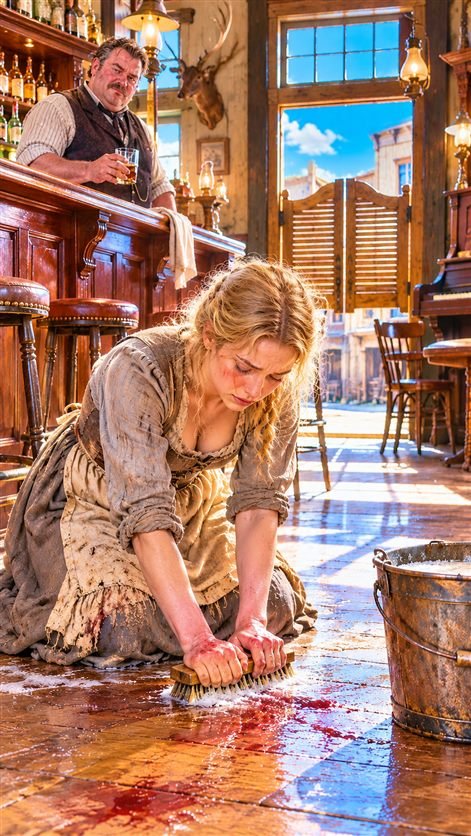
She was forced to scrub the bloodstained floorboards of the Gold Dust Saloon with lye water until her knuckles cracked and bled, paying for a debt she never owed. Her wicked stepuncle watched from the bar, laughing as he pocketed the coins she earned, dismissing her as a worthless orphan meant only for unpaid labor.
The coarse bristles of the scrub brush tore mercilessly into Clara Vance’s raw skin, yet she dared not stop. One slip of her hand, one moment of faltering breath, and Arthur Vance’s heavy leather belt would find her shoulders before the midnight bell rang.
“Faster, you clumsy little charity case,” Arthur sneered from behind the polished mahogany bar, swirling amber whiskey in a dirty glass. “Nobody wants to see a sullen face when they come in for a drink. Smile, Clara. Remind them of the charity my good wife showed taking you in.”
Clara kept her chin pressed hard against her chest, her ash-blonde hair falling forward in greasy, damp tendrils to hide the hot, humiliated tears pooling in her eyes. She was twenty-two years old, standing barely five-foot-three, yet she carried the crushing weight of an entire town’s contempt. To the citizens of Red Pine, Wyoming, she was merely the unwanted niece living on scraps, a quiet shadow who mucked out stables and hauled slops without complaint.
She gripped the wooden handle of the bucket, her knuckles swollen and purple from the biting winter draft leaking beneath the batwing doors. Inside her pocket rested her only solace: a small, silver-plated pocket watch with a cracked crystal, the sole remaining relic from her dead father. It had stopped at 4:14, the exact minute her mother’s carriage had supposedly plunged off Eagle’s Bluff ten years ago. Arthur claimed her parents had died penniless and in deep disgrace, leaving her entirely at his mercy.
The swinging doors groaned open, cutting through the stale stench of tobacco smoke and cheap gin. A blast of frigid March air swept across the floorboards, carrying the scent of pine, saddle leather, and rain.
A man stepped into the warm amber light of the saloon, and the boisterous chatter of the evening patrons instantly subsided.
Elijah Cole did not look like a man who sought trouble, but trouble had a habit of giving him a wide berth. Standing well over six feet, with broad shoulders beneath a dust-dusted canvas duster and eyes the color of a winter storm over the Laramie Range, he possessed an imposing quietness. He was thirty-eight, a widower who owned the sprawling Lazy C ranch north of town, and rumor whispered he spoke fewer than fifty words a day. Yet men respected him because every single one of those words carried the weight of iron.
Elijah walked straight to an empty corner table, his spurs clinking softly against the stained floor. He did not look at the painted women dancing near the piano, nor did he join the card game by the stove. Instead, his dark, piercing gaze tracked slowly across the room until it landed squarely on Clara, who was desperately trying to scrub a dark stain near the baseboards.
Arthur Vance lumbered out from behind the bar, flashing a greasy, obsequious grin as he approached the rancher’s table. “Evening, Mr. Cole! Fine night for a drink. Can I get you our finest bourbon, or maybe a hot meal brought out from the back?”
“Whiskey,” Elijah said, his voice a low, gravelly baritone that seemed to vibrate through the floorboards. He didn’t break eye contact with Arthur, though his head tilted slightly. “And a rag for the girl.”
Arthur blinked, momentarily confused, before glancing down at Clara. A flicker of annoyance crossed his face. “Ah, Clara’s just finishing up. She’s clumsy, Mr. Cole. Doesn’t know her proper place yet, but we’re beating it into her.”
“She’s been on her knees for three hours scrubbing a floor that was already clean,” Elijah stated flatly, setting a silver dollar on the scarred wood table. He stood up slowly, towering over Arthur. “A man who lets a girl ruin her hands over grease isn’t running a respectable establishment. He’s running a pen.”
The saloon went dead silent. Arthur’s face flushed a deep, mottled crimson, his mustache twitching with suppressed rage, but he dared not cross Elijah Cole—not when the rancher held mortgages across half the county.
Elijah ignored Arthur entirely, stepping past the saloon keeper and walking directly toward Clara. He knelt down beside her, ignoring the filthy water splashing near his polished boots. Up close, his face was weathered by sun and wind, etched with lines of deep sorrow, but his eyes were remarkably gentle.
“Stand up, Clara,” Elijah said quietly, extending a large, calloused hand toward her trembling fingers.
“I… I can’t,” she whispered, her voice cracking from exhaustion. “If I don’t finish, Uncle Arthur will—”
“Your uncle won’t do a damn thing,” Elijah interrupted, his tone brooking no argument. “Because you’re leaving with me.”
Clara stared at his outstretched hand, terrified that this was some cruel joke engineered by Arthur. But when she looked up into Elijah’s steady, unwavering eyes, she saw no mockery—only a profound, aching recognition of suffering. Slowly, hesitantly, she placed her bruised, trembling hand in his.
The ride to the Lazy C ranch was silent, save for the rhythmic crunch of wagon wheels over frozen ruts and the blowing of the horses. Clara sat huddled in the passenger seat of Elijah’s buckboard, wrapped in a heavy wool blanket that still smelled faintly of cedar and pipe tobacco. She kept her eyes fixed on her lap, waiting for the inevitable moment when the rancher would demand payment for his rescue, or reveal himself to be just another tyrant seeking cheap labor.
Instead, when they reached the sprawling ranch house—a sturdy, two-story timber home surrounded by glowing lanterns—Elijah simply helped her down, carried her worn leather satchel inside, and sat her down by a roaring stone fireplace.
“The guest room is upstairs, but you can sleep by the hearth tonight,” Elijah said, setting a steaming mug of spiced cider and a plate of warm bread and beef stew on the small wooden table beside her. “Eat. You don’t have to earn your supper here, Clara. You’re a guest.”
Clara looked at the food, her stomach aching with a hunger she had long grown accustomed to ignoring. A lump rose in her throat. “Why are you doing this?” she whispered, her voice trembling. “Nobody helps for nothing.”
Elijah paused with his hand on the wooden staircase, his broad back turned to her. For a long moment, the only sound was the crackle of the fire. “My wife, Sarah, was gentle like you,” he said softly, his voice thick with a grief that time had failed to dull. “She spent five years trying to please men who only took. I watched her spirit break piece by piece because nobody stepped in. I wasn’t there when she needed me most. I’m here now.”
He walked up the stairs without another word, leaving Clara alone in the warm, safe glow of the hearth.
The next few days were a blur of bewildered healing. Clara woke each morning expecting shouts and commands, but found only quiet mornings, the smell of roasted coffee, and Elijah silently tipping his hat to her across the breakfast table. Slowly, she began to notice the subtle rhythms of the ranch. She watched the hired hands—rough-hewn cowboys like old Tom and a young buckaroo named Toby—treat Elijah with deep, unwavering loyalty.
One afternoon, while organizing the ranch’s supply ledger in the study, Clara noticed a glaring discrepancy in the inventory columns. For months, the Lazy C had been paying exorbitant prices for feed and iron shipped from Red Pine, yet the quantities delivered did not match the bills. Driven by a quiet curiosity, she pulled out a ledger from three years prior—before Elijah’s wife had died—and began cross-referencing shipping receipts with local freight records.
Her breath hitched. The fraudulent invoices bore the signature of Arthur Vance.
As the weeks melted into April, the prairie bloomed with pale yellow wild grass and melting snow rushing through the creek beds. Working side by side with Elijah, Clara’s posture straightened, and the perpetual hollows beneath her eyes began to fade. She proved to be astonishingly sharp; within a fortnight, she had reorganized the ranch’s entire bookkeeping system, saving Elijah hundreds of dollars in misplaced freight fees.
One evening, as they sat on the wide front porch watching the sun dip below the jagged peaks of the western horizon, Elijah handed her a small, neatly wrapped parcel.
“Open it,” he instructed quietly, leaning against the porch railing.
Clara untied the thin twine and pulled back the brown paper. Inside lay a leather-bound journal with thick, cream-colored pages, accompanied by a set of fine German steel nib pens and a bottle of dark black ink.
“You spend half your nights scribbling calculations on scrap paper and old envelopes,” Elijah said, looking out at the grazing cattle. “A mind like yours shouldn’t be cramped. You kept my books cleaner in a month than my old foreman did in five years. You’re more than a guest here, Clara. If you want to stay… I want you to be a partner in this place.”