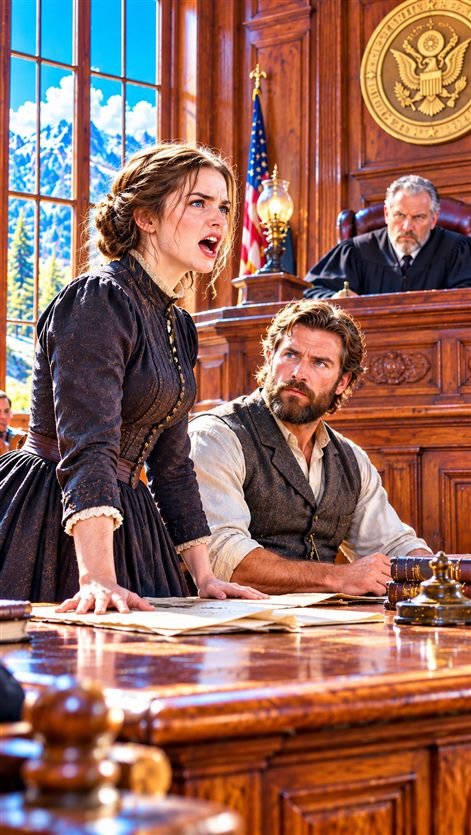
A forgotten ledger proved that the town’s most respected benefactor had stolen an entire inheritance from a defenseless orphan. Now, the quiet rancher who dared to see her true worth will help her claim ultimate justice and an unexpected, enduring love.
The heavy iron skillet slipped from Philippa’s chapped fingers, crashing onto the wide pine floorboards of the Elkhorn Hotel dining room with a sharp, echoing clang.
“Clumsy little beggar!” Orville barked, his face instantly mottling to a furious shade of plum as he strode out from behind the scarred mahogany counter. His thick leather belt, brandished before she could even draw breath, struck the table’s edge with a violent snap. “Three years I take in my late brother’s charity case, putting a roof over your ungrateful head, and all you can do is break my kitchenware and stare off into the middle distance like a brain-addled calf!”
Philippa didn’t cinch her shoulders or weep; she had learned by her fourteenth winter that tears only brought a harsher sting. Instead, she kept her chin leveled, her gray eyes locked onto the brass buttons of his waistcoat, her hand clutching the edge of her faded calico apron. Inside that pocket rested her only true possession: a small, smooth river stone carved with a crescent moon, left behind in her mother’s worn travel trunk before the fever took everything.
“I am sorry, Uncle,” she said, her voice steady despite the dry rattle in her chest. “The flour sacks were heavy. My arms gave out.”
“Your arms give out because you’re idle!” Orville raised the strap again, his breath smelling heavily of stale rye whiskey and fried salt pork. Around the dining room, three traveling salesmen and the local apothecary looked down into their plates of greasy bacon, deliberately ignoring the scene. Charity in the Dakota Territory came with a price, and everyone in Oakhaven knew Philippa paid hers daily in blisters, bruises, and silence.
Before the leather could descend, a heavy hand closed over Orville’s wrist with the unyielding pressure of a steel vise.
The room went dead silent. The only sound was the steady drip of melting snow from the porch eaves outside.
Orville blinked, turning to snarl at the interruption, but the words died in his throat. Standing beside him was Magnus Lindqvist, the reclusive Swedish-born cattleman from the high benchlands south of town. Magnus stood over six feet tall, his sheepskin coat smelling of pine smoke, saddle leather, and cold mountain air. His fair hair was dusted with snow, his jaw shadowed by a thick, dark beard, and his ice-blue eyes were fixed on Orville with a cold, terrifying stillness.
“That’s enough,” Magnus said. His voice was low, devoid of shouting, yet it commanded the entire room instantly.
“Mind your business, Lindqvist,” Orville blustered, trying and failing to yank his arm free. “She owes me for her keep. She’s my niece, bound to my service until her twenty-first birthday by parish decree.”
“She owes you nothing,” Magnus replied evenly. He released Orville’s wrist with a slight shove that sent the older man stumbling back against the flour bins. Magnus turned his gaze downward, looking directly at Philippa. His stern expression softened perceptibly, lines around his eyes easing as he took in her thin frame, the smudge of coal dust on her cheek, and the fierce, unbroken dignity in her posture.
He didn’t offer pity—a commodity Philippa despised even more than cruelty. Instead, he offered a proposition that would alter the course of both their lives.
“My kitchen at Pine Ridge Ranch is short a hand,” Magnus said, his gaze never leaving hers. “And my ledgers are an absolute disaster. I’m told you finished three years of seminary schooling back in St. Louis before the carriages stopped running west.”
Philippa’s breath hitched. “I did.”
“I pay twelve dollars a month, gold coin, and you sleep in the dry timber cabin behind the main house with your own stove. No straps. No shouting.” Magnus reached into his coat pocket and pulled out a small leather-bound notebook, laying it on the counter between them. “Well, Miss Vane? Do you care to trade broken skillets for honest work?”
Orville turned purple. “She’s my indentured—”
“Her indenture papers expired on her eighteenth birthday last Tuesday,” Magnus interrupted without looking back at the hotel owner. “I checked the county clerk’s ledger in town this morning before the blizzard set in. She is legally free.”
Philippa looked from Orville’s trembling, furious face to Magnus’s calm, resolute eyes. Without a single word of farewell, she untied her stained apron, let it drop onto the sawdust-strewn floor, and reached for her coat.
*
The ride up to Pine Ridge Ranch through the blinding Dakota flurry tested every ounce of Philippa’s endurance. Seated beside Magnus in the high buckboard wagon, wrapped in a heavy buffalo robe that smelled of cedar and woodsmoke, she felt the strange, terrifying sensation of safety settling over her shoulders.
The ranch house was a sprawling structure of hand-hewn logs nestled against the wind-breaking slope of a towering pine ridge. Inside, it was warm, smelling of roasted coffee, mutton tallow, and old leather. There was no one else living there; Magnus was a solitary man, a widower by local rumor, though nobody in Oakhaven dared ask about the past that had driven him high into the foothills three winters ago.
Over the next two weeks, the rhythm of Pine Ridge worked its quiet magic on Philippa’s bruised spirit. She scrubbed the heavy oak floors, tended the hearth, and cooked hearty meals of beef stew and corn bread, which Magnus consumed with quiet gratitude. But her true value emerged on the third evening, when she picked up the ranch’s neglected leather ledger and a steel-nibbed pen.
Magnus sat across the pine table, carving a wooden latch for the barn door while watching her through the amber glow of a kerosene lamp.
“You’re holding the pen wrong for double-entry,” he noted quietly, a faint smile touching his lips.
“My father taught me merchant’s style in Philadelphia before he lost his shipping firm,” Philippa replied, her pen scratching rhythmically across the paper. “Your cattle sales to the railhead in Bismarck were under-tallied by four head last autumn, Mr. Lindqvist. And the mercantile in town has been charging you double for imported salt licks.”
Magnus paused his carving, staring at her in genuine astonishment. “Call me Magnus. And are you certain about the salt licks?”
“I am never uncertain about arithmetic,” she said, looking up, her gray eyes flashing with a sudden, brilliant spark of confidence that made Magnus’s chest tighten in an unfamiliar way.
As the winter snows melted into the muddy, vibrant green of an early Dakota spring, their working partnership deepened into something rare and tender. Magnus never offered grand romantic declarations; instead, he showed his devotion through steady, protective actions. He built a small writing desk by her cabin window so she could read late into the night without straining her eyes by the hearth. He brought home a stack of old law and commerce books from a passing stagecoach driver, knowing her sharp mind hungered for knowledge far beyond the ranch.
One afternoon, while mending fences near the western creek line, Magnus found her sitting on a flat boulder, sketching the distant peaks of the Black Hills in the margin of an old account book. He dismounted his bay gelding, walked over quietly, and sat beside her on the sun-warmed stone.
“You don’t belong in a hotel kitchen, Philippa,” he said softly, his voice rough like gravel shifting under a stream. “You have a mind that could run a bank, not just tally cattle.”
“For nineteen years, everyone told me I was a burden, Magnus,” she whispered, looking out over the rolling grasslands. “An orphan living on charity, fit only for scrubbing floors and avoiding my uncle’s temper.”
Magnus reached out, his large, calloused hand gently covering hers where it rested on the stone. His thumb brushed over her knuckles. “They were blind. Every last one of them.”
When his fingers closed around hers, Philippa didn’t pull away. Instead, she turned her hand over, lacing her fingers through his. The warmth of his skin sent a delicious shiver through her veins. When Magnus leaned in and pressed his lips softly to her temple, lingering there as the prairie wind rustled the grass around them, the last cold corner of her heart melted entirely.
*
Their fragile peace shattered on a crisp Tuesday morning in late May.
A heavy buckboard bearing the seal of the territorial court rumbled up the Pine Ridge drive. At the reins sat Orville, accompanied by a sharp-eyed, well-dressed stranger wearing a round wire-rimmed spectacles and a tailored black suit that looked entirely out of place in the cattle country.
Philippa was standing on the porch with a basket of damp laundry when they pulled to a halt. Magnus stepped out of the barn, pitchfork in hand, his face darkening into a dangerous scowl as he walked toward the gate.
“Mr. Lindqvist,” the stranger called out, stepping down from the wagon with an air of practiced legal authority. “I am Thaddeus Vance, attorney-at-law representing the estate of the late Arthur Vane—this young woman’s grandfather.”
Philippa dropped her laundry basket. The wicker hit the porch boards with a dull thud. “My grandfather died in Philadelphia twelve years ago,” she said, her voice trembling as she walked to the edge of the porch. “He left nothing. My father died penniless after his business partners ruined him.”