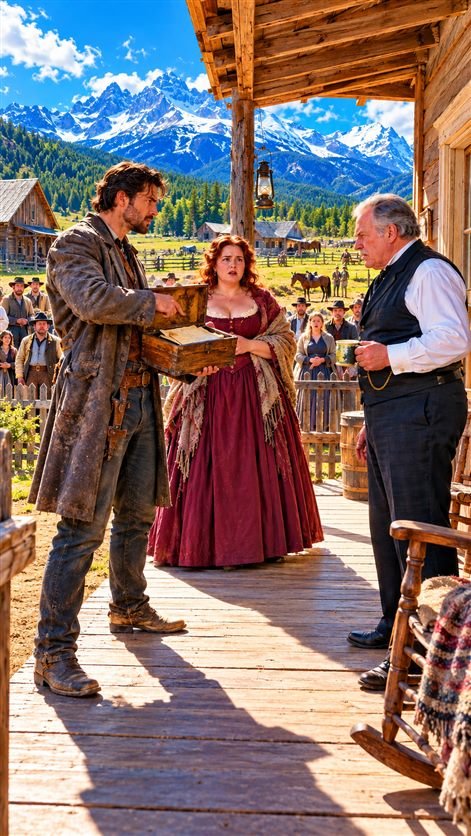
My daughter needs a good man, not a rich one, I told the people gathered on my porch. Then I gave the young cowboy six months at a mountain ranch and no promise I would ever approve the marriage.
The afternoon sun beat down upon the polished white railing of the veranda, casting sharp shadows across the floorboards where my neighbors stood in tight, judgmental clusters. Mercy stood beside Elias Wren, her fingers clenched so tightly around the hem of her woolen shawl that her knuckles showed white. Her eyes were bright with unshed tears, swimming with a mixture of defiance and quiet desperation. Elias stood tall, though his posture was stiff with the defensive pride of a man who knew every pair of eyes was cataloging his poverty. His boots were worn through at the instep, the leather scarred and grey with dried mud. His heavy coat had been patched twice across the shoulders with coarse, mismatched thread, and the fourteen crumpled dollar bills stuffed into his breast pocket were nearly all he owned in the world.
The neighbors had already reached their verdict, murmuring among themselves with the easy cruelty of people who had never known a hard winter. He does not own a single acre, one whispered loudly enough for Elias to hear, the woman folding her arms over her expensive silk bodice. He can not even afford a proper wedding ring, another scoffed, adjusting his pocket watch with a smug little flick of his wrist. They saw only the frayed cuffs and the dust of the road clinging to his trousers. They saw a nobody, a drifter with empty pockets who had wandered down from the high country looking to latch onto a comfortable life and a respectable inheritance.
But when Elias removed his battered felt hat and looked me dead in the eye, I noticed what they had all missed. His hands were trembling, not from cowardice, but from an intense, overwhelming effort to remain steady. I could see in the sharp set of his jaw and the slight twitch in his cheek just how much my answer mattered to him. He was not looking for a handout, and he was not looking for an easy route to wealth. He was looking for a future with my daughter, and he was terrified that his empty hands would condemn him before he even had a chance to speak.
Sir, I can not offer Mercy a grand house or a herd of cattle, he said, his voice deep and raspy from the mountain air. But she will never have to wonder whether she matters to me.
Mercy reached out blindly and caught his hand, her fingers intertwining with his rough, calloused ones. I looked at them both, standing there in the harsh afternoon glare, and the porch fell suddenly quiet as the neighbors waited for my swift, predictable dismissal. They expected me to wave the boy away, to protect my property and my social standing with a sharp word and a closed door. They did not know the weight of the past that I carried, nor did they understand the peculiar nature of the test I had been turning over in my mind for weeks.
Then I said there was one condition.
I pointed toward the jagged peaks of the mountains rising behind the town, where the dark slate clouds of early winter were already settling over the highest ridges, turning the timberline a bruised, menacing purple. A ranch needed tending until spring, an isolated place tucked away in a high valley that everyone in town had abandoned years ago. There were fences to mend where the frost heaves had torn them apart, wild cattle to feed through the blizzards, and an old, drafty cabin to repair before the snows closed the passes.
You will have food and shelter, I told Elias, my gaze never leaving his face, but no wages. And when spring comes, I still may not give you my blessing.
Father, that is six months, Mercy said, her voice cracking with sudden protest as she stepped between us. You can not ask a man to work through the dead of winter for nothing, with no guarantee at the end of it.
I know, I said softly, my voice dropping beneath the murmur of the crowd.
Elias looked down at his worn boots, his gaze tracing the cracked leather as if searching for an answer hidden in the dust. For a long, agonizing moment, I thought he would refuse, that his pride would finally snap under the weight of my impossible demand, and that he would mount his tired horse and ride away out of my life forever. The silence stretched out, heavy and brittle, broken only by the distant clatter of a wagon in the street below.
Instead, he put his hat back on, settling it firmly over his brow with a slow, deliberate motion.
When do I start, sir? he asked.
The laughter of the neighbors was loud and cruel when he rode away the next morning at first light, his thin blanket roll tied behind an empty saddle. They said he would be back before Christmas, broken by the loneliness and the bitter cold, crawling back to town to beg for day labor or better terms. They chuckled over their morning coffee at the diner, wagering among themselves whether he would last until the first hard freeze or turn tail at the first flurry.
He was not back by Christmas.
Snow covered the mountain trails by January, piling deep against the pine trunks and sealing the high passes in a tomb of white silence, and by February the ranch was practically impossible to reach even on snowshoes. The wind howled down the valley day and night, stripping the bark from the cottonwoods and driving the temperature down far below zero, freezing the breath in a man’s lungs. Still, every rare traveler or trapper who came down from the higher elevations brought the same report, delivered with a hint of bewildered grudging respect. The animals were cared for, the haystacks were intact, the broken fences stood straight against the drifts, and Elias remained up there in the wilderness, alone with the elements and his hard labor.
Mercy wrote to him every week, folding her heart into small squares of blue paper and giving them to the stagecoach driver whenever he made the perilous run toward the upper station. He answered every single letter, his replies coming back irregularly whenever a passing packer could be bribed to carry the mail down the mountain. She read those letters by the parlor fire, her face glowing with a quiet, stubborn light that defied every doubt my neighbors tried to whisper into my ear.
I let them all believe the ranch was the test. I let the town think I was simply a hard-fisted father trying to weed out a penniless suitor with brutal physical labor. It was not the real test at all, though the labor was real enough to break a weaker man.